Leading Reporters
  • Headlines
  • Health
  • Business
  • Exclusives
  • Investigation
  • Entertainment
  • Opinion
Thursday, May 7, 2026
Hot
Jabi Lake takeover stands even if God comes...
Fuel Scarcity Looms As Dangote Refinery Hikes Fuel...
IGP scraps SWAT nationwide
17 Reps Dump ADC for NDC
Bride’s father, hypeman shot dead at Lagos wedding...
Xenophobia: 130 Nigerians apply for evacuation as tensions...
Abuja Female Pastor Kneels, Begs Wike Not to...
Obi, Kwankwaso Join NDC, Demand Litigation Free Elections
Tinubu nominates economic reform expert, Tegbe as minister...
Money Laundering: ‘We investigated Pastor Jerry Eze for...
  • About Leading Reporters
  • Contact Us
Leading Reporters
Advertise With Us
  • Headlines
  • Health
  • Business
  • Exclusives
  • Investigation
  • Entertainment
  • Opinion
Hot
Jabi Lake takeover stands even if God comes...
Fuel Scarcity Looms As Dangote Refinery Hikes Fuel...
IGP scraps SWAT nationwide
17 Reps Dump ADC for NDC
Bride’s father, hypeman shot dead at Lagos wedding...
Xenophobia: 130 Nigerians apply for evacuation as tensions...
Abuja Female Pastor Kneels, Begs Wike Not to...
Obi, Kwankwaso Join NDC, Demand Litigation Free Elections
Tinubu nominates economic reform expert, Tegbe as minister...
Money Laundering: ‘We investigated Pastor Jerry Eze for...
Leading Reporters
Leading Reporters
  • Headlines
  • Health
  • Business
  • Exclusives
  • Investigation
  • Entertainment
  • Opinion
Copyright 2024 - All Right Reserved
Home > FG
Tag:

FG

Headlines

Breaking: FG files treason charge against ex-minister Sylva, others

by Folarin Kehinde April 21, 2026
written by Folarin Kehinde

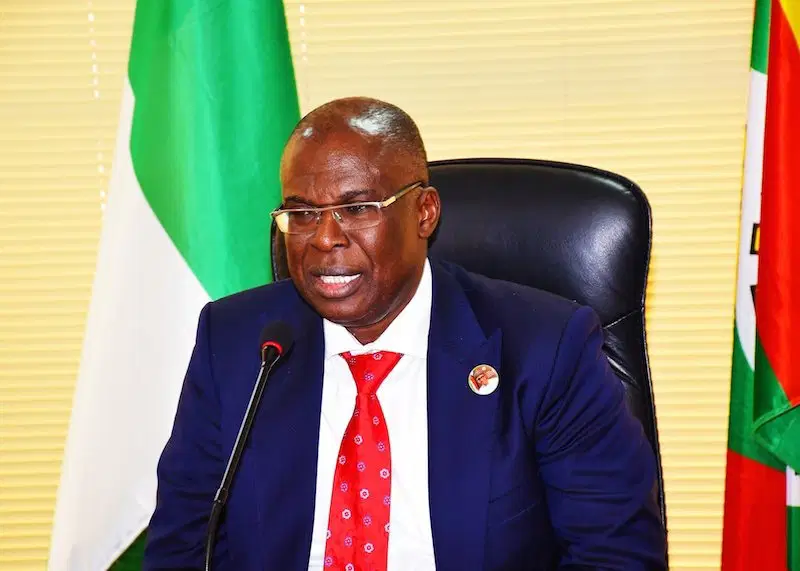
The Federal Government has filed a 13-count charge before a Federal High Court sitting in Abuja against former Minister of State for Petroleum Resources, Timipre Sylva, a retired Major General, a retired Naval Captain, a serving police inspector and three others over their alleged involvement as coup plotters in a plot to wage war against Nigeria and commit acts of terrorism.

The other defendants, Major General Mohammed Ibrahim Gana (retd), Captain (NN) Erasmus Victor (retd), Inspector Ahmed Ibrahim, Zekeri Umoru, Bukar Goni and Abdulkadir Sani, are scheduled to be arraigned on Wednesday before Justice Joyce Abdulmalik of the court.

Sylva is said to be at large.

The charge, filed by the Office of the Attorney-General of the Federation and signed by the Director of Public Prosecutions of the Federation, Rotimi Oyedepo, SAN, accuses the defendants of offences ranging from treason and terrorism to failure to disclose security intelligence and money laundering linked to terrorism financing.

At the heart of the case is an allegation that the defendants conspired in 2025 to undermine the Nigerian state.

According to the charge, they “conspired with one another to levy war against the state to overawe the President of the Federal Republic of Nigeria,” an offence punishable under Section 37(2) of the Criminal Code.

The prosecution further alleged that the defendants had prior knowledge of a planned treasonable act involving one Colonel Mohammed Alhassan Ma’aji and others, but failed to alert authorities.

The charge states that they, “knowing that and was intended to commit treason, did not give the information thereof with all reasonable despatch to either the President or a Peace Officer.”

In a related count, the defendants were also accused of failing to take preventive steps, as they allegedly “did not use any reasonable endeavours to prevent the commission of the offence.”

Beyond treason, the Federal Government is prosecuting the defendants for terrorism-related offences under the Terrorism (Prevention and Prohibition) Act, 2022.

The charge alleged that they “conspired with one another to commit an act of terrorism in the Federal Republic of Nigeria.”

Particularly, Inspector Ahmed Ibrahim and Zekeri Umoru are accused of participating in meetings tied to terrorist activities.

Prosecutors claim they acted “in a bid to further a political ideology which may seriously destabilize the constitutional structure of the Federal Republic of Nigeria.”

The charge also accuses the defendants of providing support for terrorism, alleging that they “knowingly and indirectly, rendered support” to facilitate acts of terror.

In addition, the prosecution alleged a deliberate suppression of intelligence, stating that the defendants “had information which would be of material assistance in preventing the commission of the act of terrorism, but failed to disclose the information to the relevant agency as soon as practicable.”

The case further traces financial transactions allegedly linked to terrorism financing, with multiple defendants accused of handling proceeds of unlawful activities.

Bukar Kashim Goni is alleged to have “indirectly retained the aggregate sum of N50,000,000 which forms part of the proceeds of an unlawful act to wit: terrorism financing,” while Abdulkadir Sani allegedly retained N2 million from a similar source.

Zekeri Umoru, according to the charge, “without going through a financial institution, accepted a cash payment of the sum of N10million” and also retained an additional N8.8 million suspected to be proceeds of terrorism financing.

Inspector Ahmed Ibrahim was also accused of taking possession of N1 million linked to the same alleged scheme.

All financial-related counts were brought under the Money Laundering (Prevention and Prohibition) Act, 2022.


April 21, 2026 0 comments
0 FacebookTwitterPinterestThreadsBlueskyEmail
FG and Inec
Headlines

FG Budgets N135bn For 2027 INEC Lawsuits

by Nelson Ugwuagbo April 7, 2026
written by Nelson Ugwuagbo

The Federal Government has proposed a total of N135.22 billion in the 2026 budget for electoral adjudication and post-election matters, signalling anticipated costs associated with election-related legal processes.

The provision, contained in the House of Representatives Order Paper dated March 31, 2026, is part of the 2026 Appropriation Bill. It falls under Service-Wide Votes—a centrally managed pool of funds used to cover obligations not directly assigned to specific ministries, departments, or agencies. The allocation is intended to cater for potential legal disputes, settlements, and administrative processes arising from elections.

An analysis of the budget shows that the provision is captured within the Consolidated Revenue Fund charges, which total N3.70 trillion. The electoral adjudication component represents about 3.65 per cent of that amount.

The allocation comes alongside a proposed N1.01 trillion statutory transfer to the Independent National Electoral Commission (INEC), accounting for 21 per cent of total statutory transfers.

Earlier estimates by INEC put the cost of conducting the 2027 general elections at N873.78 billion, with an additional N171 billion projected for its 2026 operations—figures that mark a significant increase compared to funding for the 2023 elections.

The proposed N135.22 billion allocation has sparked reactions from opposition parties and civil society groups, who have raised concerns about its size and implications.

The National Publicity Secretary of the Peoples Democratic Party (PDP), Ini Ememobong, criticised the provision, suggesting it reflects a lack of confidence in the electoral process.

“It means that INEC itself is anticipating that it will not do well and that people will not accept the outcome of the results. Because if INEC becomes very transparent, post-election litigation will be reduced drastically. It is the lack of transparency and the obvious opacity of INEC during elections that result in post-election litigation,” he said.

Also reacting, the Publicity Secretary of the African Democratic Congress (ADC), Bolaji Abdullahi, acknowledged the need for preparedness but questioned the scale of the allocation, citing concerns over accountability and the expected volume of litigation.

Political economist Pat Utomi argued that election-related legal expenses should not be borne directly by the Federal Government.

“It is not the Federal Government that goes to elections, it is the individual candidates, so why should the Federal Government have a budget for it? They should not,” he said.

He further added that if the provision is meant for INEC, it should be reflected within the commission’s budget rather than under federal allocations, describing Nigeria’s budget process as flawed.

Human rights lawyer Femi Falana (SAN) also faulted the proposal, describing it as excessive.

“It is on the very high side. Apart from the fact that INEC has its legal department that services all its offices in the 36 states of the federation, INEC does not pay more than N3m per brief, even to a senior advocate. This is due to the fact that INEC maintains a neutral position in the majority of pre-election cases,” he said.

April 7, 2026 0 comments
0 FacebookTwitterPinterestThreadsBlueskyEmail
Headlines

Valentine’s Day: FG bans money bouquets, warns against currency abuse

by Folarin Kehinde February 12, 2026
written by Folarin Kehinde

The Federal Government has banned the use of banknotes to create money bouquets, towers, and decorative cakes ahead of the 2026 Valentine’s Day celebrations, warning that such practices violate Nigeria’s currency laws.

The Central Bank of Nigeria (CBN) said the misuse of the naira constitutes abuse of the national currency and is punishable under the law.

The apex bank stated that spraying, arranging, or moulding banknotes into celebratory displays for gifts or events amounts to defacing and mishandling legal tender.

According to the CBN, these practices undermine the integrity and value of the naira, stressing that the currency must be treated with dignity and respect at all times.

The bank warned that individuals and businesses involved in producing or using money bouquets and similar items risk facing legal consequences, including fines and prosecution.

Authorities further advised Nigerians to adopt alternative gift options during celebrations rather than using cash in ways that damage or disrespect the nation’s currency.

The warning comes ahead of Valentine’s Day, a period when money bouquets and cash-themed gifts have become increasingly popular at parties and romantic celebrations across the country.


February 12, 2026 0 comments
0 FacebookTwitterPinterestThreadsBlueskyEmail
Headlines

DisCos reject FG’s free meter plan

by Folarin Kehinde January 26, 2026
written by Folarin Kehinde

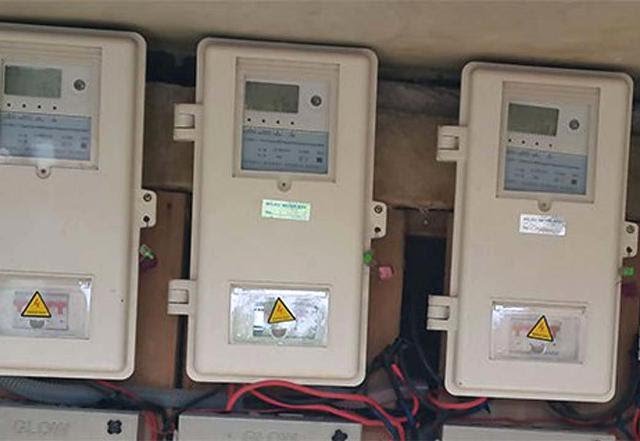
Power distribution companies have expressed doubt over the directive by the Minister of Power, Adebayo Adelabu, that prepaid meters must be free for all categories of customers.

Operators, who spoke with our correspondent anonymously due to the sensitivity of the matter, said the minister made only a political statement without considering the input of other stakeholders, especially the installers and meter providers.

On Thursday, the Federal Government banned electricity distribution companies and installers from collecting any form of payment for meters, warning that DisCo officials and installers found extorting customers would be prosecuted. Adelabu issued the warning during an on-site inspection of newly imported smart meters at APM Terminals, Apapa, Lagos.

Adelabu said the meters were procured under the World Bank–funded Distribution Sector Recovery Programme and must be installed for consumers free of charge, stressing that any demand for money would be treated as an offence.

He said the meters would be given to all electricity customers, regardless of their band.

“I want to mention that it is unprecedented that these meters are to be installed and distributed to consumers free of charge—free of charge! Nobody should collect money from any consumer. It is an illegality. It is an offence for the officials of distribution companies across Nigeria to request a dime before installation; even the indirect installers cannot ask consumers for a dime. It has to be installed free of charge so that billings and collections will improve for the sector,” Adelabu said.

However, the DisCo operators who spoke with The PUNCH said the meters tagged as free by the Federal Government would still be paid for by the DisCos within a period of 10 years. The operators told our correspondent that the DisCos cannot be the ones paying for installation, wondering why the government wants them to bear the cost of installation.

According to them, meter installers are not DisCo workers, and someone has to bear the cost of installation.

“Those meters you see, someone has to pay for them, and the government expects the DisCos to bear the cost of the so-called free meters. They said the DisCos can pay it over 10 years.

When you ask the DisCos to pay for any capital expenditure, we call it allowable capex. You have to allow it when computing their tariffs; otherwise, it makes their balance sheets toxic,” an official with a distribution company stated.

Another operator said, “We need to know that meter installers are not staff of the DisCos. They are already asking who will pay them if the consumers do not pay. Did the minister consider all those? You said the people should not pay the installers; who should pay them? We, the DisCos, are not the ones installing meters. That role was taken away from the DisCos when Babatunde Fashola was the power minister.

“They said the DisCos have no business with metering. This is the result we are seeing today. Assuming the DisCos are the ones installing meters, you can force them to pay. We will all see the outcome of that pronouncement in the coming days. If the government can pay installers, no problem, but I’m not sure any DisCo will volunteer to pay the installers.”

The officials described Adelabu’s comment as a populist statement from a politician.

“The statement was just a populist statement from a politician. We are not sure if the President sent him that message. He said everything should be free; where is the position of cost recovery? Anything you do in the power sector, you have to first consider who bears the cost. Somebody has to bear the cost to avoid debt piling up.

“The government ought to sit with the Discos and the meter manufacturers to seek advice if the plan is to make sure the people don’t bear any cost, and we will come up with our various contributions. But instead of doing that, the government would go and make unrealistic promises to the public. For instance, the meters are coming in batches, but you have made the masses believe that there are enough meters for everyone. That’s not the reality,” one of the sources stated.

The operators added that the free meter declaration would jeopardise the Meter Asset Providers scheme, which allows the sale of meters to individuals who desire them.


“People are now rejecting the Meter Asset Providers scheme because they have heard that meters are free. The minister came up with a very wrong narrative. Has he sat down with stakeholders before going out to say meters are free? How can you say you have enough meters for over five million people? We still have the MAP scheme ongoing, whereby the meter provider sells directly to the customer. MAP is still there because the free meters they are bringing cannot fill the metering gap.


January 26, 2026 0 comments
0 FacebookTwitterPinterestThreadsBlueskyEmail
Peter Obi
Business

31 errors in New Tax laws – Obi slams FG

by Folarin Kehinde January 13, 2026
written by Folarin Kehinde

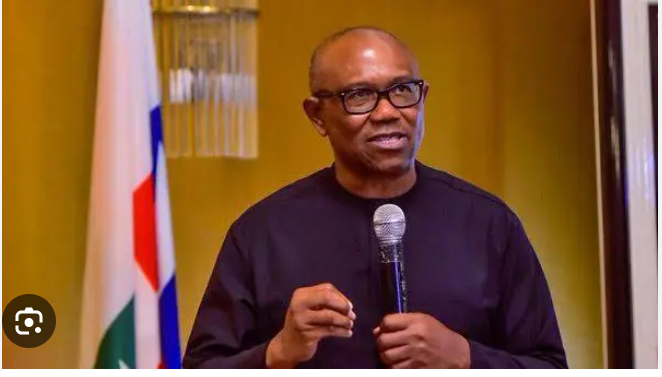
The 2023 Labour Party presidential candidate, Peter Obi, has urged the Federal Government to suspend the rollout of Nigeria’s newly gazetted tax laws, warning that the framework contains significant mistakes, contradictions, and loopholes.

In a statement shared on his X (formerly Twitter) handle on Tuesday, Obi cited an analysis by KPMG Nigeria, which identified possible concerns around the taxation of shares, dividend handling, obligations of non-residents, and foreign exchange deductions.

Obi, the report identified “31 critical problem areas, from drafting errors to glaring policy contradictions and administrative gaps,” noting that the complexity of the issues was such that “it took private meetings between the National Revenue Service and KPMG for these serious issues to be acknowledged.

If experts require closed-door discussions to navigate the complexities of our tax laws, what hope does the average Nigerian have of comprehending the obligations being imposed on them?”

Obi maintained that taxation should function as a social contract between citizens and the state and criticised the absence of broad public engagement before the laws were finalised.

“Typically, months, if not years, are dedicated to consulting with businesses, workers, and civil society before tax drafts are presented for public discussion, with the ramifications clearly explained.

“Yet, in Nigeria, we have seen no such public consultations or discussions regarding the final tax laws, leaving ordinary citizens completely in the dark about both the regulations and the benefits of the taxes they’re expected to pay.”

Peter Obi also faulted the government’s implementation strategy, stating, “We have hastily pursued collection without securing a consensus and imposed enforcement without providing adequate explanations.

“Even after the removal of subsidies, Nigerians remain in limbo, waiting for tangible benefits or relief. Instead, they are grappling with skyrocketing food prices, exorbitant transport costs, dwindling purchasing power, and escalating poverty levels.”

He further described the tax framework as “riddled with inconsistencies and producing 31 alarming red flags from a leading global accounting firm.

This is not the hallmark of responsible governance. Without trust, taxation feels like punishment. Without clarity, it breeds confusion. Without evident public value, it amounts to robbery.”

“Nigeria cannot afford to place further burdens on its already struggling citizens. What we need is a government that listens, communicates effectively, and prioritises building national consensus. This is the only viable path to genuine reform, unity, growth, and shared prosperity,” Obi concluded.

January 13, 2026 0 comments
0 FacebookTwitterPinterestThreadsBlueskyEmail
Headlines

Christmas: FG reduces train fare by 50%

by Folarin Kehinde December 24, 2025
written by Folarin Kehinde

The Federal Government has approved a 50 percent reduction in train fares nationwide to ease travel costs during the Christmas and New Year celebrations.

Kayode Opeifa, Managing Director and Chief Executive Officer of the Nigerian Railway Corporation, disclosed this in a statement issued on Tuesday in Lagos.

Opeifa said the fare reduction took effect on Tuesday and has already recorded a high passenger turnout across major railway corridors.

“At major stations along the Lagos–Ibadan and Abuja–Kaduna routes, as well as key narrow-gauge corridors, passengers turned out in large numbers, with several departures operating at near full capacity as early bookings reflected strong public response to the 50 percent discount initiative,” he said.

He said the festive rail service will run from December 23 to January 4, 2026, during which passengers will enjoy a 50 percent discount on train fares nationwide.

“This is to ease the cost of festive travel during the yuletide period,” Opeifa said.

The NRC Managing Director said many passengers have commended the initiative, describing it as timely and economically relieving, particularly for families and group travellers seeking to reunite with loved ones.

He said the fare reduction aligns with President Bola Tinubu’s Renewed Hope Agenda, describing it as a people-focused intervention aimed at reducing transportation costs and promoting inclusive mobility.

Opeifa assured passengers of the corporation’s readiness to sustain safe, efficient and customer-focused services throughout the festive season.

He said both standard-gauge and narrow-gauge train services are fully operational nationwide.

“It will come with enhanced security, safety and customer service arrangements in place across stations and onboard trains to manage increased passenger traffic resulting from the 50 percent discount offer,” he said.

Opeifa advised passengers on standard-gauge routes to continue using NRC-approved online booking platforms, while those on narrow-gauge services should purchase tickets directly at designated railway stations.

He said the NRC remains committed to seamless festive operations and urged passengers to cooperate with railway officials and comply with travel guidelines to ensure smooth journeys during the yuletide period.


December 24, 2025 0 comments
0 FacebookTwitterPinterestThreadsBlueskyEmail
Headlines

FG insists on death penalty for kidnappers

by Folarin Kehinde December 23, 2025
written by Folarin Kehinde

The Federal Government has dismissed opposition by the Nigerian Bar Association (NBA) and the National Human Rights Commission (NHRC) to the proposed death penalty for kidnappers and bandits, saying the punishment is consistent with Nigerian laws.

Minister of information and national orientation, Mohammed Idris, spoke on the issue on Monday at the Federal Government’s end-of-year press conference in Abuja.

Idris said the government would act strictly within the law and would not pursue any policy that contradicts Nigeria’s legal framework.

His words: “The Nigerian government will not do anything that is not consistent with the laws of the nation.

“If there is a need to adapt or to modify these laws, we have the national assembly to consult and to take them so that we can have a response, but for now it is important to say that Nigeria as a sovereign country has its laws and is being governed by these laws, and all the operators, including the security agencies, are acting within the ambit, within the parameters of those laws.”

The minister said the national counterterrorism doctrine unveiled this year is anchored on four pillars — unified command, intelligence, community stability and counterinsurgency.

He said under the doctrine, any armed group involved in kidnapping, attacks on farmers or terrorising communities would be treated as a terrorist organisation.

“Let me be clear about what this means: that henceforth, any armed group that kidnaps our children, attacks our farmers, or terrorises our communities is officially classified and will be dealt with as a terrorist organisation. The era of ambiguous nomenclature is over,” Idris said.

Addressing concerns about human rights violations, Idris said he could not reconcile human rights arguments with acts of terrorism and mass violence.

“I don’t know how human rights will stop you first when somebody comes into a room and randomly starts shooting at people,” he said.

He added that Nigeria must defend itself while observing globally accepted rules of engagement.

“Nigeria has to defend itself as a country, observing the highest standards of procedure. All our armed forces are trained, they collaborate with international partners and they are following strict protocols of engagement with terrorists or whoever they are engaging with,” the minister said.

He said where there are specific complaints about the conduct of security agencies, such issues should be raised and addressed through appropriate channels.

The minister also spoke on Nigeria’s relations with the United States, saying the recent diplomatic disagreement had been resolved through what he described as firm and respectful engagement.

He added that the N5.41 trillion allocation to defence and security — the largest in Nigeria’s history — is aimed at protecting lives and property through modern equipment for the armed forces, a new national intelligence architecture and a secure digital border surveillance system.

December 23, 2025 0 comments
0 FacebookTwitterPinterestThreadsBlueskyEmail
Tinubu
Headlines

Drug tests compulsory for public service job applicants – FG

by Folarin Kehinde December 23, 2025
written by Folarin Kehinde

The Federal Government has introduced compulsory pre-employment drug testing for all applicants seeking jobs in the public service.

In a statement issued by the Director of Information and Public Relations at the Office of the Secretary to the Government of the Federation (OSGF), Segun Imohiosen, the government said the policy is part of broader efforts to curb the rising rate of drug abuse and its impact on national security and productivity.

The statement directed permanent secretaries and heads of ministries, departments and agencies (MDAs), as well as extra-ministerial departments and parastatals, to include drug screening as part of their recruitment processes.

According to the directive, MDAs are to collaborate with the National Drug Law Enforcement Agency (NDLEA) in conducting the tests, in line with approved standards.

The government said the policy was informed by growing concerns over substance abuse, particularly among young Nigerians.

It warned that the trend poses a threat to public health, socio-economic development, workplace efficiency and national security.

It added that the directive underscores the administration’s commitment to safeguarding the public service from drug-related challenges and aligns with existing anti-drug initiatives, including recent policies mandating drug testing in universities and other sectors.


December 23, 2025 0 comments
0 FacebookTwitterPinterestThreadsBlueskyEmail
Muhammad Idris
Headlines

FG Designates Kidnappers, Armed Groups as Terrorists

by Nelson Ugwuagbo December 22, 2025
written by Nelson Ugwuagbo

The Federal Government has formally classified kidnappers and violent armed groups as terrorists.

The declaration was made on Monday by the Minister of Information, Mohammed Idris, during the Federal Government’s end-of-year press briefing in Abuja.

With the new designation, acts such as mass kidnappings and coordinated assaults in farming communities will no longer be treated as conventional criminal offences but addressed within the framework of counterterrorism operations.

Idris said any individual or group involved in abducting citizens, attacking farmers, or instilling fear in communities would now fall under the terrorist classification and face the full weight of the law.

According to the minister, the decision puts an end to what he described as vague labels previously used to describe violent actors, stressing that anyone who terrorises Nigerians will be treated as a terrorist without exception.

He added that the policy shift would improve intelligence gathering, enhance collaboration among security agencies, and enable quicker, more coordinated responses to security threats across the country.

December 22, 2025 0 comments
0 FacebookTwitterPinterestThreadsBlueskyEmail
Headlines

BREAKING: US Imposes Visa Ban on Nigerians Behind Anti-Christian Religious Violence

by Folarin Kehinde December 3, 2025
written by Folarin Kehinde

The United States has announced a sweeping visa restriction targeting Nigerians believed to be involved in anti-Christian attacks across the country.

The policy, which also extends to the immediate family members of those affected, marks one of Washington’s strongest actions in recent years regarding religious-based violence in Nigeria.

According to the U.S. Department of State, the decision is part of a renewed global campaign aimed at tackling what it describes as “egregious anti-Christian violence.”

American officials say the move follows years of repeated assaults, killings, and destruction of Christian settlements by extremist groups, armed militias, and coordinated criminal networks operating in several parts of Nigeria.

The statement explained that the restrictions fall under Section 212(a)(3)(C) of the U.S. Immigration and Nationality Act.

Under this rule, visas may be denied to individuals who directed, authorised, funded, or participated in violations of religious freedom.

The policy may also apply, where necessary, to close relatives of those individuals.

The U.S. government stressed that it would not ignore the rising wave of religiously-motivated attacks.

Officials referenced ongoing patterns of violence in communities repeatedly targeted by radical Islamic terrorists, factions linked to Fulani militias, and other armed groups.

They described these incidents as part of a broader trend that demands urgent international attention.

Washington also reiterated that the protection of religious minorities remains a key part of its foreign policy.

The new visa ban is expected to put pressure on Nigerian authorities to intensify efforts toward preventing sectarian killings, improving security intelligence, and ensuring accountability for perpetrators.

The Nigerian government, however, has often maintained that many of the conflicts are driven by land disputes, banditry, and long-standing economic tensions.

However, critics argue that religious identity has increasingly become a defining factor in several of the recent attacks, especially in rural communities.


December 3, 2025 0 comments
0 FacebookTwitterPinterestThreadsBlueskyEmail
Newer Posts
Older Posts

Recent Posts

  • Jabi Lake takeover stands even if God comes down – Wike

    May 6, 2026
  • Fuel Scarcity Looms As Dangote Refinery Hikes Fuel Price to N1350

    May 6, 2026
  • Why I moved to Kenya – Femi Lazarus

    May 5, 2026
  • IGP scraps SWAT nationwide

    May 5, 2026
  • 17 Reps Dump ADC for NDC

    May 5, 2026

Usefull Links

  • Contact Page
  • About Leading Reporters
  • Contact Us
  • Headlines
  • Investigation
  • Exclusives
  • Opinion
  • Business
  • Facebook
  • Twitter
  • Instagram
  • Linkedin

@2021 - All Right Reserved. Designed and Developed by PenciDesign


Back To Top
Leading Reporters
  • Featured
  • Politics
  • Opinion
  • Business
  • Entertainment
  • Sports
  • About Us
  • Contact