
Leading Reporters
  • Headlines
  • Health
  • Business
  • Exclusives
  • Investigation
  • Entertainment
  • Opinion
Monday, August 17, 2026
Hot
European Union ‘Boycotts’ Nigeria’s 2027 General Elections, Rejects...
Nigerians Raise Concern Over Rising Mob Justice
Atiku Abubakar Raises Alarm over Suspicious Deposit to...
Nigerian Author Loses $2 Million Book Deal Over...
Onaiyekan to Tinubu: Catholic Bishops Have Said Enough,...
Nigeria not short of gas but short of...
How Nigeria’s Mineral Wealth Is Being Handed to...
NAFDAC DG Vows Serious Consequences for Manufacturers Violating...
Peter Obi Reaffirms Commitment to Single Term Governance:...
#FixPolitics demands probe, accountability in ‘fake agency’ scandal
  • About Leading Reporters
  • Contact Us
Leading Reporters
Advertise With Us
  • Headlines
  • Health
  • Business
  • Exclusives
  • Investigation
  • Entertainment
  • Opinion
Hot
European Union ‘Boycotts’ Nigeria’s 2027 General Elections, Rejects...
Nigerians Raise Concern Over Rising Mob Justice
Atiku Abubakar Raises Alarm over Suspicious Deposit to...
Nigerian Author Loses $2 Million Book Deal Over...
Onaiyekan to Tinubu: Catholic Bishops Have Said Enough,...
Nigeria not short of gas but short of...
How Nigeria’s Mineral Wealth Is Being Handed to...
NAFDAC DG Vows Serious Consequences for Manufacturers Violating...
Peter Obi Reaffirms Commitment to Single Term Governance:...
#FixPolitics demands probe, accountability in ‘fake agency’ scandal
Leading Reporters
Leading Reporters
  • Headlines
  • Health
  • Business
  • Exclusives
  • Investigation
  • Entertainment
  • Opinion
Copyright 2024 - All Right Reserved
Home > NIMC
Tag:

NIMC

Opinion

WHY NIGERIA’S DIGITAL IDENTITY DRIVE NEEDS THE CENSUS

by Folarin Kehinde August 3, 2026
written by Folarin Kehinde

By Stanley Nwosu

When President Bola Ahmed Tinubu recently directed the National Identity Management Commission (NIMC) to ensure that every Nigerian citizen is enrolled and issued a National Identification Number (NIN) by the end of 2026, it was more than a policy instruction. It was a national call to action, one that speaks to the future of governance, planning, inclusion, security, and development.

The directive, strengthened by the signing of the NIMC Act 2026, sets Nigeria on a path toward universal digital identity coverage. It is an ambitious goal, but also a necessary one in a country where identity remains the gateway to nearly every formal system: banking, healthcare, social protection, education, taxation, voting, and public service delivery.

So far, NIMC has registered more than 137.37 million Nigerians in its database. That is no small feat. It represents one of the most significant identity-enrollment efforts in Africa, and a laudable step toward building a country where every citizen can be seen, counted, and served.

But here lies the critical question: How do we know when everyone has truly been captured if we do not know exactly how many people we are?

That is where the Population and Housing Census comes in.

Without current and reliable population data, no national identity programme can confidently claim full coverage. The absence of up-to-date census figures makes it difficult to determine the true size of the population, measure the actual percentage of Nigerians enrolled, or identify the gaps that still exist. In practical terms, it means the country may be moving forward in the dark, working hard, but without a complete map.

The National Population Commission has projected Nigeria’s population to be over 238 million. While such projections are useful for planning, they remain estimates. They cannot replace the precision, depth, and authority of a properly conducted Population and Housing Census. A census does not merely count people; it provides the foundation upon which national decisions are made. It tells the government who lives where, how communities are changing, what services are needed, and where to direct resources.

This is why the next Population and Housing Census is no longer just desirable. It is urgent.

Nigeria cannot plan effectively without knowing itself. A country of this size and complexity cannot afford to rely indefinitely on projections when the demands of development require certainty. Whether the issue is identity management, infrastructure, schools, hospitals, electoral planning, social intervention, or security, the census remains the backbone of evidence-based governance.

For NIMC, the relationship is especially direct. The push to issue NINs to all Nigerians is deeply connected to the census exercise. The two are not competing national priorities; they are complementary ones. Census data gives the country a reliable denominator, the total number of people to be accounted for, while digital identity provides the unique personal record that allows government systems to function efficiently and inclusively.

It is important and relevant to note that the upcoming Population and Housing Census will be biometric based, and there is a plan to use the exercise to identify Nigerians without NIN and enroll them.

That is why NIMC and the National Population Commission must work hand in hand. The success of one strengthens the success of the other. A credible census will help Nigeria measure identity coverage accurately as well as help NIMC enroll the remaining citizens. A robust identity system, in turn, will help support planning, targeting, and service delivery after the census.

At the heart of both efforts is a simple idea that a nation cannot manage what it cannot count, and it cannot fully serve those it has not identified.

Digital identity is no longer a technical issue alone. It is a development issue. It determines access, inclusion, accountability, and state capacity. But digital identity must rest on a sound demographic foundation. That foundation is the census.

If Nigeria must truly achieve universal NIN coverage by the end of 2026 (although the deadline is not feasible), then it must also accelerate the process of counting its people. The road to a complete digital identity system runs through the census. One cannot be fully accomplished without the other.

In the end, the story is not simply about numbers. It is about visibility. It is about ensuring that every Nigerian exists not just in memory or projection, but in the data that drives national progress.


—Stanley Onyeka Nwosu, mnipr, a Communication Strategist, Political Economist, and Development Expert, is the Special Adviser on Media to the Honourable Chairman of the National Population Commission.

August 3, 2026 0 comments
0 FacebookTwitterPinterestThreadsBlueskyEmail
Headlines

JUST IN: 110m Nigerians Have Enrolled For NIN – NIMC DG

by Folarin Kehinde September 16, 2024
written by Folarin Kehinde

The National Identity Management Commission (NIMC) says the number of Nigerians that have enrolled for the National Identification Number (NIN) has hit 110 million.

NIMC Director General, Abisoye Coker-Odusote revealed this in Abuja on Monday at an ongoing event to commemorate the sixth edition of the National Day of Identity,

The event has as its theme, “Digital Public Infrastructure: Enabling Access to Services.”

The latest figure showed an increase of 2.39 per cent compared to the 107.34 million recorded at the end of May 2024.

According to her, this accomplishment results from the strategic plan implemented by the current NIMC management, highlighting that the role of DPI has become indispensable to Nigeria’s economic development.

She said, “The role of DPI has become indispensable to Nigeria’s economic development, as it offers a framework that connects citizens to essential services such as social welfare, healthcare, education, and financial inclusion. At the forefront of this transformation is NIMC, responsible for the National Identification Number, which has enrolled over 110 million Nigerians.

“This provides a unique opportunity for the other two pillars of the DPI – data exchange and payment – to be layered on foundational identity for its effective development and adoption.”

September 16, 2024 0 comments
0 FacebookTwitterPinterestThreadsBlueskyEmail
Business

JUST IN: FG unveils plans to launch New National ID Card

by Folarin Kehinde April 6, 2024
written by Folarin Kehinde

The Nigerian Federal Government, through the National Identity Management Commission, NIMC, in collaboration with the Central Bank of Nigeria, CBN and the Nigeria Inter-bank Settlement System (NIBSS), has unveils plans to launch an innovative identity solution with payment functionality for all types of social and financial services.

Head of Corporate Communications at NIMC, Kayode Adegoke, disclosed this in a statement on Friday.

He explained that AfriGO will power the National ID card, layered with verifiable National Identity features, and is backed by the NIMC Act No. 23 of 2007.

According to NIMC, the card will address the demand for physical identification, enabling cardholders to prove their identity, access government and private social services, facilitate financial inclusion for disenfranchised Nigerians, empower citizens, and encourage increased participation in nation-building.

“Only registered citizens and legal residents with the National Identification Number (NIN) can request the card.

“The card, which will be produced according to ICAO standards, is positioned as the country’s default national identity card. In addition to this functionality, cardholders can use the cards as debit or prepaid cards by linking them to bank accounts of their choice.

“The card shall enable eligible persons, especially those financially excluded from social and financial services, to have access to multiple government intervention programs”, the Commission stated.

April 6, 2024 0 comments
0 FacebookTwitterPinterestThreadsBlueskyEmail
Headlines

About 600,000 prospective candidates yet to receive codes, JAMB, NIMC Keeps mum

by Leading Reporters May 14, 2021
written by Leading Reporters

………….Registration Agents on exploitation spree

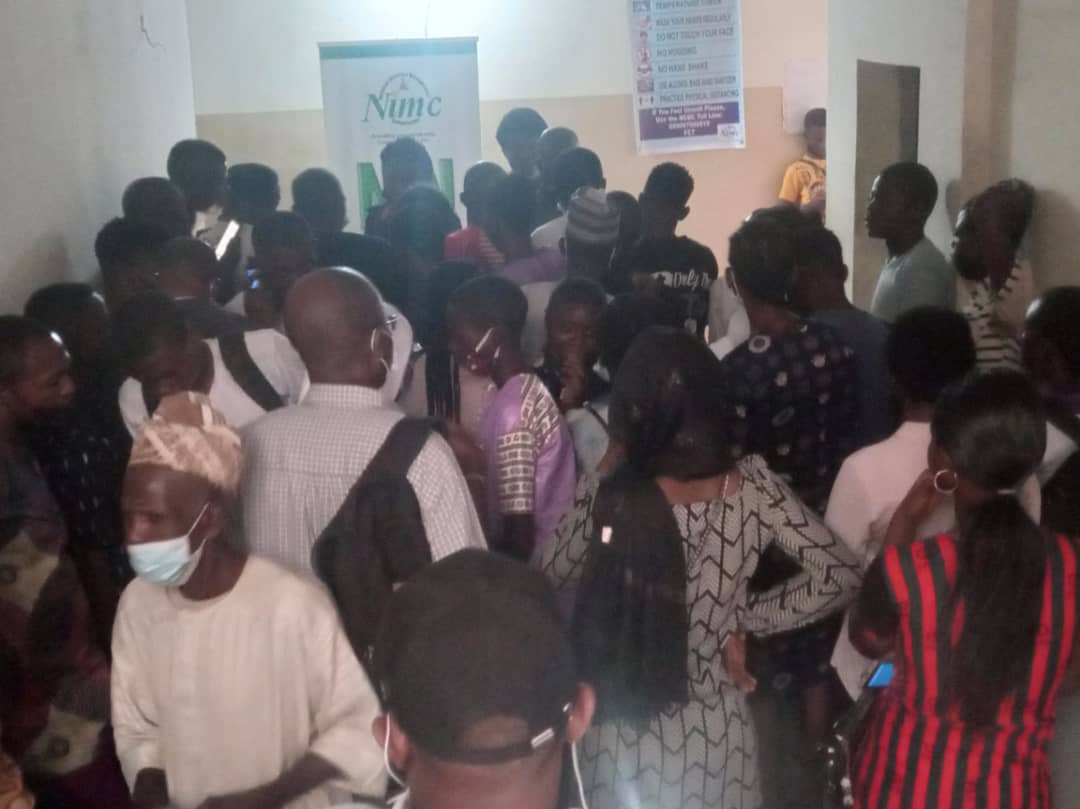
Barely less than 48 hours to the deadline for the registration of the 2021 Unified Tertiary Matriculation Examination (UTME), about 600,000 prospective candidates are yet to receive the required unique national identification number (NIN) codes to be ‘transported’ to their mobile lines for profile update.

Over the years, prospective UTME candidates have experienced issues ranging from registration, writing the examination and checking results all attributed to flaws from JAMB.

The 2021 UTME is likely to be worse following the compulsory use of the national identification number as a pre-requisite for the examination.

According to report, roughly 72 hours to the May 15 deadline set by the examination body, only 1,012,000 candidates have so far registered for the UTME and about 30,000 candidates for the programme.

This figure is low when compared to about 1.9 million UTME and 200,000 DE candidates already captured within the same period in 2020.

As at Wednesday about 600,000 prospective candidates, who have initiated the registration process, are yet to receive the required codes meant to be transported to their mobile lines by the network operators.

A prospective candidate for the 2021 UTME who preferred anonymity narrating her experience with LEADING REPORTERS almost in tears stated that her code has not been sent to her, she cannot wait till next year and the registration is almost closing.

She further revealed that one of the officials of the network provider when approached on the issue demanded one thousand naira from her to fast track the process which she quickly paid but was not sure if he actually did anything when the code was sent two days after.

Some officials of the examination body, who preferred anonymity claiming they were not authorised to speak on the matter, said the problem is caused by the adoption of the mandatory use of NIN for the registration.

“The National Identity Management Commission (NIMC) that is responsible for the issuance of NIN is expected to generate the linked number to be transported to candidates as soon as they input their required USSD code. But this has been difficult for the agency due largely to inadequate manpower and lack of required technical skill,” one of the sources told our reporter on the phone.

NIMC

Another source blamed the mobile telecommunication operators for the delayed response to transporting codes generated to candidates, saying this is the worst outing being recorded by JAMB since the adoption of the USSD system in its registration.

Some ad hoc staffers of the examination body, who were meant to register using the same procedure ahead of the examination, have also expressed frustration in their attempts to be registered for the exercise.

“We keep sending the codes to 55019 as instructed by JAMB but the response is always that it is being processed and that we should await SMS. But the SMS never comes even after more than 48 hours. I can now imagine the problem the prospective candidates are going through,”

Meanwhile, the director of public affairs and protocol for the examination body, Fabian Benjamin, refused to comment on the matter.

It would be recalled that JAMB had earlier scheduled its mock examination for April 30 but later rescheduled it to hold on May 20. The abrupt change might not be unconnected with the difficulties being experienced in the registration exercise.

Meanwhile, a highly placed source in the agency who does not want to be mentioned stated that the best solution would have been to waive the use of NIN for candidates.

“If we do that, I can assure you that in two days the whole exercise would be completed. But we cannot because the Ministry of Communications and Digital Economy was impressed by our efforts and has even written appreciation to our supervising ministry and also to the federal executive council. So we cannot backtrack on that for now,” the source said.

The examination body is billed to meet with ‘stakeholders’ including members of various groups such as civil societies and media ahead of the examination.

JAMB Registrar, Professor Ishaq Oloyede One of such meetings is billed to hold on Friday, May 14, where the JAMB registrar, Is-haq Oloyede, is expected to address the groups.

Meanwhile, the mobile network operators have denied being responsible for the challenges being faced by candidates in their efforts to be registered for the examination.

The operators’ umbrella body- Association of Licenced Telecommunications Operators in Nigeria (ALTON) said its role is ”simply to transport the codes to the candidates and not to generate”.

The association’s chairman, Gbenga Adebayo, said the delays cannot be from the systems of the telecommunication companies.

“Telecommunication companies don’t manage the process of generating the code for candidates, we only provide the “transport” access to their servers and we rely on the examinations agency to generate the code. We don’t manage their database and as such we’re not responsible for generating the said examination code,” Mr. Adebayo said.

When confronted with the claim of the existing generated codes”yet to be transported”, Mr Adebayo said; “If the codes are generated and their servers do not upload them to the operators, there would be nothing on the link to deliver.

Operators are just a medium of transport, and if their servers don’t deliver the codes, the link (transport) will be empty. Maybe there’s something they’re not saying. Ask them again and let them show a proof!”

When reached for reaction, the authorities at the National Identity Management Commission (NIMC) also refuse to respond.

May 14, 2021 0 comments
0 FacebookTwitterPinterestThreadsBlueskyEmail

Recent Posts

  • European Union ‘Boycotts’ Nigeria’s 2027 General Elections, Rejects Observer Role Over Rising Insecurity

    August 10, 2026
  • Nigerians Raise Concern Over Rising Mob Justice

    August 10, 2026
  • Atiku Abubakar Raises Alarm over Suspicious Deposit to his Account

    August 7, 2026
  • Nigerian Author Loses $2 Million Book Deal Over AI Plagiarism

    August 7, 2026
  • Onaiyekan to Tinubu: Catholic Bishops Have Said Enough, Govern Better

    August 4, 2026

Usefull Links

  • Contact Page
  • About Leading Reporters
  • Contact Us
  • Headlines
  • Investigation
  • Exclusives
  • Opinion
  • Business
  • Facebook
  • Twitter
  • Instagram
  • Linkedin

@2021 - All Right Reserved. Designed and Developed by PenciDesign


Back To Top
Leading Reporters
  • Featured
  • Politics
  • Opinion
  • Business
  • Entertainment
  • Sports
  • About Us
  • Contact