Leading Reporters
  • Headlines
  • Health
  • Business
  • Exclusives
  • Investigation
  • Entertainment
  • Opinion
Wednesday, September 30, 2026
Hot
How The Group Managing Director/CEO of Fidelity Bank...
34 years after 159 died, foundation challenges FG...
Ocean swallowing Okun Alfa, residents risk extinction –...
Dalung Condemns Wike Over Conduct During Amaechi’s Mother’s...
Atiku Decries High Rate of Kidney Sale Among...
Four Kidnappers Killed As Police Rescue 15 Kidnapped...
FCT Senatorial Seat: Ndigbo Urged to Back Philip...
Medical Lecturers Association (NAMDA) To Begin Strike September...
Local Government Autonomy Is a Scam” Tinubu, Governors...
Foreign Investors not Participating As Nigerian Stock Exchange...
  • About Leading Reporters
  • Contact Us
Leading Reporters
Advertise With Us
  • Headlines
  • Health
  • Business
  • Exclusives
  • Investigation
  • Entertainment
  • Opinion
Hot
How The Group Managing Director/CEO of Fidelity Bank...
34 years after 159 died, foundation challenges FG...
Ocean swallowing Okun Alfa, residents risk extinction –...
Dalung Condemns Wike Over Conduct During Amaechi’s Mother’s...
Atiku Decries High Rate of Kidney Sale Among...
Four Kidnappers Killed As Police Rescue 15 Kidnapped...
FCT Senatorial Seat: Ndigbo Urged to Back Philip...
Medical Lecturers Association (NAMDA) To Begin Strike September...
Local Government Autonomy Is a Scam” Tinubu, Governors...
Foreign Investors not Participating As Nigerian Stock Exchange...
Leading Reporters
Leading Reporters
  • Headlines
  • Health
  • Business
  • Exclusives
  • Investigation
  • Entertainment
  • Opinion
Copyright 2024 - All Right Reserved
Home > Headlines > Page 557
Category:

Headlines

Headlines

Osun Festival: Why Devotees, Visitors Shun Govt, Drink Poisonous Water From River

by Folarin Kehinde August 15, 2022
written by Folarin Kehinde

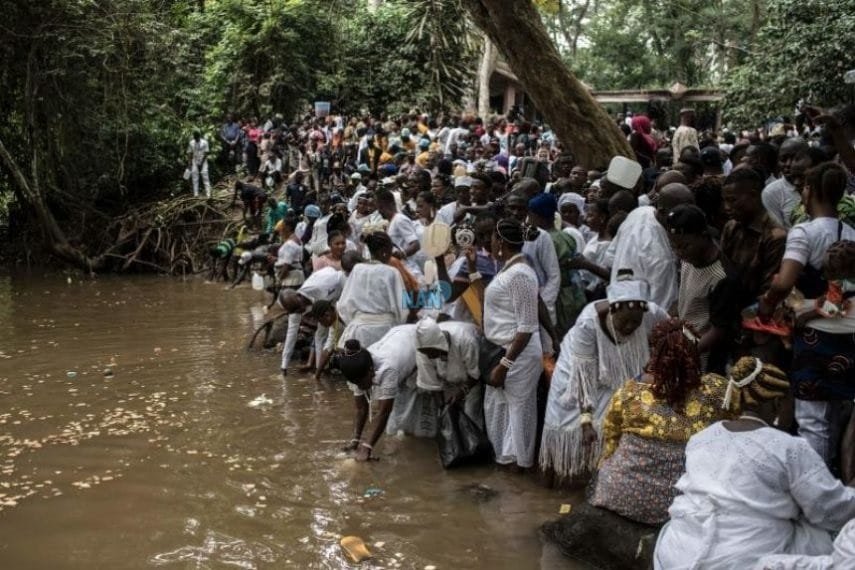
Despite state government’s warning against drinking water from Osun River during the grand finale of the Osun Osogbo festival due to contamination, many devotees and visitors were sighted on Friday defying the warning.

Correspondents of the News Agency of Nigeria (NAN) at the grove reports that some of the worshippers, who fetched the water in different sizes of Jerry Cans, were seen drinking the water on their way out of the grove.

Devotees and visitors, who had trooped out to the river side in their white attires and beads, were seen singing traditional songs and dancing.

One of the worshippers, Abidoye Osungbenro, told NAN that she has a strong faith that nothing would happen to her inspite of the fact that the water is contaminated .

She said the state government’s warning against drinking the water would not be beneficial to those who believe in the efficacy of the water.

Another devotee, Adeoye Ifadayo, who also spoke with NAN, described the Osun River as divine, adding that it could heal and protect.

Mr Ifadayo said goverment warning would not stop them from drinking the water even if contaminated.

Also speaking, Sadiq Adeoso, another devotee, said with the divine power in the river, nothing would happen to those who drink the water because of its sacred powers.

NAN reports that those selling the Jerry cans made brisk business at the entrance of the grove.

Prices of the Jerry cans ranged from N150 to N350, depending on size.

During the festival, tourists, visitors and devotees usually drink from the Osun River for its perceived divine healing properties while some take the water home to bathe with.

NAN reports that government on Thursday had advised tourists and devotees to the grand finale of the festival to refrain from drinking the water because of contamination.

The Commissioner for Health, Rafiu Isamotu, gave the advice in an interview with NAN.

He said government embarked on sensitisation to discourage people from drinking the water during the festival as it had been contaminated by the activities of artisanal miners.

Mr Isamotu said public health officials would be at the grove during the festival to further sensitise people on the dangers of drinking the water.

According to the Curator and Site Manager of Osun Osogbo Grove, Adekunle Fatai, no fewer than 60,000 devotees and tourists are expected at the grand finale.

The river is said to have been heavily contaminated with mercury, lead, cyanide and other injurious elements that are poisonous to human health.

A Geographical Information Analysis and Laboratory Tests carried out by a Non-governmental Organisation, Urban Alert, also affirmed the presence of heavy elements in the water.
August 15, 2022 0 comments
0 FacebookTwitterPinterestThreadsBlueskyEmail
Headlines

Wadume, 2 Others Sentenced to 7 Years Imprisonment

by Folarin Kehinde August 15, 2022
written by Folarin Kehinde

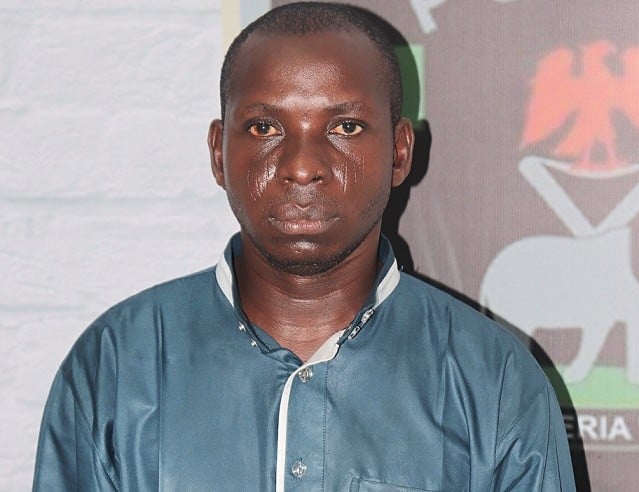
A Federal High Court sitting in Abuja has sentenced a suspected kidnap kingpin, Hamisu Bala (alias Wadume) and two others convicted to seven years imprisonment.

The trial Judge, Justice Binta Nyako, in a judgement delivered on July 22 convicted Wadume on counts two and 10 of the 13-count charge brought against him and six others by the office of the Attorney General of the Federation (AGF) on behalf of the Federal Government.

In the judgement, sighted in Abuja, Wadume was specifically convicted for escaping from lawful custody and unlawfully dealing in prohibited firearms.

Other defendants in the charge marked: FHC/ABJ/CR/30/2020 are: Aliyu Dadje (a police inspector), Auwalu Bala (aka omo razor), Uba Bala (aka Uba Delu), Bashir Wazlri (aka baba runs), Zubairu Abdullahi (aka Basho) and Rayyanu Abdul.

Justice Nyako also convicted and sentenced Inspector Dadje to three years on count seven, in which he was accused of tampering with Police record to conceal a crime.

Dadje, who was a Station Officer at the Ibi Divisional Police Headquarters, Ibi Local Government Area, Taraba State was said to have, in August 2019 willfully, “Tampered with the entry made by the leader of the Inspector General of Police Intelligence Response Team (IGP IRT), Insp. Felix Adolije, by tearing off the entry page to cover up for Captain Tijani Ahmed Balarabe and his team”,

when he knew that an offence of terrorism had been committed by Capt. Balarabe and his team, who attacked and killed three members of the team and two civilians who were in Ibi, Taraba State to make lawful arrest.

The Judge equally convicted and sentenced Uba Bala (aka Uba Delu) and Zubairu Abdullahi (aka Basho) to seven years each on counts three, four, five, six and 11. The duo was, in the four counts, charged with illegal possession and unlawful dealing in prohibited firearms and ammunition.

Justice Nyako also convicted and sentenced Abdul to three years for harbouring Wadume in his house in Kano after Wadume’s escape from police custody in Ibi and struck out count one, in which Wadume was charged with kidnaping Usman Garba (aka Mayo) and collecting N106 million before releasing him.

August 15, 2022 0 comments
0 FacebookTwitterPinterestThreadsBlueskyEmail
Africa & WorldHeadlines

Kenya Elections: Results To Be Announced Soon

by Folarin Kehinde August 15, 2022
written by Folarin Kehinde

Kenyans are moving closer to learning the outcome of their closely-fought presidential elections after days of anxious waiting.

Kenyans voted on Tuesday last week in six elections, choosing a new President as well as senators, governors, lawmakers, women representatives and some 1,500 county officials.

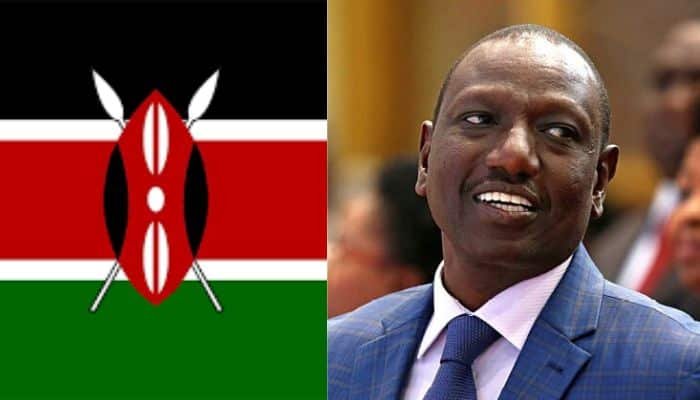
Deputy President William Ruto was leading with slightly more than 51 percent of the vote against 48 per cent for Raila Odinga, based on official results from more than 80 percent of constituencies, according to a tally published by the Daily Nation newspaper.

Ruto, 55, is deputy president but is effectively running as the challenger after outgoing President Uhuru Kenyatta threw his support behind his former foe Odinga, the 77-year-old veteran opposition leader making his fifth bid for the top job

Both men had on Sunday appealed for calm as the wait for the final results of the August 9 vote dragged on.

Polling day passed off largely peacefully, but memories of vote-rigging and deadly violence in 2007-08 and 2017 still haunt Kenyans.

The Independent Electoral and Boundaries Commission is under intense pressure to deliver a clean poll in a country regarded as a beacon of stability in a troubled region.

Results must be issued by Tuesday at the latest, according to Kenya’s constitution.

August 15, 2022 0 comments
0 FacebookTwitterPinterestThreadsBlueskyEmail
Headlines

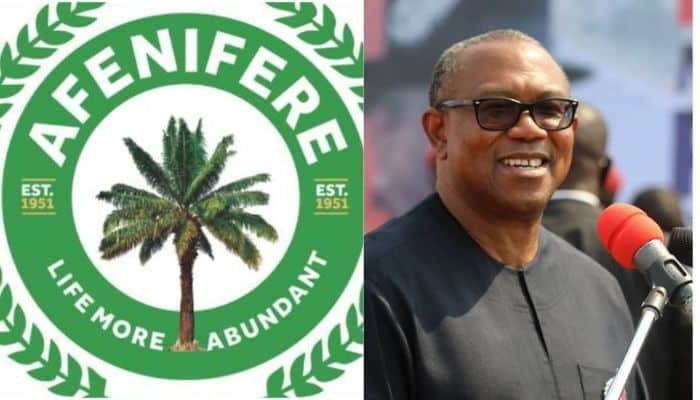
Afenifere Group Endorses Peter Obi For 2023 Presidency

by Folarin Kehinde August 15, 2022
written by Folarin Kehinde

Yoruba Socio-Political group, Afenifere Renewal Group, have expressed their support for Peter Obi in the upcoming 2023 general election.

The Afenifere group has been in existence before the independence of Nigeria as it was founded together with the Action Group (AG) political party in 1951 by late Yoruba leader, Pa  Obafemi Awolowo. It was responsible for much of the fight for Nigeria’s independence and constitution.

Over the years, they have pioneered political parties like the Action Group (AG), Unity Party of Nigeria (UPN) and Alliance for Democracy (AD)Even after Awolowo’s death, the group still thrived till this day

A spokesperson of the Afenifere group who is also a member of their 9 man National Caucus Committee stated their groups decision regarding Peter Obi and the 2023 elections in an interview with PlusTv.

He stated that the Afenifere group has always been relevant in the political discourse of Nigeria with an ability to see trouble from afar. When Buhari was campaigning in 2015, they warned that he was not going now to do anything for Nigerians since he had nothing to offer. People did not listen, now look where we find ourselves.

He said that for equity, justice and fairness, the presidency has to be given to a candidate from the south east. According to him, Obasanjo from the South West has had 8 years of presidency, Buhari and Yaradua from the north have enjoyed 11 years (8 and 3 respectively) while Good Luck Jonathan from the South-South has enjoyed 5 years of presidency.

If power is to return to the South, then it is imperative that it is given to an Igbo person.

He expressed his disappointment on how the people who divided the country, brought it to its knees and made it ungovernable through Boko-Haram and other mercenaries are now the preferred candidates for the 2023 elections

According to him, after their groups interrogation and examining of Peter Obi, and looking at the issues at stake for the country namely our Structure, wasteful and woeful governance amongst others, the only person capable of putting this country back on track is HE Peter Obi.  

August 15, 2022 0 comments
0 FacebookTwitterPinterestThreadsBlueskyEmail
Headlines

El-Rufai Mocks Igbos, Says 2 million March For Peter Obi in Kaduna Impossible

by Folarin Kehinde August 15, 2022
written by Folarin Kehinde

Former FCT minister and sitting governor of Kaduna State, Mallam Nasir Ahmad El-Rufai has gone on social media to openly abuse Igbo people and mock a planned 2 million march by supporters of Peter Obi in Kaduna State.

A twitter user whose name is Abdullahi Umar Zarma tweeted “Kaduna Two million march for Peter Obi” various times, ending the tweet with a hashtag #KadunaTwoMillionMarchforPeterObi.

Governor El-Rufai unprovoked, came to quote reply the tweet from Abdullahi. He responded to the tweet saying “In Kaduna? Not Kaduna twitter? /* Laughing emojis */, I hope you get two hundred persons on the streets, including those ‘imports’ that can’t open their shops on Mondays, and come on overnight bus last night!!! I jus’ dey laff, wallahi tallahi!!!.

Social Media users have lashed out at the governor for his lack of decorum and open tribalism towards Igbo people whom he referred to as ‘imports’, ‘overnight bus travellers’.

Popular Activist, Aisha Yesufu said that even shame is ashamed of Governor El-Rufai.

Many people have also reminded the governor to be more concerned about Kaduna state that is current plagued by terrorists and bandits. Kaduna residents are now afraid to ply the Kaduna-Abuja road for fear of being kidnapped.

Others used the opportunity to task politicians to stop putting out statements that is aimed at dividing Nigeria, and work on fostering unity among Nigerians.

August 15, 2022 0 comments
0 FacebookTwitterPinterestThreadsBlueskyEmail
Headlines

CORRUPTION: Termites Eat Up Documents On N17.158B Expenditure of Nigeria Social Insurance Trust Fund (NSITF)

by Folarin Kehinde August 15, 2022
written by Folarin Kehinde

The Senate Public Accounts Committee (SPAC) has put the current and past management of the Nigeria Social Insurance Trust Fund (NSITF) under scrutiny.

The committee said it discovered that the fund’s management failed to produce relevant documents to justify alleged spending of N17.158 billion in 2013.

Some of the documents to back the expenses were said to have been eaten up by termites.

The Office of the Auditor General of the Federation (OAuGF), in its 2018 audit report – now being considered by the Senate panel chaired by Senator Matthew Urhoghide (Edo South) – had queried the agency over the disbursed sums without appropriate supporting documents.

In his report, the AuGF said the N17.158 billion represented the total sum of money, transferred by the agency from its Skye and First Bank accounts, into various untraceable accounts belonging to individuals and companies between January and December 2013.

The OAuGF had, in its 2018 audit report, raised 50 different queries bordering on alleged misappropriation of funds against the agency.

The AuGF’s query reads: “Management of NSITF, as shown in statements of account number 1750011691 with Skye Bank Plc, for the period 1st January, 2013 to 20th December, 2013, and statements of account number 2001754610 with First Bank Plc for the period January 7, 2013 to February 28, 2013, transferred amounts totalling N17,158,883,034.69 to some persons and companies from these accounts.

“However, payment vouchers relating to the transfers together with their supporting documents were not provided for audit. Consequently, the purpose(s) for the transfers could not be authenticated.

“These are in violation of Financial Regulation 601 which states that ‘all payment entries in the cashbook/accounts shall be vouched for on one of the prescribed treasury forms. Vouchers shall be made out in favour of the person or persons to whom the money is actually due’.

“Under no circumstances shall a cheque be raised, or cash paid for services for which a voucher has not been raised.”

The Chairman of the Senate Committee, Urhoghide, had summoned and interviewed NSITF’s past and present managements on where the said N17.158 billion was transferred to between January and December 2013.

It was learnt that no official of the former management could offer satisfactory explanation on the alleged multiple transfers with necessary documents.

Members of management in charge of the agency in 2013 had told the committee that relevant cash vouchers pertaining to the transactions were left behind by them.

But the current NSITF Managing Director, Dr. Michael Akabogu, was said to have claimed that no such documents were in the organisation’s custody.

“The container the said documents were kept by past management has not only been beaten by rains over the years but even possibly been eaten up by termites.

“As directed by this committee, I told the past management officers on the need for them to help us out in answering this query with necessary documents which have not been made available for us,” Akabogu allegedly said.

The Managing Director of NSITF from 2010 to 2016, Mallam Umar Munir Abubakar, allegedly claimed that he was aware of the query and had no explanations to render since the audit exercise was not carried out during his tenure.

But his successor, Mr. Adebayo Somefun, who was head of the agency from May 2017 to July 2020, allegedly insisted that those in the agency’s account section should be able to trace the documents.

But the current General Manager Finance of the agency allegedly said that the container in question had been under lock and key and abandoned in an isolated area within the premises of the organisation in Abuja.

In his ruling, Urhoghide expressed worry over the development and ordered both members of past and present management of the NSITF to re-appear before the panel with all necessary evidence concerning the transactions unfailingly on Thursday, September 22, 2022.

Source: NigeriaDispatch

August 15, 2022 0 comments
0 FacebookTwitterPinterestThreadsBlueskyEmail
Headlines

7 Years After, Deployment of IPPIS, GIFMIS, TSA, didn’t follow Nigeria’s law – Pantami

by Leading Reporters August 14, 2022
written by Leading Reporters

The latest revelations about the challenges with the IPPIS by the minister has been described as a vindication of ASUU’s position on the payment system.

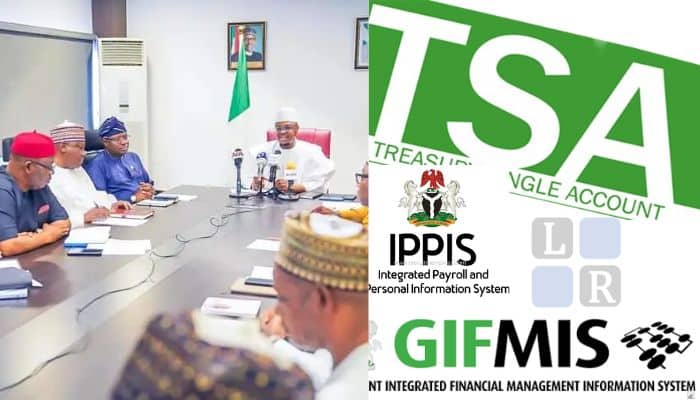
The Minister of Communications and Digital Economy, Isa ‘Pantami’ Ibrahim, has said the deployment of the Integrated Personnel Payroll Information System (IPPIS), Government Integrated Financial Management Information System (GIFMIS), and the Treasury Single Account (TSA), did not follow relevant laws as put in place by the Nigerian government.

The minister said the section of the NITDA Act that requires the standardisation and certification, application and delivery of such systems in Nigeria were not followed during the deployment of IPPIS, GIFMIS and TSA.

“At the time they were deployed, the provision of NITDA Act under section A, of setting the standardisation of ICT deployment in federal public institutions was not followed. Because of this, these three systems were not subjected to government certification and IT project clearance as encouraged by law and many other government policies,” he said.

Mr Ibrahim said following allegations that the systems are being used to syphon money from the treasury, the National Information Technology and Development Agency (NITDA) reviewed the IPPIS critically, “and found errors in high, medium and low magnitudes.”

President Muhammadu Buhari has, therefore, approved the constitution of a Presidential Steering Committee on critical technical review of the three payment systems used by the government, he said.

The minister spoke on Friday while inaugurating the members of the committee on behalf of the President.

He said the results of the test conducted on IPPIS have been submitted to relevant government agencies including the Ministries of Finance, Budget and National Planning, Labour and Employment as well as the Presidency.

The minister said the tests will also be carried out on GIFMIS and TSA and the final report will be submitted to the President.

He said: “Prior to this meeting as part of the government’s processes, testing and certifying systems IPPIS was recently subjected to critical review by NITDA. A report has been submitted to the relevant ministries including Finance, Budget and National Planning, Ministry of Labour and Employment, and a copy was sent to the Presidency.

“There is no doubt, we discovered there are high errors. There are challenges with IPPIS. There is no doubt about this. But in spite of all the challenges we have recorded, there are high, medium and low errors in these systems.”

The suspended Accountant General of the Federation, Ahmed Idris, who is currently facing corruption trial, was alleged by the Economic and Financial Crimes Commission (EFCC) to have diverted funds through IPPIS, GIFMIS and TSA.

Benefits of IPPIS, others

However, despite the irregularities identified in the system, Mr Ibrahim said the systems have proved to be useful, saying they have saved the government over N10 trillion.

He said: “Inspite of that, many achievements have been recorded. For example, based on the report from the relevant institutions of government that IPPIS saved the government over N120 billion naira, while Treasury Single Account (TSA) saved over N10 trillion for the government.”

The committee

The technical committee, which was inaugurated by Mr Ibrahim, is also to be chaired by him. He said its activities will be supervised by his ministry while NITDA serves as the secretariat for the committee.

“The main work is to ensure that there is no leakage in these systems, and to ensure that the process is of high quality,” he said.

He said all the institutions managing the platforms to be reviewed must provide unlimited access to the committee to do its job.

He said any institution that fails to cooperate with the committee will report the president for punishment.

“Any institution that failed to give access to it will be reported to the President immediately. And in addition to that recommendation, a punishment is going to be recommended to the president for implementation.

“It is the mandate of this ministry and the relevant parastatals under the ministry to ensure that any system deployed in government, there is value for money and we must continue to improve on that.”

Members of the committee, according to the minister, include NITDA’s Director General, Kashifu Inuwa, who serves as the secretary; the Minister of Finance, Budget and National Planning, Zainab Ahmed; Head of Civil Service of the Federation, Folashade Yemi-Esan; Auditor General of the Federation, Aghughu Arhotomhenla; and the Chairman, Economic and Financial Crimes Commission (EFCC), Abdulrasheed Bawa.

Others include the Director General, Bureau of Public Service Reforms, Dasuki Arabi; Chairman, Salaries Income and Wages Commission, Richard Egbule; and the Managing Director, Galaxy Backbone Limited, Muhammed Abubakar, a professor.

Backstory

The striking university workers’ unions have consistently opposed the deployment of IPPIS for the payment of its members’ emoluments, saying the system is a product of fraud and an imposition by foreign economic interests.

The Academic Staff Union of Universities (ASUU) has insisted on the replacement of the payment platform with an alternative its members designed which the union tagged; University Transparency and Accountability System (UTAS).

Meanwhile, both the Senior Staff Association of Nigerian Universities (SSANU) and the Non-Academic Staff Union of Educational and other Associated Institutions (NASU) have also developed its alternative solution tagged; “University Peculiar Payroll Payment System (U3PS).

The chairman of the Lagos zone of ASUU, ‘Laja Odukoya, described as a vindication of the union’s position the minister’s latest revelation about the challenges with IPPIS.

August 14, 2022 0 comments
0 FacebookTwitterPinterestThreadsBlueskyEmail
OpinionHeadlines

Tinubu And Obi Will Either Affirm Or Destroy These Two Theories In 2023

by Leading Reporters August 14, 2022
written by Leading Reporters

Farooq Kperogi

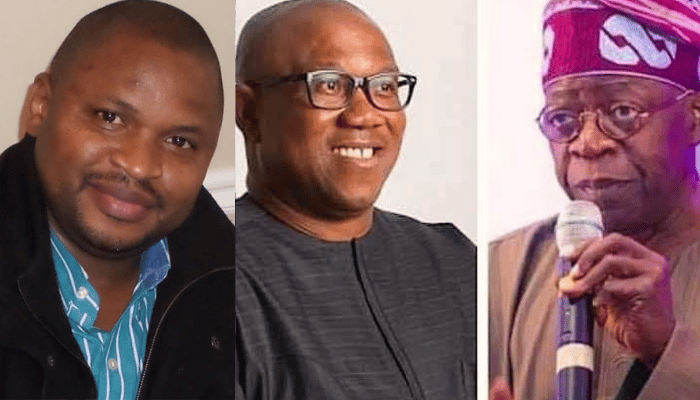
TWO certainties have underpinned voting behavior in Nigeria, which APC’s Asiwaju Bola Ahmed Tinubu and Labour Party’s Mr. Peter Obi will either uphold or explode in next year’s presidential election. While one of the certainties is time-honored, the other is more contemporary and enabled by social media.

The most time-honored fixity in Nigerian electoral politics since independence is the certitude that the Yoruba electorate will always overwhelmingly vote for a Yoruba candidate in national elective contests in which other candidates are non-Yoruba. Will Tinubu uphold, modify, or disaffirm this age-old pattern? I’ll return to this shortly.

The second fixture in Nigeria’s electoral politics since at least 2011 is the almost inexorable nexus between candidates who dominate the social media discursive arena and candidates who win the presidential election. Peter Obi is now undoubtedly the undisputed favorite in Nigeria’s social media circles. Will he replicate previous patterns?

Let’s start with Tinubu and the Yoruba voting trajectory. On the surface, it seems outrageously accusatory and unfair to say Yoruba people inescapably vote for their kind in presidential elections. But that is what the historical evidence says.

Note, however, I am not by any means saying that every single Yoruba voter has always voted for Yoruba candidates in presidential elections. I am only saying that the majority of Yoruba voters always vote for their kind.

Chief Obafemi Awolowo enjoyed the kind of political dominance in Western Nigeria that Sir Ahmadu Bello didn’t have even in Hausaphone Muslim Northern Nigeria (he could never win over Kano, for example) and that Dr. Nnamdi Azikiwe didn’t enjoy in Eastern Nigeria.

Well, one can attribute Awolowo’s political iconicity in Western Nigeria to his admirable policies and inclusive strategies when he was a premier of the region. But how about Chief MKO Abiola?

Abiola spent the better part of his political career undermining Awolowo and swimming against the political mainstream in Yoruba land. His Concord newspaper was virulently and implacably anti-Awolowo.

Unlike Tinubu who used to subordinate his Muslim identity to the point of erasure until the last few years, Abiola wore his Islam on his sleeves.

He advocated the establishment of sharia in Yoruba land; built hundreds of mosques nationwide; openly supported Islamic causes in and outside Nigeria; was the Baba Adini of Yoruba land [i.e., the ceremonial head of Islam in Yoruba land); and aggressively worked for and defended Nigeria’s membership in the Organization of Islamic Conference (OIC), which caused the Christian Association of Nigeria (CAN) in 1986 to urge Christians to boycott the Concord newspaper.

Abiola was also the victim of a vicious whispering campaign in churches that he bought hundreds of thousands of bibles and intentionally sunk them in the sea. It was false but many Christians believed it.

So, when he chose a northern Muslim running mate in 1993, like Tinubu has done, the exact same reaction as we’re seeing today from Christians followed. Northern Christians kicked, and Yoruba Christians said they wouldn’t vote for him both because of his past and his choice of a Muslim running mate.

But when his opponent turned out to be Alhaji Bashir Tofa, a Kanuri Muslim born and raised in Kano, the Yoruba electorate closed ranks, eschewed religious divisions, accentuated Abiola’s ethnicity, and voted for him overwhelmingly.

We saw a repeat of this with Chief Olusegun Obasanjo. When his major opponent was Chief Olu Falae, another Yoruba man, he lost not only the Southwest but also his natal Ogun State. However, when his major opponent in 2003 was Major General Muhammadu Buhari, the Yoruba electorate voted for him massively.

Note that Obasanjo did things that made him unpopular in the Southwest. For example, he ordered the shooting on sight of OPC members, starved Lagos of federal allocations out of spite, and actively worked to disrupt the prevailing political consensus of the region. Yet, the Yoruba political elite not only preferred him to Buhari, they also merged their political party, the Alliance for Democracy (AD), with the Peoples Democratic Party (PDP) for the purpose of the 2003 presidential election, which led to the death of AD.

In a February 21, 2003, confidential cable revealed by WikiLeaks in 2011, the US Consul General reported Tinubu to have told him that Yoruba people would vote for Obasanjo against Buhari because even though Obasanjo was unlikeable, he was Yoruba and Buhari wasn’t.

The cable reads: “Turning to the presidential contest, Tinubu disclosed that he does not like President Obasanjo because he contributed to the end of democracy in Nigeria during his tenure as a military president and is now benefiting from that history.

“That said, Tinubu admitted that he and his party, the Alliance for Democracy, must support Obasanjo. Southwest Nigeria is Yoruba land and the President is Yoruba. Tinubu”s [sic] party had no choice since it has not fielded a presidential candidate. Moreover, Obasanjo is the only candidate who stands a chance of blocking his rival, General Muhammadu Buhari, whose ethnocentrism would jeopardize Nigeria’s [sic] national unity. Buhari and his ilk are agents of destabilization who would be far worse than Obasanjo….”

Tinubu and his group would later embrace the same Buhari the fear of whom had driven them to embrace and support an unlikeable Obasanjo.

If the Yoruba voting pattern that I have established is any guide, Tinubu will win the majority of votes in the Southwest in spite of the apparent religious dissension in the region now.

Should he, however, win only marginally or, worse, lose in the region, it would mean that religion, particularly Pentecostal Christianity, has finally succeeded in trumping ethnicity in Yoruba land. That would be seismic and invite a reworking of the sociology of the region, especially if Peter Obi makes significant inroads in Southwest states outside of Lagos (where Igbos constitute a significant voting bloc).

It would mean that, like in Northern Nigeria, religion has graduated to a more significant predictor of political behavior than ethnicity in Yorubaland. That would have far-reaching consequences for the mapping of the contours of the Yoruba political landscape going forward.

The second observational data that will be up for empirical corroboration or explosion in the 2023 election is the nexus between social media popularity and electoral triumph in presidential contests. I studied this systematically from 2011 to now.

In 2011, when social media was still at its inchoate stage in Nigeria, Dr. Goodluck Jonathan bestrode the social media scene like a colossus and pulverized Buhari in the election. Buhari returned the favor in 2015 after coalescing with the dominant political elites of the Southwest. Buhari dominated the social media space and ended up winning the election.

In 2019, Buhari’s online devotees lost their creative juices and left the stage for Alhaji Atiku Abubakar’s online foot soldiers. Atiku ruled the social media conversation during electioneering and went ahead to win the election but was rigged out in one of the most brazen electoral heists in Nigeria’s history. Both INEC insiders and U.S. State Department officials have confirmed that Buhari lost the 2019 election by close to 2 million votes.

The clamorousness of Peter Obi’s dominance of the Nigerian social media scene is uncannily redolent of Buhari’s 2015 social media supremacy. The temperaments of their supporters are eerily similar: like Buhari’s 2015 supporters, Obi’s votaries are aggressive, malicious, passionate, monomaniacal, worshipful in their admiration of their idol, intolerant of alternative views, self-righteous, and apt to invent easily falsifiable falsehoods to shore up their hero’s image.

Like Buharists in 2015, Obi adherents, who call themselves by the singularly headless and uninspired moniker “Obi-dient,” have succeeded in shutting out the voices of people who support other candidates with their venomous vituperative darts, although they met their match on Twitter in former Enugu State governor Dr. Chimaroke Nnamani who requitted their verbal violence and caused the hashtag #ObidiEND to trend for days.

Well, although the link between social media dominance and eventual electoral triumph in presidential contests is more correlational than causational, it nonetheless points to the symbiosis between online and offline political organizing.

In other words, there’s a mutually reinforcing relationship between online visibility and offline success. For example, the exponential rise in PVC registration in the last few weeks has been attributed to the energy Obi has infused into the political process.

But should Obi fall short in 2023 in spite of dominating social media, I would attribute his social media dominance to what we call the spiral of silence in communication theory. Spiral of silence occurs when vast swaths of people self-censor themselves because they fear that a vocal minority’s shrill opinions are the dominant and only acceptable opinions. Fear of insults and social isolation from the vocal minority keep the majority from expressing opinions that depart from the consensus of the vocal minority.

Whatever it is, the 2023 election is shaping up to be an election like no other in the history of Nigeria.

August 14, 2022 0 comments
0 FacebookTwitterPinterestThreadsBlueskyEmail
OpinionHeadlines

Allowing criticisms of government is overdue in Nigeria

by Leading Reporters August 14, 2022
written by Leading Reporters

Tonnie Iredia

Unlike today’s fresh journalists, those of us who joined the profession in the early 70s had golden opportunities of attending professional training courses outside Nigeria. One of the courses I attended which has  remained indelible to me even after several years of retirement from service was on how to develop journalistic courage. Interestingly, it is not the content of the course that has  refused to go, but the impact of an inscription on the office door of one of the resource persons. It read as follows: “If you speak, you will die. If you don’t speak you will still die.” The author’s  explanation of the purport of the inscription, was that those who are always petrified of speaking should realize that because such fears would not stop the ultimate reprisal- death, they stood the chance of dying without speaking.

 
Of course people have a right to speak whenever they have something they wish to convey to other people. That is the whole essence of the constitutional freedom of speech provided that in the exercise of his/her freedom, no one defames any other person. Indeed, in a free world, every country has since the 1970s been encouraged by UNESCO to operate as a communicating nation. If however people don’t feel obliged to talk to one another, there are by far too many cogent reasons for them to talk to government. First, it helps to shape public policies because people’s preferences are best reflected in what they say instead of what they fail to disclose. Second,  it is through feedbacks from people in a particular community that government can monitor and form judgment on the degree of success of public policy execution in each community.
 
Government is therefore better positioned to comprehend public rating of her performance. In other words, it is in the interest of government  to listen to public criticisms no matter how scathing they may appear to be. Where the criticisms are generally factual and devoid of malice, they constitute what can reasonably be deemed to be constructive and ought to be used by a good government to make amends. It is in fact ill-adviable for government officials to denounce public criticisms on the ground that they are restricted to only areas where government has not done well without correspondingly reflecting her areas of success. The point must also be made that where critics are pragmatic enough to offer solutions or alternative options, their criticisms are elegantly coated in a positive garb.
 
Considering that the third world accommodates an appreciable number of tyrannical government officials, it is heartwarming that Nigeria has some citizens both now and in the past who were and are always available to speak truth to power. Here, one remembers with eternal gratitude, the selfless fight against bad governance by the late irrepressible Gani Fawehinmi to enthrone justice and equity in the land.  Another great example of crusaders that cannot be forgotten in hurry is Anthony Cardinal Olubunmi Okogie. The Cardinal it was who courageously berated government for running down hitherto viable private schools which she took over without establishing any formidable strategies to run them. The courage to call out the government on many current political and socio-economic policies that are feebly formulated and ineffectually executed has been the main concern of Bishop Mathew Kukah of the Sokoto Catholic Diocese.
 
Only last week, another Catholic Bishop, John Ebebe Ayah of the Uyo Diocese joined the list of moral teachers and social reformers who are always drawing attention at the appropriate time to matters of public interest calling for change. At  a Thanksgiving service organized in honour of newly appointed Justice Emmanuel Agim Akomaye of the Supreme Court, Bishop Ayah subtly rejected a donation made by Governor Ben Ayade of Cross River State to the bewilderment of the congregration. In the words of the Bishop, “I want to appreciate the governor and tell him to package whatever he has for me, add to it and use it to pay the salaries of workers.” The Bishop according to the media received thunderous ovation from the congregation establishing clearly that someone needed to let political leaders know that  irregular payment of workers’ salaries ought to be deprecated. 
 
But was the top clergy playing to the gallery with no evidence that Governor Ayade belongs to the league of state governors that toy with workers’ pay? Those who listened to Ayade’s immediate rejoinder after the Bishop threw the bomb may have felt that it was an unfair attack because the governor reportedly confirmed that his administration has been faithful and consistent in the payment of salaries for well over seven years. However, there is doubt if the governor was not merely playing Nigerian politics where truth is often denied with confidence and oratory. This is because a group of civil servants in Cross River had recently protested publicly on the streets of Calabar that they had not been paid any salary since they were recruited in 2018.  Besides, there was the report from far away, Geneva, Switzerland that Ayuba Wabba, President of the Nigerian Labour Congress ( NLC) named Ayade of Cross River State and three other governors: Darius Ishaku of Taraba, Bello Matawalle of Zamfara and Okezie Ikpeazu of Abia  as the only four who are yet to pay the approved minimum wage in their states. 
 
It is significant that the minimum wage story came up; because one of the most insensitive things in our clime is the payment of huge salaries and allowances to top political office-holders who consistently insist that government cannot afford to meet the small figures that are to be paid to junior workers and university teachers. Failure to pay minimum wage is not only a social problem but also a legal issue because the minimum wage was approved by law, making it an offence to not pay it. Those who are ready to speak truth to power should direct attention to more than the executive arm of government. For example, Nigerians have remained perturbed about the huge allowances of members of the Nation Assembly. Although the legislators often speak of only their basic salaries, the huge allowances they allegedly pay themselves without the approval of the Salaries and Wages
Commission have remained worrisome. Under the relevant subheads, it is alleged that newspaper allowances of a legislator are far in excess of the salary of the highest paid university teacher.
 
Nigerians must continue to talk because many well-placed persons often hoard sensitive information away from those in top leadership positions until it is too late to nip the problem in the bud. It worthy of note that governor El Rufai is a good example of a leader who interrogates a public story at the appropriate time. The other day, it was him that was quoted by several media sources as the first to inform President Muhammadu Buhari of threats against his person by insurgents.  At the 7th Wole Soyinka Centre Media Lecture Series in Abuja in 2015, the governor had called for the dissolution of what he called the “corrupt” Nigerian National Petroleum Company NNPC or stand the risk of itself being destroyed. In 2017, it was the same governor that wrote a private letter to the president to apprise him of the negative comments by many Nigerians about his government and steps that can be taken to improve governance and move the country forward. Just four days ago, El Rufai also informed the president that terrorists were creating a parallel government in Kaduna. What the governor appears to be anxious to confirm is that it is better to speak before one dies.
 
In contrast, there are governors and other officials close to the corridors of power who operate the “silence is golden” approach in the new age of information technology in which the old order of stifling information and criminalizing dissent have become obsolete. Also overtaken by events is the old practice of placing the public media in a cooler in the hope that not much would in the process be said about government. It is time for political leaders who incarcerate  journalists and political opponents on account of their view points to close shop

August 13, 2022.

August 14, 2022 0 comments
0 FacebookTwitterPinterestThreadsBlueskyEmail
SportsHeadlines

France Football Snubs Lionel Messi In 2022 Ballon d’Or Shortlist

by Folarin Kehinde August 13, 2022
written by Folarin Kehinde

For the first time since 2005, Seven time Balon d’or winner Lionel Messi was not among the 30 players shortlisted in 2022 Ballon d’or.

The Ballon d’Or committee has acknowledged that, unlike Cristiano Ronaldo, the current winner Lionel Messi’s first season with Paris Saint-Germain was not good enough to get him on the shortlist for the 2022 award.

Top players like Cristiano Ronaldo, Karim Benzema, Mohammed Salah and others were included in the 30 men shortlist, so it was a disappointment for fans of the Argentine as he was not included.

Messi’s disappointing first season in Paris ended with him failing to make the final 30-man shortlist for the Ballon d’Or for the first time in 17 years. He finished the season with 11 goals and 15 assists in 34 games, a dismal total by Messi’s high standards.

Fans were outraged by the decision to leave Messi off the shortlist, and France Football, the organisation behind the award, quickly put together a Q&A session to try to put their minds at ease.

“Inevitably, Lionel Messi, with his 15 appearances in a row since 2006, his seven Ballon d’Or victories, his title holder status, weighs very heavily when it comes to the final choice,” the organisers said.

“The Argentinian was part of the discussions to integrate the 30, but the new criteria for the Ballon d’Or were unfavourable to him: disappearance of the criterion of a player’s entire career, and new periodicity, modelled on a season of football and no longer over a calendar year, which does not make it possible to integrate the Copa America of July 11, 2021.

“And then, it must be admitted that his first season in Paris was very disappointing both in terms of the visual impression and the statistics.”

August 13, 2022 0 comments
0 FacebookTwitterPinterestThreadsBlueskyEmail
Newer Posts
Older Posts

Recent Posts

  • How The Group Managing Director/CEO of Fidelity Bank Nneka Onyeali-Ikpe Doubled Her Personal Loan From Fidelity Bank; Other Directors Left ₦1Billion In Insider Loans Deals

    September 28, 2026
  • 34 years after 159 died, foundation challenges FG over fallen heroes’ memorials

    September 28, 2026
  • Ocean swallowing Okun Alfa, residents risk extinction – RDI

    September 12, 2026
  • Dalung Condemns Wike Over Conduct During Amaechi’s Mother’s Burial

    September 7, 2026
  • Atiku Decries High Rate of Kidney Sale Among Young Nigerians, Blames High Cost of Living

    September 4, 2026

Usefull Links

  • Contact Page
  • About Leading Reporters
  • Contact Us
  • Headlines
  • Investigation
  • Exclusives
  • Opinion
  • Business
  • Facebook
  • Twitter
  • Instagram
  • Linkedin

@2021 - All Right Reserved. Designed and Developed by PenciDesign


Back To Top
Leading Reporters
  • Featured
  • Politics
  • Opinion
  • Business
  • Entertainment
  • Sports
  • About Us
  • Contact