Leading Reporters
  • Headlines
  • Health
  • Business
  • Exclusives
  • Investigation
  • Entertainment
  • Opinion
Tuesday, December 2, 2025
Hot
Tinubu Nominates Ex-CDS Christopher Musa As Defence Minister
BREAKING: FG Publishes List of 15 Alleged Terrorist...
FG Proposes 40% Salary Increase for ASUU Lecturers
Northern Governors Host Emergency Meeting Over Escalating Security...
Tinubu appoints ex-INEC Chair Yakubu, Fani-Kayode, Reno Omokri,...
Niger Delta Boss Jennifer Adighije Accused of Corruption,...
India Orders $570 Million Payout in Major Fraud...
Dangote Refinery Saves Nigeria over ₦10bn Annually in...
Bandits Abduct 16-year-old boy, six girls in FCT...
Social Security: A Missing Link in Nigeria’s Search...
  • About Leading Reporters
  • Contact Us
Leading Reporters
Advertise With Us
  • Headlines
  • Health
  • Business
  • Exclusives
  • Investigation
  • Entertainment
  • Opinion
Hot
Tinubu Nominates Ex-CDS Christopher Musa As Defence Minister
BREAKING: FG Publishes List of 15 Alleged Terrorist...
FG Proposes 40% Salary Increase for ASUU Lecturers
Northern Governors Host Emergency Meeting Over Escalating Security...
Tinubu appoints ex-INEC Chair Yakubu, Fani-Kayode, Reno Omokri,...
Niger Delta Boss Jennifer Adighije Accused of Corruption,...
India Orders $570 Million Payout in Major Fraud...
Dangote Refinery Saves Nigeria over ₦10bn Annually in...
Bandits Abduct 16-year-old boy, six girls in FCT...
Social Security: A Missing Link in Nigeria’s Search...
Leading Reporters
Leading Reporters
  • Headlines
  • Health
  • Business
  • Exclusives
  • Investigation
  • Entertainment
  • Opinion
Copyright 2024 - All Right Reserved
Home > Ukraine
Tag:

Ukraine

Ukranine
Africa & World

‘Vladimir, STOP!’ – Trump Condemns Latest Attack on Ukrainian Capital

by Nelson Ugwuagbo April 24, 2025
written by Nelson Ugwuagbo

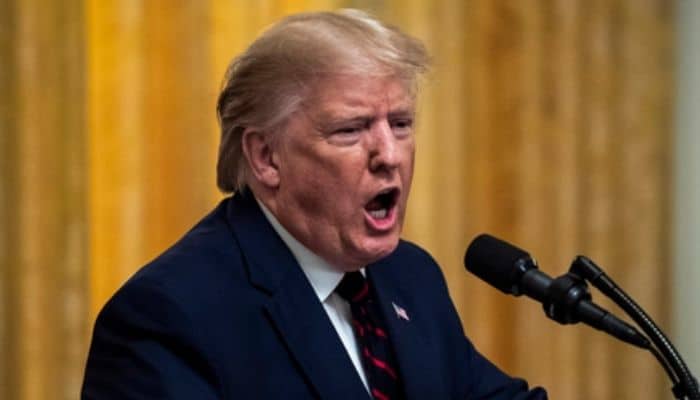
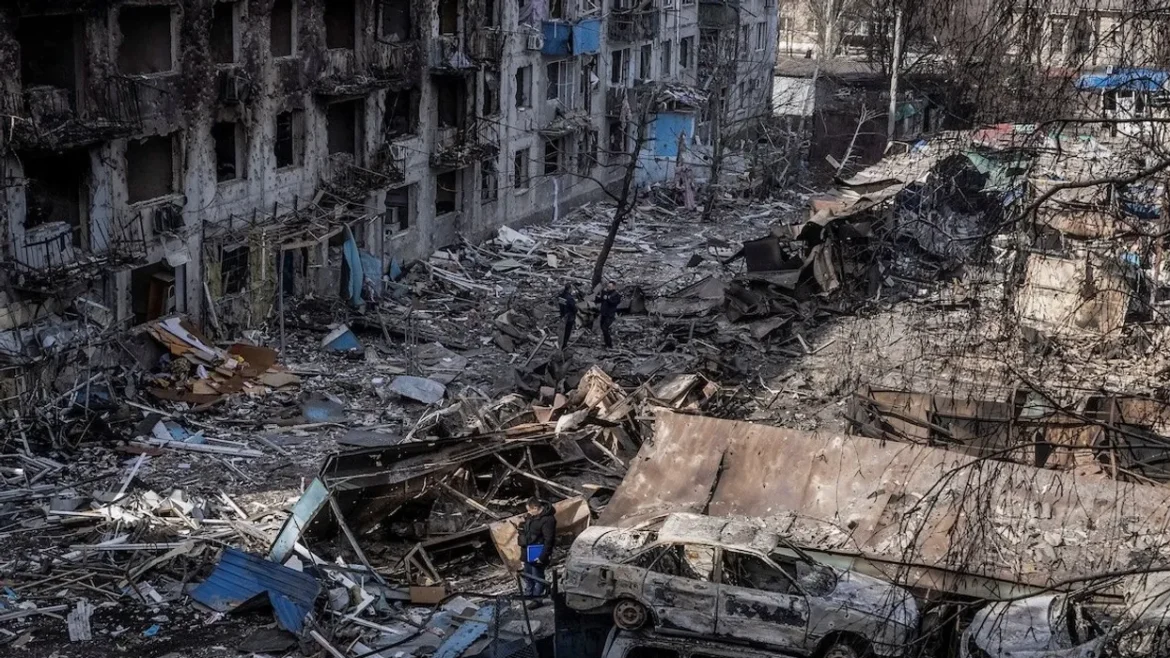
Former U.S. President Donald Trump has called on Russian President Vladimir Putin to halt military attacks on Kyiv following a wave of missile and drone strikes on the Ukrainian capital.

“Vladimir, STOP!” Trump wrote in a social media post on Thursday. “I am not happy with the Russian strikes on KYIV. Not necessary, and very bad timing.”

The Kremlin has not yet issued a response to the statement.

Trump’s comment came a day after he weighed in on peace efforts between Russia and Ukraine, referencing Ukrainian President Volodymyr Zelenskyy’s continued stance on Crimea. Trump stated that Ukraine’s position could impact ongoing peace negotiations and reiterated his view that Crimea had been lost years ago.
April 24, 2025 0 comments
0 FacebookTwitterPinterestThreadsBlueskyEmail
Africa & World

‘Swastika-shaped burns’: Ukrainian MP claims Russian soldiers raped and branded girls, shows gory image

by Leading Reporters April 4, 2022
written by Leading Reporters

Lesia Vasylenk, who is a Ukrainian Member of Parliament, alleged that Russian soldiers have raped girls and also branded them. According to Vasylenk, swastika-shaped burns were found on their bodies. 

Taking to her official Twitter handle on Monday (April 4), the Ukrainian MP stated that Russian soldiers raped girls as young as 10 years old. She also mentioned that crimes such as loot and killings were also committed. 

Labelling Russia as a “nation of immoral criminals”, Vasylenk alleged that the young girls were left with “vaginal and rectal tears”. She also claimed that women’s bodies with burns in the shape of a ‘swastika’, which is a hooked cross — similar to a sacred Hindu symbol. 

“Russian soldiers loot, rape and kill. 10 yrs old girls with vaginal and rectal tears. Women with swastika shaped burns. Russia. Russian Men did this. And Russian mothers raised them. A nation of immoral criminals,” she tweeted. 

Russian soldiers loot, rape and kill. 10 y.o. girls with vaginal and rectal tears. Women with swastika shaped burns. Russia. Russian Men did this. And Russian mothers raised them. A nation of immoral criminals

— Lesia Vasylenko (@lesiavasylenko) April 3, 2022

18300 Russian soldiers killed in #Ukraine. And I’m not sorry for any one of them. #WarDay #40

— Lesia Vasylenko (@lesiavasylenko) April 4, 2022
https://twitter.com/lesiavasylenko/status/1510736577592537092?ref_src=twsrc%5Etfw%7Ctwcamp%5Etweetembed%7Ctwterm%5E1510736577592537092%7Ctwgr%5E%7Ctwcon%5Es1_c10&ref_url=https%3A%2F%2Fwww.wionews.com%2Fworld%2Fswastika-shaped-burns-ukrainian-mp-claims-russian-soldiers-raped-and-branded-girls-shows-gory-image-468336

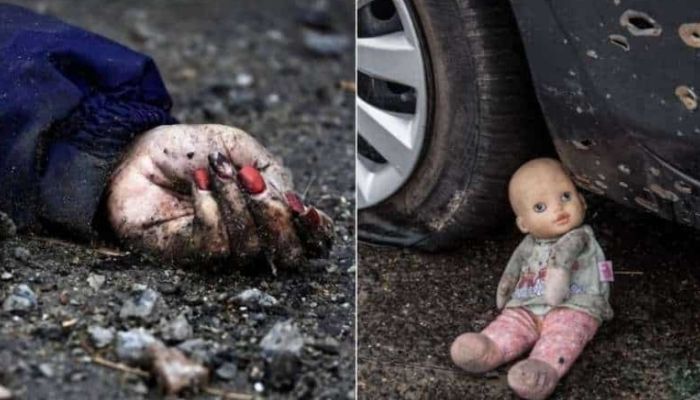
Russia has been levelled with fresh allegations of war crimes after mass graves were allegedly found in Bucha, a town outside Kyiv after Russian troops recently withdrew from that area. 

Reports have stated that Russian troops tortured, killed civilians and raped women. In response, the Kremlin on Monday (April 4) “categorically” rejected accusations. 

🇷🇺 came in 🇺🇦 with military bands and columns of the Rosguard. But they were followed by mobile crematories. Why do you need them if you don’t believe in resistance? Now we know – to hide war crimes. This is not a performer's mistake. This is a planned genocide. #BuchaMassacre pic.twitter.com/koRdQbtbX8

— Михайло Подоляк (@Podolyak_M) April 3, 2022

In the latest European Commission chief Ursula von der Leyen said the EU was ready to send a team of investigators to gather evidence of possible war crimes. 

“The EU is ready to reinforce this effort by sending investigation teams on the ground to support the Ukrainian Prosecution Services. Eurojust and Europol are ready to assist,” she said. 

April 4, 2022 0 comments
0 FacebookTwitterPinterestThreadsBlueskyEmail
Africa & World

Ukraine: what will end the war? Here’s what research says

by Leading Reporters March 15, 2022
written by Leading Reporters

In a matter of days, Russia’s invasion of Ukraine has escalated to one of the biggest military conflicts in Europe since the second world war. The fog of war can obscure our view of who is winning, who is losing, and how long all of this will last. While no one can provide definitive answers, academic research on war gives us some insights into how the conflict in Ukraine might unfold.

Research suggests that the path to war resembles a bargaining game, where countries compete over issues like territory and resources to patriotism or the style of governance. Rather than going to war, which is very costly, competing states prefer to settle these disagreements peacefully. Ideally, the two sides do this based upon their relative probabilities of winning a hypothetical war. Sometimes this is not possible and war occurs.

War is, usually, the result of one of three problems. First, states might not have enough information to assess their relative probabilities of success.

Second, the two sides might not trust that an agreement made today will be honoured tomorrow. Finally, countries might not be able to settle the contentious issue, especially when ethnic, religious or ideological tensions are involved.

According to this approach, wars will end when the problem that caused the war is resolved by fighting on the battlefield. How long the fighting will last and the form it takes depends on the extent and type of the problem.

In the case of Ukraine, it seems that the two sides did not have accurate information about their relative probabilities of success. Success in war is a product of two critical factors: the ability to fight and the willingness to suffer costs.

It was largely apparent that Russia’s army was and is far superior to Ukraine’s in terms of stockpiles of weapons and number of personnel. However, what was not apparent to Russia until the fighting began is that the Ukrainian people are far more willing to fight than they anticipated.

Russia now knows that they miscalculated the willingness of the Ukrainian people, but to what extent is still unknown. The problem is that it is difficult for Ukraine to demonstrate the extent of its willingness to bear costs, and Russia is likely to mistrust any attempts to communicate this, anticipating that Ukraine will overstate in order to obtain a more favourable agreement.

This suggests that the two sides will have difficulty ever resolving the information problem. When this happens, countries often end up fighting wars of attrition that last until one side gives up.

Wars require the tacit approval and support of those on the home front. Regardless of a country’s government style, a leader is still dependent upon the support of a group of people, or coalition, to stay in power. Vladimir Putin depends on oligarchs, the Russian mafia and the military for his survival. Although Putin attempted to build up a financial bulwark that would allow him to protect the interests of the oligarchs, the sanctions imposed by the west have undercut most of his efforts.

The war has already become very costly for the oligarchs and these costs will only increase with time. When a sufficient number of Putin’s coalition privately turn against the war, this will pressure Putin to end the war or risk his position of power. However, where this line is and if there are any viable alternatives that would better serve the interests of this coalition is questionable.

Costs of war

To a lesser extent, Putin is dependent on the support of the general population. The public is bearing the costs of war in the form of inflation, economic decline and battlefield deaths.

Putin has so far protected himself from these costs in three ways: First, he employs a selective system of conscription, which shields him from the full costs of battlefield deaths.

Second, he controls the state media apparatus and has censored other media organisations, limiting the information available to the general public. Third, since there are not free and fair elections, there is no way other than mass mobilisation and revolution for the Russian people to overthrow Putin.

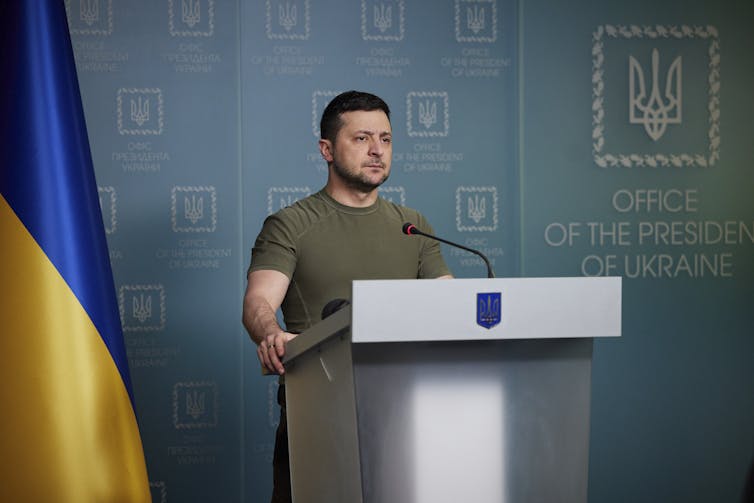
Volodymyr Zelensky in a military green t-shirt standing at a podium with an expression of resolve on his face
Putin underestimated the willingness of Volodymyr Zelensky and the Ukrainian military. Ukraine Presidential Press Service / EPA-EFE

The calculation for Ukraine is much more straightforward. Ukraine is a democratic country aggressively pursuing European integration. This means that the willingness of the general population to suffer in the face of high costs is of the utmost importance.

Without a critical mass of support, resistance to the Russian military will fall apart and Ukraine will lose the war. The fierce determination of the Ukrainian people up to this point suggests that this will not occur any time soon.

As Russian tactics become more aggressive, the Ukrainian people are paying ever higher costs. If we see the average Ukrainian’s willingness to suffer and fight lagging, it should give us cause for concern. To this end, western governments have stepped up humanitarian and defensive aid to Ukraine, in order to ensure that Ukrainian support for the war endures.

Ultimately, it appears that this war will not end quickly, as it will take a considerable amount of time for either side to make the other give up. Either the Russian military’s transition to indiscriminate bombing of civilian targets succeeds in eroding Ukrainian resistance, or battlefield casualties and domestic economic woes succeed in defeating Russia’s will to fight. Neither outcome is likely in the coming weeks and months, meaning people around the world are left to watch the horrors of war unfold, and wait.

March 15, 2022 0 comments
0 FacebookTwitterPinterestThreadsBlueskyEmail
Africa & World

A Russian offers $1 million bounty for Putin’s “Dead or alive”

by Leading Reporters March 4, 2022
written by Leading Reporters

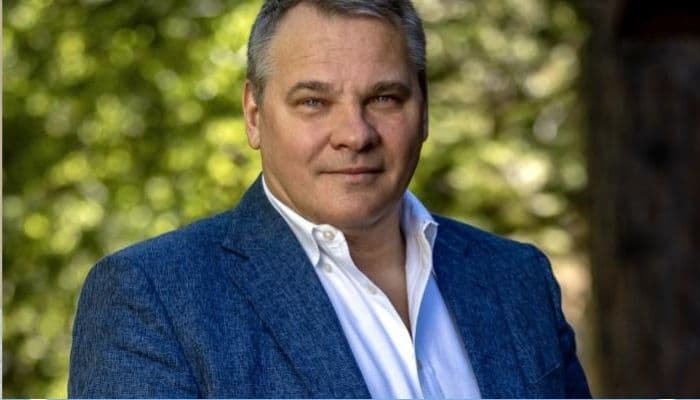
A Russian entrepreneur has put a $1 million bounty on Vladimir Putin, following the Russian president’s decision to invade Ukraine last week 

In a LinkedIn post that has since been taken down, entrepreneur Alex Konanykhim posted a photo of Putin and the words “Wanted: Dead or alive. Vladimir Putin for mass murder,” according to The Jerusalem Post. 

“I promise to pay $1,000,000 to the officer(s) who, complying with their constitutional duty, arrest(s) Putin as a war criminal under Russian and international laws,” wrote Konanykhin on LinkedIn, according to The Jerusalem Post. “Putin is not the Russian president, as he came to power as the result of a special operation of blowing up apartment buildings in Russia, then violated the [Russian] Constitution by eliminating free elections and murdering his opponents.”

Konanykhin is a former banker and the current CEO of TransparentBusiness, a software company based in San Francisco, California. 

“Some reports suggest that I promised to pay for the assassination of Putin,” Konanykhin wrote in an updated Facebook post on Wednesday. “It is NOT correct. While such an outcome would be cheered by millions of people around the world, I believe that Putin must be brought to justice.”

Konanykhim said he posted a similar message on Facebook, along with the “Wanted” photo, promising $1,000,000 to officers who arrested Putin as a war criminal, but it was banned by the social media platform. In a follow up post, he wrote his original message without the photo.

“I promise to pay $1,000,000 to the officer(s) who, complying with their constitutional duty, arrest(s) Putin as a war criminal under Russian and international laws,” Konanykhin wrote. 

Konanykhin did not directly respond to Fortune’s questions about the bounty on Putin, but did say that propaganda was negatively affecting the lives of Russian citizens. 

“I’m dismayed and outraged by the onslaught and war crimes Russia is committing in Ukraine. Putin cannot admit defeat or he risks to lose his power, which would almost certainly lead to his arrest. He has no legitimacy of an elected leader, as he eliminated free and fair elections, the news media and opposition a long time ago, so his power rests solely on fear he instills in his subordinates,” Konanykhin told Fortune. “He must be arrested before he makes an irreversible decision which may cost lives to many people.”

March 4, 2022 0 comments
0 FacebookTwitterPinterestThreadsBlueskyEmail
Africa & World

Europe war: Interpol decides on Russia’s membership

by Leading Reporters March 4, 2022
written by Leading Reporters
Several western countries demanded Russia’s suspension from the international police body

Interpol has rejected calls from several Western countries to suspend Russia from its ranks over the conflict in Ukraine, the world police organization said on Thursday. Canada, Poland, and the UK were among those demanding the move.

Just a few hours earlier, Canadian Prime Minister Justin Trudeau announced Ottawa had joined the chorus calling for Russia’s suspension, arguing that “international law enforcement cooperation depends on a collective commitment to the Universal Declaration of Human Rights and mutual respect between Interpol members.”

Canada, Poland, and the UK have all imposed a wide array of economic, political and other measures against Russia, accusing Moscow of aggression against Ukraine.

Russia sent troops into Ukraine last week, saying the government in Kiev was committing “genocide” in the Donbass region and needed to be demilitarized and “denazified.”

Interpol, which stands for the International Criminal Police Organization, has 195 member countries and maintains 19 police databases of crimes and criminals, including names and fingerprints, to facilitate international law enforcement cooperation. RT.com

March 4, 2022 0 comments
0 FacebookTwitterPinterestThreadsBlueskyEmail
Headlines

Ukraine: Group Seeks Collaboration With FG to Stem Social Media Misinformation

by Folarin Kehinde March 2, 2022
written by Folarin Kehinde

Mothers United and Mobilized (MUM) paid an inquiry visit to the Ministry of foreign Affairs to request first hand information about Government efforts to evacuate willing Nigerians from war torn Ukraine.

The concerned mothers also offer thier support to government to assist with the dissemination of information accurately and in a timely manner to stem the panic that is on social media presently.

The President and converner of the group, Boluwaji Onabolu disclosed this in Abuja on Wednesday

According to her, we have spoken with the ministry representatives and we believe that for any respond to be effective, it depends on accurate and timely information.

“We are very encouraged by the Federal government’s efforts especially to hear that the 1st 2 evacuation flights will leave today.  

We are concerned about news that our children are not being allowed to board the trains and urge that every effort is made to ensure that our children and all willing citizens return home safely she said .

Also speaking at the event, Co-convener, Sonye Alannah, said ,“I have a niece who is in Ukraine and she is very close to Polish border, when asked her to come back, she said no, because she’s very far from the capital and she is safe, unfortunately, she walked to Polish border, we hope she would be home by weekend”.

“For some people who are not ready to come back home, it is a question of faith and believes while some believed that it cannot happened but we will always pray for their safety”.

The Permanent Secretary, Ministry of Foreign affair, Ambassador Gabriel Aduda on his part said efforts are being made to evacuate Nigerians from the neighboring countries surrounding Ukraine,

“We can confirm that charter flights will depart on Wednesday,2, March, 2022 to pick up Nigerians evacuees back home .

He said the First batch of evacuees are expected to arrived on Nigeria on Thursday,3, March 2022 assured that they are working round the clock to see that Nigerians are brought back home safely”, he said.

March 2, 2022 0 comments
0 FacebookTwitterPinterestThreadsBlueskyEmail
Opinion

How the Ukraine Crisis Ends, By Henry Kissinger

by Folarin Kehinde March 1, 2022
written by Folarin Kehinde

Public discussion on Ukraine is all about confrontation. But do we know where we are going? In my life, I have seen four wars begun with great enthusiasm and public support, all of which we did not know how to end and from three of which we withdrew unilaterally. The test of policy is how it ends, not how it begins.

Far too often the Ukrainian issue is posed as a showdown: whether Ukraine joins the East or the West. But if Ukraine is to survive and thrive, it must not be either side’s outpost against the other – it should function as a bridge between them.

Russia must accept that to try to force Ukraine into a satellite status, and thereby move Russia’s borders again, would doom Moscow to repeat its history of self-fulfilling cycles of reciprocal pressures with Europe and the United States.

The West must understand that, to Russia, Ukraine can never be just a foreign country. Russian history began in what was called Kievan-Rus. The Russian religion spread from there. Ukraine has been part of Russia for centuries, and their histories were intertwined before then. Some of the most important battles for Russian freedom, starting with the Battle of Poltava in 1709, were fought on Ukrainian soil.

The Black Sea Fleet – Russia’s means of projecting power in the Mediterranean – is based by long-term lease in Sevastopol, in Crimea. Even such famed dissidents as Aleksandr Solzhenitsyn and Joseph Brodsky insisted that Ukraine was an integral part of Russian history and, indeed, of Russia.

The European Union must recognize that its bureaucratic dilatoriness and subordination of the strategic element to domestic politics in negotiating Ukraine’s relationship to Europe contributed to turning a negotiation into a crisis. Foreign policy is the art of establishing priorities.

The Ukrainians are the decisive element. They live in a country with a complex history and a polyglot composition. The Western part was incorporated into the Soviet Union in 1939, when Stalin and Hitler divided up the spoils. Crimea, 60 per cent of whose population is Russian, became part of Ukraine only in 1954 , when Nikita Khrushchev, a Ukrainian by birth, awarded it as part of the 300th-year celebration of a Russian agreement with the Cossacks. The West is largely Catholic; the East largely Russian Orthodox.

The West speaks Ukrainian; the East speaks mostly Russian. Any attempt by one wing of Ukraine to dominate the other – as has been the pattern – would lead eventually to civil war or breakup. To treat Ukraine as part of an East-West confrontation would scuttle for decades any prospect to bring Russia and the West – especially Russia and Europe – into a cooperative international system.

Ukraine has been independent for only 23 years; it had previously been under some kind of foreign rule since the 14th century. Not surprisingly, its leaders have not learned the art of compromise, even less of historical perspective.

The politics of post-independence Ukraine clearly demonstrates that the root of the problem lies in efforts by Ukrainian politicians to impose their will on recalcitrant parts of the country, first by one faction, then by the other. That is the essence of the conflict between Viktor Yanu­kovych and his principal political rival, Yulia Tymo­shenko. They represent the two wings of Ukraine and have not been willing to share power. A wise U.S. policy toward Ukraine would seek a way for the two parts of the country to cooperate with each other. We should seek reconciliation, not the domination of a faction.

Russia and the West, and least of all the various factions in Ukraine, have not acted on this principle. Each has made the situation worse. Russia would not be able to impose a military solution without isolating itself at a time when many of its borders are already precarious. For the West, the demonization of Vladimir Putin is not a policy; it is an alibi for the absence of one.

Putin should come to realize that, whatever his grievances, a policy of military impositions would produce another Cold War. For its part, the United States needs to avoid treating Russia as an aberrant to be patiently taught rules of conduct established by Washington. Putin is a serious strategist – on the premises of Russian history. Understanding U.S. values and psychology are not his strong suits. Nor has understanding Russian history and psychology been a strong point of U.S. policymakers.

Leaders of all sides should return to examining outcomes, not compete in posturing. Here is my notion of an outcome compatible with the values and security interests of all sides:

• Ukraine should have the right to choose freely its economic and political associations, including with Europe.

• Ukraine should not join NATO, a position I took seven years ago, when it last came up.

• Ukraine should be free to create any government compatible with the expressed will of its people. Wise Ukrainian leaders would then opt for a policy of reconciliation between the various parts of their country. Internationally, they should pursue a posture comparable to that of Finland. That nation leaves no doubt about its fierce independence and cooperates with the West in most fields but carefully avoids institutional hostility toward Russia.

It is incompatible with the rules of the existing world order for Russia to annex Crimea. But it should be possible to put Crimea’s relationship to Ukraine on a less fraught basis. To that end, Russia would recognize Ukraine’s sovereignty over Crimea. Ukraine should reinforce Crimea’s autonomy in elections held in the presence of international observers. The process would include removing any ambiguities about the status of the Black Sea Fleet at Sevastopol.

These are principles, not prescriptions. People familiar with the region will know that not all of them will be palatable to all parties. The test is not absolute satisfaction but balanced dissatisfaction. If some solution based on these or comparable elements is not achieved, the drift toward confrontation will accelerate. The time for that will come soon enough.

March 1, 2022 0 comments
0 FacebookTwitterPinterestThreadsBlueskyEmail
Africa & World

Trump Says Joe Biden’s Remarks Gave Russia the ‘assent’ on Ukraine

by Leading Reporters January 21, 2022
written by Leading Reporters

Donald Trump has accused President Joe Biden of giving Russia the “green light” to invade Ukraine.

Speaking to Fox News on Thursday, the former president criticized Biden’s remarks during a press conference about the buildup of Russian troops next to the border with Ukraine.

Biden suggested on Wednesday that a “minor incursion” ordered by President Vladimir Putin would result in a softer response from Washington than a full-scale invasion. The comments sparked alarm in Kyiv and were quickly walked back by the White House.

Trump told Fox host Sean Hannity: “Really what he said last night when he said, ‘They may go in, they will go in,’ and he talked about a minor incursion. I said, ‘I don’t believe he said that,’ because that’s like giving them, they use the term ‘green light.’ He was green-lighted.”

He added that the president of Ukraine, Volodymyr Zelensky, “could not believe what he heard. He couldn’t believe what he heard, and I couldn’t believe what — it’s whether you are for strong stoppage or not, you’re really telling them ‘You might as well go in.'”

Zelensky tweeted on Thursday that “there are no minor incursions.”

Biden later clarified his remarks, telling reporters that if any “assembled Russian units move across the Ukrainian border, that is an invasion.”

He added: “It will be met with [a] severe and coordinated economic response that I’ve discussed in detail with our allies as well as laid out very clearly for President Putin. But there is no doubt—let there be no doubt at all—that if Putin makes this choice, Russia will pay a heavy price.”

During the Fox News interview, Trump also suggested that Biden should be doing more to de-escalate tensions as the number of Russian troops massed at the border nears 130,000.

“You also can’t just talk in terms of sanctions. Sanctions don’t mean too much to Russia. If you want to stop somebody, you are not going to just be talking about sanctions,” Trump said.

“But he really told them ‘Go in.’ I think this is a whole different ball game right now.”

The former president added” “If you look at what’s going on with Russia and Ukraine, what they’ve done at the border, they’ve loaded up with soldiers—that would’ve never happened with me. I had a very good relationship with Putin.”

As fears mount over a potential invasion, an opposition politician from Ukraine has suggested how President Zelensky will respond in the event of conflict.

“I know for sure that those in power, who led the country to a situation with the threat of war, will definitely stand aside or the first convenient plane will leave its borders with their families,” Illia Kyva wrote on the encrypted messaging app Telegram.

On Friday, U.S. Secretary of State Antony Blinken is due to meet Russia’s Foreign Minister Sergey Lavrov in Geneva for talks on Ukraine.

January 21, 2022 0 comments
0 FacebookTwitterPinterestThreadsBlueskyEmail

Recent Posts

  • Tinubu Nominates Ex-CDS Christopher Musa As Defence Minister

    December 2, 2025
  • Poor Toilets Driving GBV, School Dropouts – Wateraid

    December 2, 2025
  • BREAKING: FG Publishes List of 15 Alleged Terrorist Financers in Nigeria [SEE LIST]

    December 1, 2025
  • FG Proposes 40% Salary Increase for ASUU Lecturers

    December 1, 2025
  • Northern Governors Host Emergency Meeting Over Escalating Security Concerns

    December 1, 2025

Usefull Links

  • Contact Page
  • About Leading Reporters
  • Contact Us
  • Headlines
  • Investigation
  • Exclusives
  • Opinion
  • Business
  • Facebook
  • Twitter
  • Instagram
  • Linkedin

@2021 - All Right Reserved. Designed and Developed by PenciDesign


Back To Top
Leading Reporters
  • Featured
  • Politics
  • Opinion
  • Business
  • Entertainment
  • Sports
  • About Us
  • Contact