Leading Reporters
  • Headlines
  • Health
  • Business
  • Exclusives
  • Investigation
  • Entertainment
  • Opinion
Tuesday, January 27, 2026
Hot
FCTA Workers, NLC Storm Industrial Court, Demand Wike...
DisCos reject FG’s free meter plan
Nigerian-born nurse loses licence in Australia for sleeping...
BREAKING: Kano Gov Abba Yusuf dumps NNPP
National Grid Collapse For First Time in 2026
BREAKING: Tinubu approves posting of Ambassadors to U.S.,...
Insecurity: Kidnappers demand 17 motorcycles for release of...
FG to Abolish Hnd-Degree Dichotomy, Allow Polytechnics to...
AFCON Initiative drives stronger Nigeria Morocco cooperation
Obasanjo: I’ll Never Stop Having Children
  • About Leading Reporters
  • Contact Us
Leading Reporters
Advertise With Us
  • Headlines
  • Health
  • Business
  • Exclusives
  • Investigation
  • Entertainment
  • Opinion
Hot
FCTA Workers, NLC Storm Industrial Court, Demand Wike...
DisCos reject FG’s free meter plan
Nigerian-born nurse loses licence in Australia for sleeping...
BREAKING: Kano Gov Abba Yusuf dumps NNPP
National Grid Collapse For First Time in 2026
BREAKING: Tinubu approves posting of Ambassadors to U.S.,...
Insecurity: Kidnappers demand 17 motorcycles for release of...
FG to Abolish Hnd-Degree Dichotomy, Allow Polytechnics to...
AFCON Initiative drives stronger Nigeria Morocco cooperation
Obasanjo: I’ll Never Stop Having Children
Leading Reporters
Leading Reporters
  • Headlines
  • Health
  • Business
  • Exclusives
  • Investigation
  • Entertainment
  • Opinion
Copyright 2024 - All Right Reserved
Home > NNPC
Tag:

NNPC

Opinion

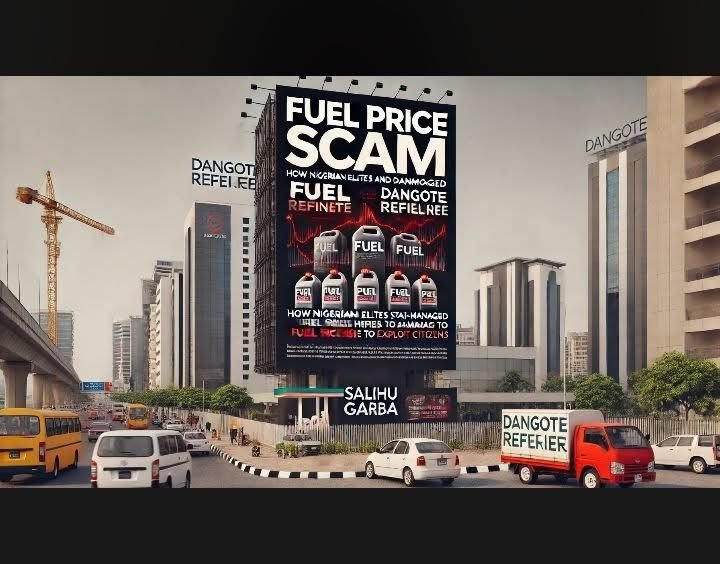
Fuel Price Scam: How Nigerian Elites and Dangote Refinery Stage-Managed Fuel Price Hikes to Exploit Citizens

by Folarin Kehinde March 4, 2025
written by Folarin Kehinde

By Salihu Garba-mama Aliyu (#SAGMA), Published on 3rd March 2025

Introduction: How This Article Evolved

This article is a continuation of my previous piece, “Fuel Price Scam: How Nigerian Elites Keep You Enslaved.” It expands upon the issues raised, incorporating feedback, counterarguments, and deeper research into the deceptive pricing mechanisms that have kept Nigerians struggling under the weight of artificially high fuel prices.

In that article, I exposed how Nigeria’s ruling elites, in collusion with foreign rent-seekers and the IMF/World Bank, have deceived Nigerians into believing that they must buy fuel at international rates, even though the crude oil is sourced from our own land. I also debunked the false argument that Nigeria cannot subsidize fuel for its citizens while exposing the hypocrisy of Western nations that heavily subsidize energy, education, and food for their own people.

This article takes the discussion further by examining how the Dangote Refinery—despite having the capacity to meet over 60% of Nigeria’s domestic petroleum needs—was complicit in an elaborate fuel price manipulation scheme that began with extreme inflation of fuel prices, followed by a gradual “reduction” to create the illusion of progress. In reality, Nigerians are still paying far more than they should.

The Dangote Refinery Fuel Price Scam: A Staged Manipulation

When the federal government removed fuel subsidies in May 2023, the official pump price of Premium Motor Spirit (PMS) shot up from ₦238.11 per liter to between ₦955 (Dangote Refinery price) and ₦1,200 (retail stations). This sudden price surge—without any meaningful increase in global crude oil prices—was part of a stage-managed scheme to exploit Nigerian citizens while shielding the government from scrutiny.

How the Deception Was Orchestrated

Phase 1: Artificial Price Inflation (May 2023 – Early 2024)

  • The elimination of fuel subsidies provided the perfect excuse to artificially inflate the price of petrol.
  • Despite the Dangote Refinery beginning production and having the capacity to refine crude at lower costs domestically, it sold PMS at exaggerated prices, aligning with the IMF/World Bank-fueled narrative that fuel should be priced at “market rates.”
  • The Nigerian National Petroleum Company Limited (NNPCL) and Dangote Refinery orchestrated a staged confrontation to divert public scrutiny from the sudden and unjustified fuel price hikes. However, in a telling contradiction, NNPCL was later granted exclusive rights to first offtake and sell Dangote’s refined products.

Why? A classic case of vested interests at play.

If NNPCL truly believed in a free market and price deregulation, why did it secure a monopoly over Dangote’s refined fuel? This blatant double standard exposes the deception behind the so-called “market-driven pricing” narrative. It was never about free-market principles—it was about control, profiteering, and ensuring that only a select few benefit at the expense of ordinary Nigerians.

Phase 2: Stage-Managed Price Reductions (Early 2024 – Present)

  • Once public frustration peaked, small reductions in fuel prices were introduced, creating the illusion that the market was “self-correcting.”
  • From a high of ₦955-₦1,200 per liter, the price was gradually lowered to ₦825 per liter, and further reductions may follow in a controlled manner.
  • This staged “reduction” is not a real price cut but a calculated deception designed to pacify Nigerians while keeping fuel prices far above the true cost of domestic refining.

Phase 3: Long-Term Price Fixing and Exploitation

  • By inflating prices to extreme levels initially, any later reductions appear “reasonable” in comparison, even though Nigerians are still paying much more than they should.
  • The same cartel that profited from the subsidy regime has now hijacked the so-called deregulated market to maintain artificial pricing structures that serve elite interests.

Why This Is a Fraudulent Scheme

  • If Dangote Refinery has the capacity to refine crude locally, why was fuel priced at over ₦955 per liter in the first place?
  • Why did NNPC and Dangote pretend to be at odds, only to later align in a staged price adjustment?
  • Why is the price of PMS in Nigeria still among the highest in Africa despite our crude oil reserves and refining capacity?

The answer is clear: The removal of fuel subsidies was never about free-market efficiency—it was about enriching a select few at the expense of ordinary Nigerians.

Rebutting the Lies: Why Must Nigerians Pay International Rates for Their Own Resources?

Imagine a local farmer in Nigeria who produces palm oil. The cost of palm oil in the international market can never be the same as the price of palm oil sold in local markets where palm oil kernels are abundantly available. Likewise, the price of Aso Oke (a traditional Yoruba fabric) in international fashion markets will never match the price of Aso Oke sold within Yoruba land.

Similarly, electric vehicles designed and manufactured in China cost significantly less in China than in African or American markets due to additional costs such as export duties, transportation, and foreign market regulations. Between domestic and export markets, there are substantial differences in overhead costs—processing, customs duties, and other levies. There are also profit margins factored into international pricing.

So why has the Nigerian government and its oil industry elites—acting in collusion with foreign rent-seekers—brainwashed Nigerians into believing that the country cannot sell its own backyard natural resources at prices cheaper than the international market rate (Reuters Platts)? Worse still, why have they convinced us that Nigeria cannot subsidize fuel to make life easier for its citizens? This grand deception has condemned Nigerians to suffering under artificial fuel scarcity and skyrocketing prices, while a small elite class, in alliance with neocolonialists, reaps the benefits.

In my previous article, “Fuel Price Scam: How Nigerian Elites Keep You Enslaved,” I exposed this fraudulent scheme and outlined the urgent reforms needed to bring down fuel costs and strengthen the naira. I also reaffirmed that subsidy on energy and food is an inalienable right of every citizen—not a privilege.

If Nigeria’s ruling class refuses to heed these patriotic calls for reform and insists on maintaining the status quo, then the 2027 elections will be an opportunity for Nigerians to correct this injustice by electing leaders who genuinely care about the common good.

The Facts Vs. Fallacies

The claim that Nigerians must buy fuel at international market prices is not only false but intellectually lazy and deceptive. The same Western countries that pressure Nigeria to remove fuel subsidies provide massive subsidies to their own citizens in key sectors such as energy, education, and agriculture.

I am a living witness to these subsidies. Having lived in the UK, I have seen firsthand how the British government subsidizes essential services viz-a-viz:

  • Education: While international students pay exorbitant fees for university education, UK citizens pay only a fraction of that amount—sometimes what an international student pays for one academic year covers the entire three-year program for a local student.
  • Food Subsidies: The same food items that elites in the UK can afford in grocery stores are also accessible to street cleaners and minimum-wage workers because the government ensures price stability through strategic interventions.
  • Health Care: The National Health Service (NHS) provides free or highly subsidized health care to all citizens, ensuring that even the poorest receive quality medical attention.
  • Energy Support: During economic downturns, European governments provide direct financial aid to citizens to help with energy bills, ensuring that everyone has access to affordable heating and electricity.

So, if these neocolonial powers aggressively subsidize key sectors for their own citizens, why should Nigeria—a country with abundant crude oil—fail to provide affordable fuel for its people? The answer is clear: Nigeria’s ruling elites are complicit in the economic enslavement of their own people.

The “High Refining Cost” Excuse: A Convenient Lie

One of the most common excuses given by the government and oil cartel is that the cost of refining crude oil is too high, making it impossible to sell fuel cheaply. This argument is nothing but a convenient lie used to justify fuel price hikes and the continued importation of refined petroleum products.

Here are the facts:

  1. Nigeria Has the Human and Material Resources to Build Local Refineries
  • The Ajaokuta Steel Company has the potential to manufacture components for building refineries. With the right investments, Nigeria can design and produce its own branded refining equipment.
  • Local engineers and technologists are fully capable of running refineries, provided there is political will and investment in skills development.
  1. Other Countries Have Lower Refining Costs—Why Can’t Nigeria Learn From Them?
  • Several developing nations with economies similar to Nigeria’s have far lower refining costs per barrel.
  • Instead of allowing IMF and World Bank dictates to cripple Nigeria’s energy sector, why not study and adopt cost-effective refining models from these countries?
  1. Artificially Inflated Costs Serve Elitist Interests
  • Many of the costs associated with refining in Nigeria are deliberately exaggerated to create loopholes for **fraudulent subsidies, inflated contracts, and fuel importation scams.
  • The government has failed to prioritize local refining, allowing a few elites and their foreign partners to profit from the importation of refined products at the expense of ordinary Nigerians.

The Hypocrisy of the Nigerian Elite

While Nigerians are told that subsidies are “unsustainable,” the same elites enjoy heavily subsidized luxuries at the expense of taxpayers:

  • Government officials receive free fuel allocations, yet they insist ordinary Nigerians should pay high prices.
  • Dangote’s refinery benefited from massive tax incentives and government-backed loans, yet it sells fuel at exorbitant prices.
  • Foreign interests who push for subsidy removal in Nigeria continue to subsidize fuel and essential goods in their own countries.

This is nothing but economic neocolonialism disguised as “reform.”

Breaking Free from IMF/World Bank Dictates: The Path to Economic Liberation

Nigeria’s continued economic struggles—high fuel prices, inflation, and worsening poverty—are not accidental. They are the direct result of policies imposed by external forces such as the IMF and World Bank, implemented by Nigerian leaders who act as their puppets.

To break free from this vicious cycle, Nigeria must adopt policies that prioritize national interests over foreign economic prescriptions.

How Do We Achieve This?

  1. End the Discretionary Pricing System in the Oil Sector
  • Nigeria’s petroleum sector must adopt an end-to-end AI-driven hydrocarbon trade and exchange system that eliminates manipulation and ensures real-time transparency in fuel pricing.
  • A centralized cloud based hydrocarbon price database must replace the foreign-controlled Reuters Platts system, ensuring that fuel prices reflect domestic production costs, not external market distortions.
  1. Revamp and Expand Local Refining Capacity
  • Why should Dangote Refinery be the only major private refiner? The government must invest in multiple refineries to prevent price-fixing by monopolies.
  • Existing public refineries must be rehabilitated and operated with full transparency to drive down costs.
  • The Ajaokuta Steel Company and other local industries should be revived to produce refinery components locally, reducing dependency on expensive foreign imports.
  1. Use the 2027 Elections to Elect Leaders Who Reject IMF/World Bank Enslavement
  • Nigerians must elect leaders who prioritize national interests over foreign economic dictates.
  • The current system benefits only a few elites at the expense of the masses. Citizens must demand economic justice at the ballot box in 2027.

Conclusion: The Scam Is Clear—Now It’s Time to Act

The Dangote Refinery fuel price manipulation, the collusion between the Nigerian government and foreign economic forces, and the artificial price hikes justified by false narratives are nothing but a grand conspiracy against the Nigerian people.

The time for economic liberation is now.

  • Expose and reject the lies of the fuel price cartel.
  • Demand transparency in the oil and gas sector.
  • Elect leaders in 2027 who will fight for Nigeria’s economic sovereignty.

Nigerians must wake up! The only thing standing between economic justice and continued exploitation is our collective will to fight back.
Fuel #fuelsubsidy #scam #Dangote #NNPC #nigeriadecides

March 4, 2025 0 comments
0 FacebookTwitterPinterestThreadsBlueskyEmail
Headlines

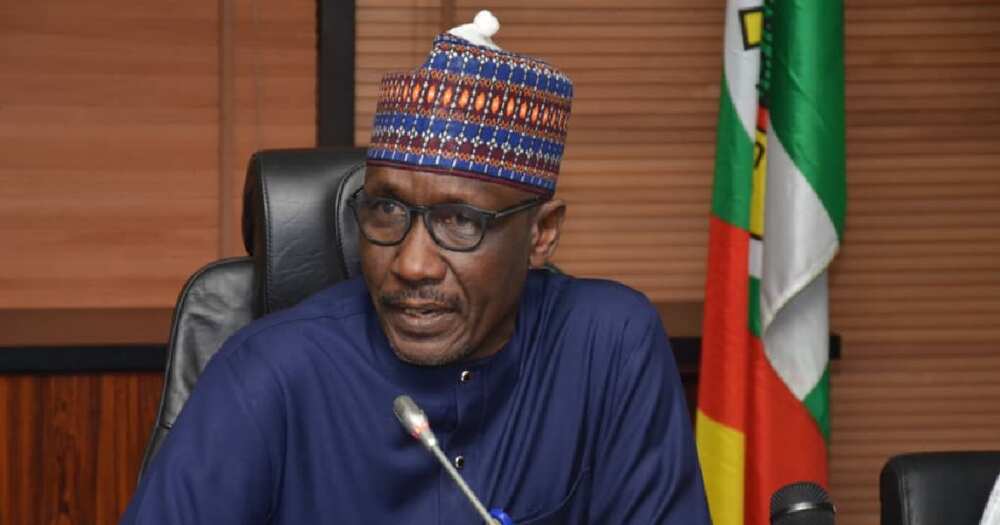
Pressure mounts on President Tinubu to retain Mele Kyari as NNPC boss

by Folarin Kehinde February 11, 2025
written by Folarin Kehinde

President Bola Tinubu is reportedly under pressure to retain Mele Kyari aa the Group Chief Executive Officer (GCEO) of the Nigerian National Petroleum Corporation (NNPC.

The president is said to be facing mounting pressure from civil society groups and stakeholders to retain Kyari, with some saying any change in the leadership of the NNPC could harm Nigeria’s oil sector.

At a press conference held at the Abuja Press Centre on Monday, February 10, Comrade Friday Maduka, Chairman of the Forum of Civil Society Organizations of Nigeria, warned against any attempt to remove Kyari.

His words: “Mele Kyari’s leadership at NNPC has been a beacon of hope and transformation in the oil sector.

“His vision, expertise, and dedication have yielded unprecedented results, including the renewed functioning of refineries, stabilization of oil prices, and a greater focus on sustainable economic integration and development.”

He reiterated that under Kyari’s leadership, the NNPC had experienced major reforms, including the company’s transition into a limited liability corporation, which significantly improved transparency and accountability.

Maduka expressed his concern over what he described as efforts driven by jealousy and envy, aimed at destabilizing the current leadership.

“In light of these achievements, it is puzzling that certain factors, driven by envy and jealousy, are seeking to undermine Mele Kyari’s leadership and the progress that has been made at NNPC.

“These underhand moves, campaigns, and shibboleths are not only a threat to the stability of the oil sector but also to the overall economic development of Nigeria,” Maduka stated.

Maduka emphasized the importance of allowing Kyari to complete his tenure, which began in 2023 and is scheduled to end in 2026 according to the extant laws governing the NNPC.

He argued that Kyari’s tenure is vital for the continued success of the corporation and the broader Nigerian economy.

“We strongly believe that he should be allowed to consummate his outstanding work, thereby enabling the NNPC to attain its full potential and reach unprecedented heights,” he added.

Maduka also referenced the legal framework that supports Kyari’s extended tenure, particularly the provisions of the Petroleum Industry Act (PIA), which allows for a tenure extension beyond 2026.

He urged all Nigerians and civil society organizations to support Kyari in ensuring the sector continues to thrive.

“It is expected that it should terminate in 2027 in compliance with Section 59 (2) of the Petroleum Industry Act 2021 which states that ‘The Composition of the Board of the NNPC Limited shall be determined in accordance with the Companies and Allied Matters Act and its Articles of Association’,” Maduka explained.

He also lauded Kyari’s efforts in reducing fuel prices and promoting alternative energy solutions, particularly gas, as part of Nigeria’s broader energy strategy.

He further called for greater unity and collaboration across all sectors to maintain the momentum of progress at NNPC.

“Mele Kyari’s tenure has adroitly modulated the transition from the hitherto unbearable PMS Price regime to the incremental progressive lowering of the Petrol pump price by importuning all stakeholders to the imperative for lower pump fuel prices for all Nigerians,” he concluded.

February 11, 2025 0 comments
0 FacebookTwitterPinterestThreadsBlueskyEmail
Mele Kyari to be sent packing November ending:  Sack letter Already with SGF:  Presidency Source LeadingReporters
Headlines

NNPC GCEO Kyari loses 25-year-old daughter, days after Tallen son’s death

by Folarin Kehinde October 11, 2024
written by Folarin Kehinde

Condolences has begin to pour in for the Group Chief Executive Officer of the Nigerian National Petroleum Company Limited (NNPCL), Mele Kyari, over the passing of his 25-year-old daughter, Fatima Kyari.

This incidence is coming barely ten days after former Minister of Women Affairs, Pauline Tallen lost his son, Richard Tallen after a brief illness.

Meanwhile, Vice President Kashim Shettima has extended his heartfelt condolences to Kyari, Shettima, who attended the funeral prayers at the Annur Mosque in Abuja, prayed for the peaceful repose of Fatima’s soul and asked God to grant the Kyari family the strength to bear the loss of their beloved daughter, who was taken too soon.

October 11, 2024 0 comments
0 FacebookTwitterPinterestThreadsBlueskyEmail
Headlines

Petrol Price Hits N1,200/Litre as Independent Marketers Follow After NNPC

by Folarin Kehinde October 9, 2024
written by Folarin Kehinde

The price of Premium Motor Spirit (PMS) popularly known as petrol has risen across the country as independent oil marketers, which account for the majority of retail outlets have adjusted the pump price of petrol to about N1,200 per liter.

This development follows the Nigerian National Petroleum Company Ltd’s (NNPC) decision to end its exclusive purchase agreement with Dangote Refinery and Petrochemical Company.

The price adjustment, which took effect on Wednesday, reflects the cost at which marketers purchased the product from Dangote Refinery.

It should be noted that the national oil company had previously bore the cost of subsidizing the product to the target users.

A survey of filling stations across the FCT revealed that many have adjusted their pump prices to align with the new market reality.

The deregulation of the downstream sector allows marketers to buy petrol directly from Dangote Refinery, effectively ending NNPC’s monopoly.

Although in the short term the price of the product is expected to be high, Wwth marketers now negotiating prices directly with Dangote Refinery, industry experts predict increased competition and potentially stabilized prices in the long run.

October 9, 2024 0 comments
0 FacebookTwitterPinterestThreadsBlueskyEmail
Headlines

BREAKING: NNPC increases petrol price, sell at N1,030 per litre

by Folarin Kehinde October 9, 2024
written by Folarin Kehinde

The price of petrol at Nigerian National Petroleum Company Limited (NNPC Ltd) outlets in Abuja increased to N1,030 per litre on Wednesday.

The development follows the termination of NNPC’s exclusive purchase agreement with Dangote Refinery.

Earlier reports indicated that NNPC Ltd would no longer be the sole buyer of petrol from Dangote Refinery.

This opens the market for other marketers to purchase directly from the refinery, allowing for a “willing buyer, willing seller” pricing model.

This adjustment aligns with the full deregulation practices currently in place for petroleum products in Nigeria.

Premium Times observed the price adjustment at several NNPC outlets across Abuja, including those in the Central area, where a customer, Glory Okoye, expressed disbelief: “This is funny; I just noticed that the pump price has changed from N897 to N1,030.”

Similar price hikes were reported in Wuse and Lugbe, leaving motorists and commuters frustrated.

In Akute, Ogun State, long queues formed at NNPC stations, which had abruptly shut down, citing technical issues.

An attendant explained the halt in service was due to waiting on a directive regarding the new prices.

This price jump follows NNPC’s September claim of purchasing petrol from Dangote Refinery at N898.78 per litre and selling to marketers at N765.99 per litre—bearing a subsidy of N133 per litre.

However, NNPC has stated that the arrangement is no longer sustainable, leading to the current price hikes as the market adjusts to new dynamics.

October 9, 2024 0 comments
0 FacebookTwitterPinterestThreadsBlueskyEmail
Nigeria's NNPC spent $10 billion on fuel subsidy in 2022 paid to WHO Leading reporters
Headlines

BREAKING: NNPC quits as middleman in purchase of Dangote Refinery petrol

by Folarin Kehinde October 7, 2024
written by Folarin Kehinde

The Nigerian National Petroleum Company Limited (NNPC) is ending its exclusive purchase agreement with Dangote Refinery, opening up the market for other marketers to buy petrol directly from the refinery.

This means NNPC will no longer be the sole off-taker, and marketers can now negotiate prices directly with Dangote Refinery.

This development aligns with the current practices for fully deregulated products, where refineries can sell directly to marketers on a willing buyer, willing seller basis.

Earlier in September, Devakumar Edwin, vice president at Dangote Industries Limited, said the 650,000 barrels per day Dangote Refinery has begun the processing of petrol.

But the NNPC, in reaction to a statement that the Dangote Refinery Limited is being undermined by actions of the company at the time, said it was not the sole offtaker of all products from the Dangote Refinery. It said the refinery was free to sell its petrol to any marketer.

The NNPC explained that the Dangote Refinery and any other domestic refinery were free to sell directly to any marketer on a willing buyer, willing seller basis, which is the current practice for all fully deregulated products such as diesel, aviation fuel and kerosene.

But on 15 September, the NNPC began loading petrol from the Dangote Refinery.

Although some major petroleum marketers were later reportedly approved to lift the product from the refinery under an agreement with NNPC Ltd, independent marketers remained excluded.

On 26 September, the House of Representatives called on the federal government to mandate the NNPC Ltd and Dangote Refinery to allow independent marketers to lift petrol directly from the refinery.

The lower chamber also urged the management of Dangote Refinery to build, acquire, or partner to establish tank farms or depots across the geo-political zones of the country, to ease access to petroleum products for the public.

This call followed a motion of urgent public importance moved on Thursday by Oboku Oforji (PDP, Bayelsa).

Moving the motion, Mr Oforji explained that the exclusion of independent marketers threatened competition in the sector.

He noted that competition is essential for reducing costs, adding that some marketers may resort to importing products to survive in the market.

“NNPCL and the major marketers being the exclusive off-takers spells monopoly, which is tantamount to greed. This is the same NNPC Ltd that has failed to manage our crude and refineries for decades,” the lawmaker said at the time.

Those familiar with the matter told PREMIUM TIMES that NNPC is now set to withdraw as the sole off-taker to allow other marketers to directly purchase petrol from Dangote Refinery at the prevailing market price, promoting competition and potentially stabilising supply chains.

Femi Soneye, the spokesperson for the NNPC is not immediately available to comment for this story but a top official of the company confirmed the development to PREMIUM TIMES Monday morning.

“Yes, it is true,” the official said. “We can no longer continue to bear that burden.”

The NNPC had claimed in September that it was buying petrol from Dangote Refiner at N898.78 per litre and selling to marketers at N765.99 per litre, shouldering a subsidy of almost N133 per litre.

The NNPC lifted about 103 million litres of petrol from Dangote Refinery between September 15 and 30. The refinery was able to load 2,207 of 3,621 trucks sent to it within the period under review.

The vehicles carried just 102,973,025 litres of the planned 400,000,000 litres of petrol earmarked to be lifted from the refinery at 25 million litres per day. That translated to just 26 per cent performance, records seen by PREMIUM TIMES show.

October 7, 2024 0 comments
0 FacebookTwitterPinterestThreadsBlueskyEmail
Headlines

Rain, lightning, thunderstorms caused petrol scarcity: NNPC

by Folarin Kehinde August 21, 2024
written by Folarin Kehinde

The Nigerian National Petroleum Corporation Ltd. has blamed the fuel scarcity that has led to long queues in filling stations nationwide due to recent rains, lightning, and thunderstorm.

NNPCL’s vice-president (downstream), Dapo Segun, disclosed this at a press conference at the NNPC towers in Abuja.

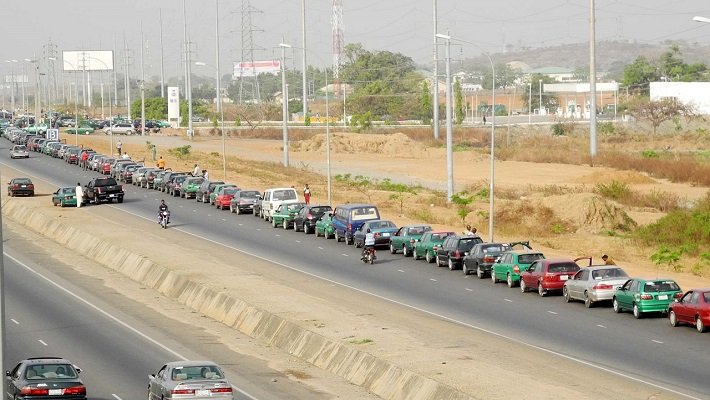
Fuel queues have resurfaced in filling stations across the country, with car owners spending long hours in queues and black markets having a field day with fuel now being sold for as much as over N1,000.

Apologising to Nigerians for the queues springing up across the country and noting that the NNPC will not like to make excuses, Mr Segun, on Tuesday, said the recent weather conditions hampering the sufficient distribution of fuel across the country is beyond the control of the corporation, but assured that all will be done to manage the situation.

“We’ll like to apologise to Nigerians for the queues we’ve been seeing springing up. A number of the causes are outside of our control but we’ll do our best to manage. We do not like to make excuses,” Mr Segun stated. “For example, since the rains began, the Estragos channel has been difficult to navigate through. We have vessel after vessel going around there because of siltation, and that has really hindered our ability to bring petroleum products, particularly PMS, up country.”

The NNPCL executive added, “We also understand that with the rains also, situations where to discharge petroleum products where there is lightning, thunderstorms, you have to suspend, not just the discharge of petroleum products onshore but also, the evacuation from the tankers. We’ve had situations that have occurred in recent times.

“We’ve also had issues with the road network. That also gives challenges in bringing these products upcountry. The tightness you see in Lagos currently was due to a very short supply gap, which has since been redressed. Vessels are in Lagos now, offloading and discharging as I speak. So, that is definitely short-lived.”

Mr Segun vowed that despite the number of factors creating the nightmarish situations, no stone will be left unturned in ensuring that petroleum products get to all nooks and crannies in the country.

August 21, 2024 0 comments
0 FacebookTwitterPinterestThreadsBlueskyEmail
Tinubu to go after Mele Kyari for refusal to remit Trillions of Naira despite several letters from RMAFC Leading Reporters
ExclusivesHeadlines

Tinubu to go after Mele Kyari for refusal to remit Trillions of Naira despite several letters from RMAFC

by Leading Reporters June 19, 2023
written by Leading Reporters

Mele Kolo Kyari is one public office holder that felt larger than life under President Muhammadu Buhari’s administration in his official capacity as the former Group Managing Director GMD of the government-owned Nigerian National Petroleum Corporation NNPC, now NNPC LTD. Despite receiving seven letters from the Revenue Mobilization Allocation and Fiscal Commission, directing him to remit trillions of unremitted government fund, Kyari refused to render account of his stewardship. He never honored any of the invitations by RMAFC nor replied to any of the agency’s letter to him.

But the tides have changed and this time, they are hauling against Mele Kyari.  A reliable source in the Presidential Villa has hinted that Mele Kyari refusal to remit hundreds of millions of Naira into consolidated Account, despite repeated appeal by the leadership of the Revenue Mobilization Allocation and Fiscal Commission to remit the money into Federation Account will land him in troubled waters any moment from now.

The discreet source told LeadingReporters that President Tinubu on enquiry, after being sworn in as President, found out that the leadership of NNPC under Kyari was enmeshed in perennial mess, untamed corruption, outrageous abuse of office, violation of Code of Conduct Acts as well as reckless diversion of Government funds under different guises.  It was learnt that the President found out despite several letters of invitation extended to Mele Kyari by the leadership of the Revenue Mobilization Allocation and Fiscal Commission to remit an undisclosed sum running into trillions of Naira, Kyari refused to appear before the commission.

“I can confirm to you that a total of seven letters were written by the Revenue Mobilization Allocation and Fiscal Commission to Mele Kyari to remit government’s money into the consolidated account.  An order he did not even violate but refuse to honour.  He did not even reply to any of the seven letters written to him. That was the height of impunity under Kyari as the GMD of NNPC”

The source hinted that Emiefele’s case may be a child’s play compared with the rot that have been uncovered in NNPC under Kyari.  It was further learnt that the President has vowed to do all he needs to do to ensure that those who bled the treasury will not go unpunished even if it means stepping on powerful toes.

“You know President Tinubu is a die-hard person who will go all out and achieve what he wants to achieve.  This is one of such times and moments that the President would not mind getting all the logs that have hindered smooth inflow of revenue off the way.  It will entail pushing the logs off the way and bringing to book those who have perennially placed the log on the way.  Kyari days of impunity is over”.  The source assured.

June 19, 2023 0 comments
0 FacebookTwitterPinterestThreadsBlueskyEmail
Headlines

Mr. President Nice Job On NNPC Limited Now NNPC PLC

by Folarin Kehinde July 21, 2022
written by Folarin Kehinde

By Ndubuisi Ekekwe, PhD, Chairman of FASMICRO Group, is the Lead Faculty in Tekedia Mini-MBA. He writes regularly in the Harvard Business Review. Email: tekedia@fasmicro.com.

Let me commend President Buhari for getting the job done on NNPC. Yes, Nigerian National Petroleum Corporation (NNPC) is now a commercial venture – a limited liability company, limited by shares – and not just an amorphous gigantic conglomerate. Welcome NNPC Limited.

Yet, there is really nothing to write since changing name, corporate formation, etc, will not change some of the underperforming elements. We still have to improve productivity and deepen innovation in the nation’s top foreign exchange earner.  

Those changes must be done for us to unlock the latent opportunities within that company.

I did three internships in NNPC and enjoyed the benefits of learning under some of the finest engineers in our nation. The first time I touched a computer was in NNPC – NGC, Moscow Rd in PHC – and the first time I changed an instrumentation and control knob was in Owasa Gas flow station.

As I wrote in 2017 when I posited that Nigeria should go all the way with NNPC Plc, I want Mr. President to take this to the Nigerian Stock Exchange. Of course, I did note the challenges that would bring, but we have to go all the way: “Nigerian can get a valuation of $300 billion for NNPC Plc”.

Meanwhile, a comment from a individual stated:

“Hope this change in nomenclature will have any positive impact on the common man? We will allow them to work first, before congratulating them.

We changed NEPA to PHCN, it didn’t click, and we unbundled to DISCOs and GENCOs and the one in between, they are largely private but our energy fortunes are yet to improve.

What will turning NNPC into a liability company bring to ordinary Nigerians, or just adding extra zeroes to the pockets of those who can buy and sell shares? There is still great silence on the productivity front, until then.”

July 21, 2022 0 comments
0 FacebookTwitterPinterestThreadsBlueskyEmail
Headlines

NNPC Increase Fuel Price Between 179 and 190 Naira per Litre

by Folarin Kehinde July 19, 2022
written by Folarin Kehinde

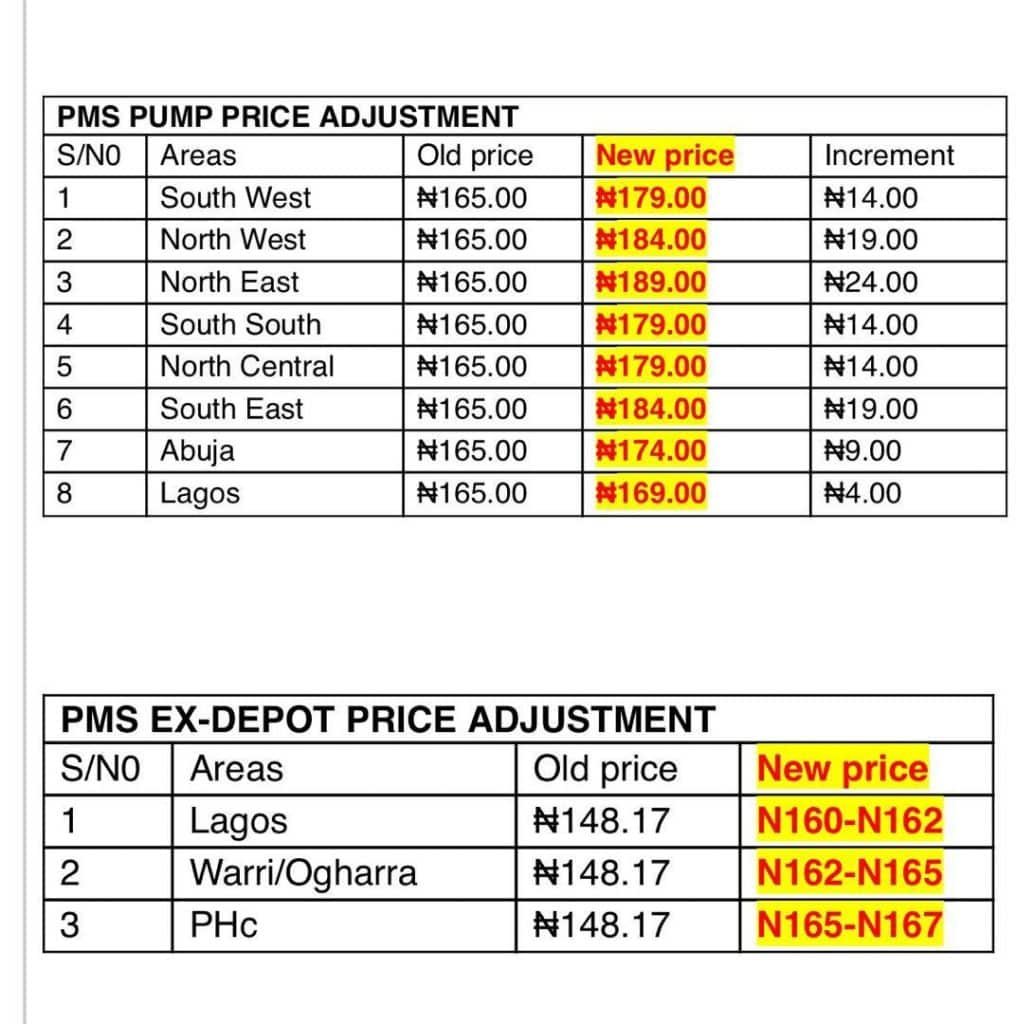
Hours after the unveiling of NNPC Limited, the Nigerian National Petroleum Corporation (NNPC) Limited has approved an increase in the pump price of Premium Motor Spirit (PMS) from N165 per litre to N179 per litre, effective today (Tuesday).

NNPC in a notice to fuel marketers directed them to change the petrol price on pumps to the new price effective today. This was even as the company equally increased the ex-depot price from N148.17 to N167 per litre.

This was even as the company equally increased the ex- depot price from N148.17 to N167 per litre.

This development came after weeks of petrol scarcity resurfaced across the country as fuel retailers were adopting different price bands to force unofficial deregulation attempts.

The new price increase differs by region. While States like Lagos had their price increased to N169, regions like the North East had theirs increased to as high as N189/Litre

A break down of the PMS pump price adjustment for the various regions is detailed below

July 19, 2022 0 comments
0 FacebookTwitterPinterestThreadsBlueskyEmail
Newer Posts
Older Posts

Recent Posts

  • FCTA Workers, NLC Storm Industrial Court, Demand Wike Sack

    January 26, 2026
  • DisCos reject FG’s free meter plan

    January 26, 2026
  • Nigerian-born nurse loses licence in Australia for sleeping on duty

    January 24, 2026
  • AI may outsmart humanity in five years — Musk

    January 24, 2026
  • BREAKING: Kano Gov Abba Yusuf dumps NNPP

    January 23, 2026

Usefull Links

  • Contact Page
  • About Leading Reporters
  • Contact Us
  • Headlines
  • Investigation
  • Exclusives
  • Opinion
  • Business
  • Facebook
  • Twitter
  • Instagram
  • Linkedin

@2021 - All Right Reserved. Designed and Developed by PenciDesign


Back To Top
Leading Reporters
  • Featured
  • Politics
  • Opinion
  • Business
  • Entertainment
  • Sports
  • About Us
  • Contact