Leading Reporters
  • Headlines
  • Health
  • Business
  • Exclusives
  • Investigation
  • Entertainment
  • Opinion
Tuesday, December 2, 2025
Hot
Tinubu Nominates Ex-CDS Christopher Musa As Defence Minister
BREAKING: FG Publishes List of 15 Alleged Terrorist...
FG Proposes 40% Salary Increase for ASUU Lecturers
Northern Governors Host Emergency Meeting Over Escalating Security...
Tinubu appoints ex-INEC Chair Yakubu, Fani-Kayode, Reno Omokri,...
Niger Delta Boss Jennifer Adighije Accused of Corruption,...
India Orders $570 Million Payout in Major Fraud...
Dangote Refinery Saves Nigeria over ₦10bn Annually in...
Bandits Abduct 16-year-old boy, six girls in FCT...
Social Security: A Missing Link in Nigeria’s Search...
  • About Leading Reporters
  • Contact Us
Leading Reporters
Advertise With Us
  • Headlines
  • Health
  • Business
  • Exclusives
  • Investigation
  • Entertainment
  • Opinion
Hot
Tinubu Nominates Ex-CDS Christopher Musa As Defence Minister
BREAKING: FG Publishes List of 15 Alleged Terrorist...
FG Proposes 40% Salary Increase for ASUU Lecturers
Northern Governors Host Emergency Meeting Over Escalating Security...
Tinubu appoints ex-INEC Chair Yakubu, Fani-Kayode, Reno Omokri,...
Niger Delta Boss Jennifer Adighije Accused of Corruption,...
India Orders $570 Million Payout in Major Fraud...
Dangote Refinery Saves Nigeria over ₦10bn Annually in...
Bandits Abduct 16-year-old boy, six girls in FCT...
Social Security: A Missing Link in Nigeria’s Search...
Leading Reporters
Leading Reporters
  • Headlines
  • Health
  • Business
  • Exclusives
  • Investigation
  • Entertainment
  • Opinion
Copyright 2024 - All Right Reserved
Home > Military
Tag:

Military

wike
Headlines

Wike: I have respect for the military, but ….

by Folarin Kehinde November 13, 2025
written by Folarin Kehinde

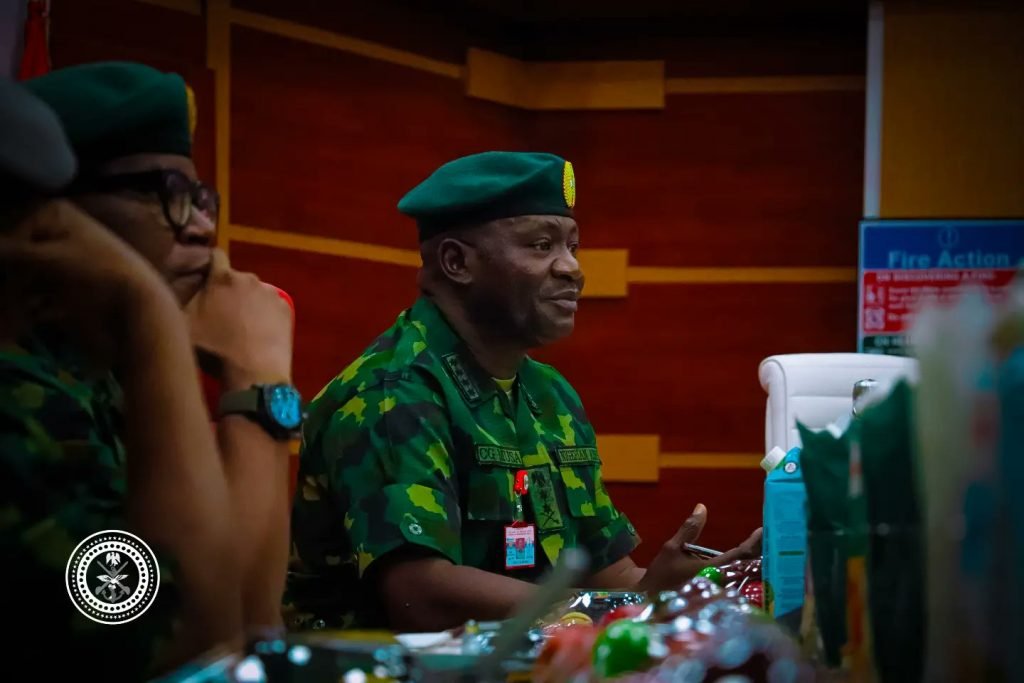
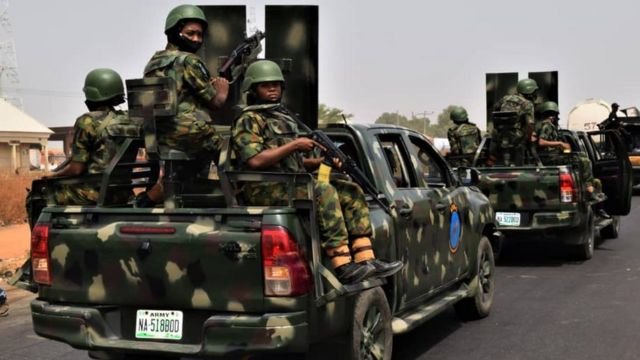
Minister of the Federal Capital Territory (FCT), Nyesom Wike, on Thursday, dismissed insinuations of using a disputed land issue in Abuja to fight the Nigerian military, saying he has always supported the armed forces.

Speaking with journalists on the clash involving his officials and some military personnel, Wike urged Nigerians to learn to obey the laws.

He said the government will not tolerate any attempt to violate land use regulations or obstruct government officials performing their lawful duties.

The Minister said his actions were strictly guided by law, not sentiment or emotion.

“You are told to obey legal orders, not orders that are illegal. So, if because you are a security aide, you think your superior ordered you to shoot at someone, you think you will not be charged for murder, because your superior gave you the order?” he asked.

“People have problems. We have tried to resolve them, but don’t use intimidation, don’t try to weaken government. You cannot weaken government. Because when we allow this now, others will follow suit. And then they will say, ‘When it happened to this and that, what did you do?’

So, gentlemen, I have respect for the military. I will continue to respect them. So, anybody trying to bring collision there, to say, ‘Oh, he is having a problem with the military,’ it is not correct. I don’t have a problem with the military and I will not have a problem.

“If we are having a problem with the military, I know where to run to. If I don’t go to the Chief of Defence Staff, I will go to the Chief of Army Staff, or the Chief of Naval Staff, or Air Force, or the Chief of Defence Intelligence, I will go to the President.

“But in this case, it has to do with a private individual. So how many people would I run to? If you have a problem with us, should I run to the President? Who does that? So, all I will be telling the President every day, ‘This individual is having a problem with us, this individual is having a problem.’ So I don’t have a problem with the military,” he said.

Wike, however, said the issue was blown out of proportion by those bent on portraying him as being at loggerheads with the military.
November 13, 2025 0 comments
0 FacebookTwitterPinterestThreadsBlueskyEmail
Headlines

Military to release 381 ex-terrorists, urges states to be vigilant

by Folarin Kehinde February 19, 2025
written by Folarin Kehinde

The military has announced plans to release 381 rehabilitated ex-terrorists in March 2025, urging state governments to ensure their proper reintegration through monitoring and empowerment programmes.

Speaking at a stakeholders’ meeting in Abuja on Tuesday, the Chief of Defence Staff, Gen. Christopher Musa, said a total 789 ex-combatants are undergoing rehabilitation, with 381 expected to graduate in 2025.

Represented by the Chief of Defence Policy and Plans, Air Vice Marshal Shayi Olatunde, Musa stressed the need for proper reintegration of the repentant terrorists to sustain the gains made by Operation Safe Corridor.

Represented by the Chief of Defence Policy and Plans, Air Vice Marshal Shayi Olatunde, Musa stressed the need for proper reintegration of the repentant terrorists to sustain the gains made by Operation Safe Corridor.

He urged the state governments to play an active role in the transition process by deploying security measures to track and monitor reintegrated individuals.

Musa said, “I, therefore, say that conforming law with localities ensures the proper integration of the first of two parties, consisting of 381 clients.

“It is also important to mention that upon graduation from this scheme, each client will be provided with some personal items as well as start-up pacts based on the three acquired, including their families

“ This is to enable them to set up small businesses and start a new life. Accordingly, I urge benefiting state governments to facilitate the seamless re-integration of the ex-combatants by providing additional support to ease the transitional process. We are very optimistic that working closely with local and traditional authorities, the state can deploy security apparatus at their disposal to effectively track and monitor the progress of the re-integrated ex-combatants.”

The Coordinator of Operation Safe Corridor, Brig. Gen. Y. Ali, said the programme has reintegrated no fewer than 2,190 repentant terrorists since its inception in 2016.

He added that the number included 27 foreign nationals who have been repatriated to their respective countries.

Ali disclosed that between July and November 2024, 825 new clients—including 14 foreigners from Burkina Faso, Cameroon, Chad, and Niger—were transferred to the De-radicalisation, Rehabilitation, and Reintegration camp for training.

Ali added that 22 clients requiring further psychological evaluation were transferred to the Federal Neuro-Psychiatric Hospital, Maiduguri.

He said, “Since the commencement of the programme in 2016, OPSC has successfully processed 2,190 clients comprising 2,163 Nigerians and 27 foreign nationals from Cameroon, Chad and Niger. All the foreign clients were transferred to their respective national authorities for reintegration.

“Between July and November 2024, a total of 825 clients were transferred to the DRR Camp to commence training. Amongst them are 14 foreigners from Burkina Faso, Cameroon, Chad and Niger. It is also important to mention that 22 clients were subsequently transferred to the Federal Neuropsychiatric Hospital, Maiduguri for further evaluation and management.

February 19, 2025 0 comments
0 FacebookTwitterPinterestThreadsBlueskyEmail
Troops
Headlines

BREAKING: Military bans drone operation in the North East

by Folarin Kehinde January 15, 2025
written by Folarin Kehinde

Operations Hadin Kai, the Joint Task Force of the military in the North East has banned the use of unmanned aerial vehicle (UAV), popularly known as drones in the region.

Air Component Commander, Air Commodore UU.Idris, who gave the directive in a signal sighted by Daily Trust said the use of drones without permission amidst poses threats in the Borno, Yobe and Adamawa,(BAY) states.

He decried that governments agencies and private individuals operates the drones without consent of the Air Component of Operation Hadin Kai.

The statement, “The proliferation of drones for domestic and commercial purposes has led to serious security concerns. These concerns mainly stem from their possible use by non-state actors and criminal elements for subversive and offensive activities.

“More disturbing is that government agencies and private individuals operate these drones without due regard to the extant regulations on their operations.

” Also, the non-state actors have perfected the use of drones against military targets and Critical National Infrastructure (CNI) as witnessed in other climes. Recently, there have been reports of drone sightings and unauthorized drone operations in the Theatre. On 7January 2025 for instance, a passenger onboard an NGO flight from Maiduguri to Monguno was intercepted with a drone during a search at the helipad.

“The drone was confiscated, and an investigation is ongoing. These incidents among others revealed trends by individuals to operate drones without due course to safety and security with detrimental consequences.

“The Air Component OPERATION HADIN KAI (AC OPHK) is saddled with the responsibility of monitoring and regulating aerial platform operations including aircraft and drones in the North East Theatre. This is aimed at deconfiicting the airspace to ensure safety and security for all operators in Borno, Yobe and Adamawa airspace. Considering this, it is pertinent to reiterate the ban on drone operations in the North East Theatre as directed by the Appropriate Superior Authority.

January 15, 2025 0 comments
0 FacebookTwitterPinterestThreadsBlueskyEmail
Headlines

Tinubu bans homosexuality in military

by Folarin Kehinde January 12, 2025
written by Folarin Kehinde

Nigeria’s military personnel are now expressly prohibited from engaging in homosexuality, lesbianism, bestiality, cross-dressing, and other acts deemed contrary to the ethics of the armed forces.

The personnel are equally barred from body piercing, tattooing, disorderly behaviour, and drunkenness on or off duty.

This directive is contained in Section 26 of the revised Harmonised Armed Forces Terms and Conditions of Service signed by President Bola Tinubu on December 16, 2024.

A copy of the document obtained by our correspondent on Saturday partly read, “An officer must not engage in homosexuality, lesbianism, and bestiality.

“He/she is not to belong to, or engage in activities of the Lesbian, Gay, Bisexual, Transgender or Trans, Queer or Questioning, Intersex, Asexual or Agender, Two-Spirit (LGBTQIA2S+) group and cross-dressing, amongst others.

“An officer must not engage in body piercing and tattooing of any part of his body. An officer shall not engage in any form of disorderly behaviour, brawl, or any action of public disgrace. An officer must not at any time be drunk whether on or off duty.”

The condition of service also forbids the involvement of officers in amorous relationships with subordinates or their spouses.

“An officer shall not engage in any amorous relationship with any soldier/rating/airman/airwoman, fellow officer’s or soldier’s/rating’s/airmen’s/air women’s spouse, “ it stated.

The military personnel are obligated to pay financial dues, including vehicle licenses and insurance on time, while they are prohibited from joining secret societies or political parties.

“An officer shall pay all just financial obligations in a proper and timely manner, especially those imposed by law and mutual contract. It is a very serious offence for an officer to be apprehended for failure to license or insure his vehicle, and other legal financial obligations. In the same vein, the issuance of a dud cheque constitutes an offence.

The document read further, “An officer shall not hold membership of any secret society or political party. He shall not participate, in any way, in activities concerned with such societies or parties even in observatory capacities.

“For the avoidance of doubt, since cultural or purely traditional religious societies are not normally secret by membership or in the conduct of their affairs, they are ipso-facto excluded from belonging to secret societies.”

Having a private business, and misuse of government property for personal gain are also prohibited for serving personnel.

“An officer shall not engage in private business. He shall not use or be allowed to use government property, his name, position and connection in any way with commercial enterprises outside employment or activity with or without compensation, which interfere or has the tendency of interfering with his official duty or which may be reasonably expected to bring discredit to the Service.

“An officer shall not accept gifts, favours, entertainments, etc, from officers junior to him in rank or from soldiers/ratings/airmen/airwomen,” the condition of service added.

The punishments or disciplinary measures against any personnel who violate the rules were, however, not stated.

January 12, 2025 0 comments
0 FacebookTwitterPinterestThreadsBlueskyEmail
Troops
Headlines

We killed 10,937 terrorists in 2024 – Military

by Folarin Kehinde January 1, 2025
written by Folarin Kehinde

The Military High Command says the troops deployed to various operations across the country have in the last 12 months eliminated 10,937 terrorists, apprehended 12,538 and rescued 7,063 hostages.

The Director of Defence Media Operations, Maj.-Gen. Edward Buba, made this known while briefing newsmen on the operations of the military in the year 2024, on Tuesday in Abuja.

Buba said that troops significantly degraded the fighting capabilities of terrorists, recording 16,171 surrendered terrorist combatants and their families, during the course of the year.

He said that troops recovered 8,815 weapons, 228,004 ammunitions and denied the oil thieves an estimated sum over N68.4 billion.

The director gave the breakdown of the recoveries as: 4,332 AK47 rifles, 1,244 locally fabricated guns; 838 dane guns; 259 pump action guns; 128,496 rounds of 7.62mm special ammo, and 45,445 rounds of 7.62mm NATO.

Others are 5,103 cartridges, 2,131 assorted arms and 29,176 assorted ammunitions.

In the North-East, he said that the troops of Operation Hadin Kai neutralised 3,151 terrorists, arrested 2,503 suspects and rescued 1,605 kidnap hostages within the year.

Buba said that the troops also recovered 1,802 AK47 rifles, 446 fabricated rifles; 438 dane guns; 378 assorted arms; 42,439 rounds of 7.62mm special ammo; 16,336 rounds of 7.62mm NATO and 12,429 assorted ammunitions in the North East.

He said that in the North-Central, the troops of Operations Safe Haven and Whirl Stroke, neutralised 1,047 violent extremists, arrested 3,001 and rescued 1,782 kidnap hostages.

Buba said that the troops also recovered 549 AK47 rifles, 321 fabricated guns; 629 assorted arms; 19,577 rounds of 7.62mm special; 2,962 rounds of 7.62mm NATO and 4,084 assorted ammunitions.

In the North-West, he said that the troops of Operation Hadarin Daji, in the course of the year neutralised 2,906 terrorists, arrested 1,826 suspects and rescued 2,616 kidnap hostages.

According to him, troops recovered 1,450 AK47 rifles, 477 fabricated guns; 576 assorted arms; 31,999 rounds of 7.62mm special; 14,960 rounds of 7.62mm NATO and 6,564 assorted ammunitions.

Under Operation Whirl Stroke, Buba said the troops neutralised 742 terrorists, arrested 1,877 suspects and rescued 595 kidnap hostages.

He said that the troops equally recovered 364 AK47 rifles, 302 assorted arms; 12,422 rounds of 7.62mm special; 5,991 rounds of 7.62mm NATO and 2,818 assorted ammunitions.

Buba said that in the South-South, the troops of Operation Delta Safe neutralised 78 terrorists, arrested 2,357 persons involved in crude oil theft and rescued 93 kidnap hostages.

According to him, troops also blocked oil thieves from stealing 56.2 million litres of crude oil; 9.7 million litres of AGO; 95,595 litres of DPK and 156,527 litres of PMS.

“Furthermore, troops recovered 538 assorted weapons; 13,198 assorted ammunition; destroyed 2,019 wooden boats and 2,612 illegal refining sites,’’ he said.

In the South-East, Buba said the troops of Operation UDO KA sustained the momentum in finding, flushing out and destroying IPOB /ESN terrorists at locations in which they hibernate.

He said that the troops intercepted and arrested several IPOB/ESN terrorists, collaborators; gun runners and informants; as well as neutralised 734 terrorists; arrested 974 suspects and rescued 372 kidnap hostages.

January 1, 2025 0 comments
0 FacebookTwitterPinterestThreadsBlueskyEmail
Headlines

BREAKING: Banex Plaza Shut As Soldiers’ Operation Enters Day 3

by Folarin Kehinde May 20, 2024
written by Folarin Kehinde

Banex Plaza, an electronics and telecommunications gadget market in Abuja, is still under lock and key, Daily Trust can report.

Leading reporters learnt on Monday on Monday morning found soldiers across the plaza.

Some traders who assembled at a distance from the plaza were seen leaving after waiting for hours.

None of them agreed to speak with our correspondents but they were heard lamenting the cost implication of having the plaza shut on a major day like Monday.

Trouble started when thugs beat up some soldiers who had a minor disagreement with a trader in the plaza.

The trader had reportedly sold a bad phone to someone who invited soldiers. Rather than resolve the issue amicably, the trader reportedly invited thugs who assaulted the uniform men.

They descended on at least two soldiers and another man in mufti. The thugs who broke into groups slapped, kicked and beat up the soldiers.

Although the police stepped in to resolve the situation, soldiers later stormed the plaza, forcing traders to shut down immediately.

Some videos on social media showed soldiers chasing a crowd of people and punishing a few others.

When Daily Daily Trust correspondent visited on Monday morning, military vans were seen stationed across different spots at the plaza.

Some troops also patrolled the plaza in Wuse 2, Abuja, in their vans.

The army has been silent on the action at the plaza as Onyema Nwachukwu has not made an official comment as of the time of filing this report.

May 20, 2024 0 comments
0 FacebookTwitterPinterestThreadsBlueskyEmail
Africa & World

Ukraine: what will end the war? Here’s what research says

by Leading Reporters March 15, 2022
written by Leading Reporters

In a matter of days, Russia’s invasion of Ukraine has escalated to one of the biggest military conflicts in Europe since the second world war. The fog of war can obscure our view of who is winning, who is losing, and how long all of this will last. While no one can provide definitive answers, academic research on war gives us some insights into how the conflict in Ukraine might unfold.

Research suggests that the path to war resembles a bargaining game, where countries compete over issues like territory and resources to patriotism or the style of governance. Rather than going to war, which is very costly, competing states prefer to settle these disagreements peacefully. Ideally, the two sides do this based upon their relative probabilities of winning a hypothetical war. Sometimes this is not possible and war occurs.

War is, usually, the result of one of three problems. First, states might not have enough information to assess their relative probabilities of success.

Second, the two sides might not trust that an agreement made today will be honoured tomorrow. Finally, countries might not be able to settle the contentious issue, especially when ethnic, religious or ideological tensions are involved.

According to this approach, wars will end when the problem that caused the war is resolved by fighting on the battlefield. How long the fighting will last and the form it takes depends on the extent and type of the problem.

In the case of Ukraine, it seems that the two sides did not have accurate information about their relative probabilities of success. Success in war is a product of two critical factors: the ability to fight and the willingness to suffer costs.

It was largely apparent that Russia’s army was and is far superior to Ukraine’s in terms of stockpiles of weapons and number of personnel. However, what was not apparent to Russia until the fighting began is that the Ukrainian people are far more willing to fight than they anticipated.

Russia now knows that they miscalculated the willingness of the Ukrainian people, but to what extent is still unknown. The problem is that it is difficult for Ukraine to demonstrate the extent of its willingness to bear costs, and Russia is likely to mistrust any attempts to communicate this, anticipating that Ukraine will overstate in order to obtain a more favourable agreement.

This suggests that the two sides will have difficulty ever resolving the information problem. When this happens, countries often end up fighting wars of attrition that last until one side gives up.

Wars require the tacit approval and support of those on the home front. Regardless of a country’s government style, a leader is still dependent upon the support of a group of people, or coalition, to stay in power. Vladimir Putin depends on oligarchs, the Russian mafia and the military for his survival. Although Putin attempted to build up a financial bulwark that would allow him to protect the interests of the oligarchs, the sanctions imposed by the west have undercut most of his efforts.

The war has already become very costly for the oligarchs and these costs will only increase with time. When a sufficient number of Putin’s coalition privately turn against the war, this will pressure Putin to end the war or risk his position of power. However, where this line is and if there are any viable alternatives that would better serve the interests of this coalition is questionable.

Costs of war

To a lesser extent, Putin is dependent on the support of the general population. The public is bearing the costs of war in the form of inflation, economic decline and battlefield deaths.

Putin has so far protected himself from these costs in three ways: First, he employs a selective system of conscription, which shields him from the full costs of battlefield deaths.

Second, he controls the state media apparatus and has censored other media organisations, limiting the information available to the general public. Third, since there are not free and fair elections, there is no way other than mass mobilisation and revolution for the Russian people to overthrow Putin.

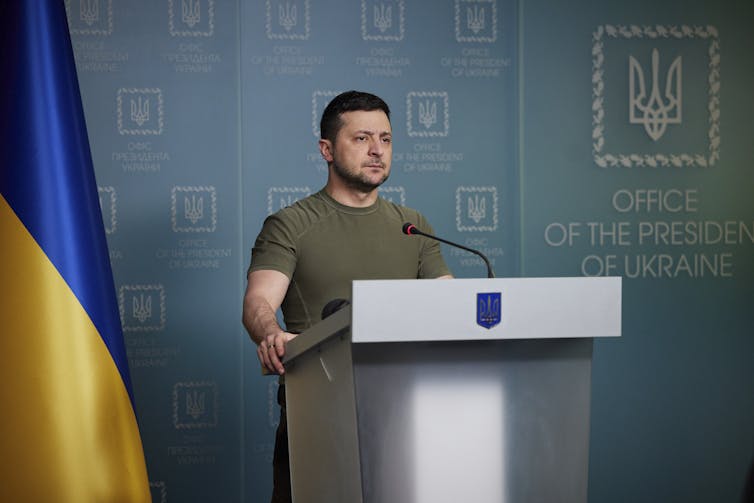
Volodymyr Zelensky in a military green t-shirt standing at a podium with an expression of resolve on his face
Putin underestimated the willingness of Volodymyr Zelensky and the Ukrainian military. Ukraine Presidential Press Service / EPA-EFE

The calculation for Ukraine is much more straightforward. Ukraine is a democratic country aggressively pursuing European integration. This means that the willingness of the general population to suffer in the face of high costs is of the utmost importance.

Without a critical mass of support, resistance to the Russian military will fall apart and Ukraine will lose the war. The fierce determination of the Ukrainian people up to this point suggests that this will not occur any time soon.

As Russian tactics become more aggressive, the Ukrainian people are paying ever higher costs. If we see the average Ukrainian’s willingness to suffer and fight lagging, it should give us cause for concern. To this end, western governments have stepped up humanitarian and defensive aid to Ukraine, in order to ensure that Ukrainian support for the war endures.

Ultimately, it appears that this war will not end quickly, as it will take a considerable amount of time for either side to make the other give up. Either the Russian military’s transition to indiscriminate bombing of civilian targets succeeds in eroding Ukrainian resistance, or battlefield casualties and domestic economic woes succeed in defeating Russia’s will to fight. Neither outcome is likely in the coming weeks and months, meaning people around the world are left to watch the horrors of war unfold, and wait.

March 15, 2022 0 comments
0 FacebookTwitterPinterestThreadsBlueskyEmail
HeadlinesOpinion

It Is Time For Legislators To Extend Their Oversight visit To Sambisa

by Leading Reporters May 14, 2021
written by Leading Reporters

Last Thursday, I was slightly amused listening to Senate President, Ahmed Lawan pouring encomiums on the service chiefs of Nigeria’s military.

When the report by the broadcast media on the event started playing, I had thought it was a valedictory session where some war veterans were taking a well-deserved bow. But when it became clearer that the day’s celebrants were the General Lucky Irabor led new service chiefs, I had to put off my initial doubt to watch more closely to find that the colorful reception by the Senate for the team was real and that it departed substantially from the old familiar song whose chorus was that no one knows into what use the military had put the huge resources appropriated and allegedly received by them.

It was as if the Senate had just discovered how well the funds had been meaningfully utilized. If so, what was the source of the new information? I mean was it credible evidence obtained from oversight function? I just hope the Senate’s position was not informed by the predictions of any of our vision-seeing members of the clergy!

Whatever the source, one thing which is certain, is that no one can blame a television viewer for being cynical; after all, the general narrative on ground has been one of despondence in which the public had been made to believe that funds meant for the military were usually diverted by the top hierarchy leaving nothing for the troops to prosecute the insurgency war.

Indeed, when the last service chiefs left office, there were reports of jubilation in military circles especially at the war front which tended to validate the rumour that military funds were truly misappropriated. Although there were official attempts to clarify the statement credited to the National Security Adviser NSA that weapons and equipment that should have been bought were not bought, the general feeling which subsisted was that the funds were missing. There was in fact the allegation by the International foundation against corruption that about N10.02 trillion spent on the security sector in Nigeria has had no audit report from 2015 till today.

So, why was the Senate President presenting a vote of thanks in favour of the military? Could it be that the legislature suddenly discovered that the military leaders were innocent of all charges against them and that the funds reportedly appropriated for the military never got to them? I found that slightly hard to believe because Zainab Ahmed, our Minister of finance, budget and national planning who should know, had confirmed two days earlier, that all the funds were released. The Minister spoke at an interactive session with members of the Senate Committee on the Army.

She also asserted that apart from funding the budget of the army almost 100 per cent, there had been a lot of instances where the security leaders went to the president, got special approvals and still got the funds. Interestingly, the Chairman of the same committee, Senator Alli Ndume had continuously complained that funds for the Army were not received by the Army. How then, can one understand our insurgency fight where the appropriation, delivery and receipt of the resources for the fight are turned into a story of several versions?

This confusion would not have arisen if oversight functions are implemented creditably in Nigeria. But painfully they are not. Elsewhere, what touches a nation most is the concern of all; in which case, Nigerians should have been mobilized by government to focus on our current major problem which incidentally concerns the security and welfare of the people. The legislature represented by her several committees on the military should have designed a monitoring framework covering when a request is made by the military, when it is approved, when it is dispatched, when it is received and how it is spent.

We ought not to have subjected our military to the distraction of spending much time pursuing approved funds. In other words, a team of legislators should have since been stationed in Sambisa by way of symbolically carrying supervision to the very point of assignment as they do, all the time, especially with lucrative agencies such as the NNPC. If that had been done, the new service chiefs would not have, on assumption of duty and indeed before settling in, be called to account for purchases made by their predecessors. Why was there no oversight at the appropriate time?

Honestly, oversight functions by the legislature have in the last one year dropped significantly. In August 2020, thirty-nine (39) Civil Society Organizations (CSOs) issued a joint statement accusing the National Assembly of not only a drop in her oversight functions but a general lack of commitment to duty. The CSOs arrived at this conclusion after a study of the performance of the lawmakers for the legislative year beginning from June 2019 to July 2020 in which they found that the legislators sat for only 149 days instead of the 181 days prescribed by the constitution. This may have been caused by the propensity of the legislators to enjoy several holidays and adjournments. For example, although all other public sector services had only two days declared as public holidays last month for Easter, the legislators were away for the same festivity for three weeks.

They have in the last three days already begun their own Sallah holidays, yet to be officially declared by government and they are not expected back till May 18th. We therefore agree with the CSOs that there ought not to be a drop in legislative activities by the National Assembly at a time when its role has become more critical than ever before, in joining the Executive to find solutions to the unprecedented challenges currently facing the country.

We also believe that our legislators should revive their mechanism for their constitutionally approved oversight functions provided, they remove from it, the tendency to commercialize the subject. The old order whereby legislators blackmailed some Ministries, Departments and Agencies into settling their travelling costs etc. must be halted. In addition, there is the need for the legislature to always get to the logical end of every investigation. Not many were pleased for instance, with how the allegations made publicly that NDDC contracts were cornered by legislators was swept under the carpet.

This attitude has always adversely affected public expectations whenever the legislature jumps into every matter as if nothing must go past them without their input. The posture no doubt has a fair share in the failure of Nigeria to have strong institutions. When for example, there is some emergency in any part of the country, and the very next day the legislature passes a resolution ‘directing’ NEMA to help the victims of the occurrence, it suggests that the entity has no capacity to independently face its mandate. It also removes from them, personal initiative and discretion. Such interventions are only rational in cases where the resolution was provoked by transparent lethargy on the part of the relevant societal institution.

It is worse when the legislature disrupts the schedule of duties of public bodies through incessant summoning of chief executives who are never allowed in what looks like ‘a show of ego’ to delegate their appearance. It is particularly offensive when it is done to the military that should be encouraged to completely face the nation’s current difficulty of incessant killings in several parts of the country.

By Tonnie Iredia

May 14, 2021 0 comments
0 FacebookTwitterPinterestThreadsBlueskyEmail
Opinion

National Assembly should avoid distracting the military

by Leading Reporters March 30, 2021
written by Leading Reporters
Tonnie Iredia

Section 89 of the 1999 Constitution, provides that the National Assembly can summon ANY person in Nigeria to give evidence before it over any matter that the Assembly can enact legislation.

Although what the provision on its face value confers on our legislators is huge power, a few knowledgeable persons in the polity have argued that there are people that cannot be summoned by the legislature. One of those cited to have such privilege is President Muhammadu Buhari.

According to Abubakar Malami, Attorney General and Minister of Justice, a plan by the National Assembly to summon the President over security issues was wrong because “the management and control of the security sector is exclusively vested in the President.” Those who didn’t agree with Malami had their points but what much can the legislature do to a President or indeed a state governor who can shun an invitation and get away with it by virtue of their constitutional immunity?

It was also canvassed that in certain cases, the National Assembly could not summon a Minister. A former Minister of Petroleum, Mrs. Diezani Allison Madueke, once told a court that both the Senate and the House of Representatives were required by law to first obtain the President’s consent before they could validly summon her.

To back her claim, she cited Sections 88 and 89 of the Nigerian Constitution 1999, as amended and Section 8 of the Legislatives Houses (Powers and Privileges) Act Cap. L12 Laws of the Federation of Nigeria, 2010. Veteran constitutional lawyer, Itse Sagay had similarly opined that not being a civil servant or a member of any commission, he was outside the group that the legislature could summon.

The cases cited above were however never fully tested to ascertain the true position of the law as Sagay, Madueke and the President did not appear before the legislature. In fact, some other Nigerians successfully shunned summons from the legislature without repercussions.

But beyond legal arguments, it is rational to accord the legislature such powers to enable her gather ample data to make or amend laws; and to expose “corruption, inefficiency or waste in the execution or administration of laws or the disbursement of funds appropriated for it.” If so, what encourages some citizens to think they can ignore our National Assembly? The reasons are many but one of them has to do with the conduct of some of our legislators.

Such law-makers usually depicted much of ego chasing with their summons – a posture which tended to imply that the summons were deployed just to establish the superiority of the legislature over other bodies. Sadly the summons often disrupted organized schedules in other segments of government because the legislators would insist that office holders must put off whatever they were engaged with to personally answer any legislative summons. Who says such summons are more useful to society than the functions they forcibly disrupt?

The more unacceptable aspect of the rather combative summons is that which discountenances the usefulness of delegation of duties. Why would legislators insist that only the chief executive of an organization can appear before them? Is it offensive for a deputy to deputize for his boss who is unable to break-off from a prior commitment? Interestingly, on many occasions, we see principal officers of the National Assembly representing the Senate President or the Speaker of the House of Representatives at functions.

If that is allowable in the legislature, does it mean that the principle of delegation of duties is in order only when employed in the legislature? Of course, that is not true because the principle is permissible worldwide. Thus when applied to the Nigerian Army, it is not out of place for Major General Charles Ofoche, Commandant of the Nigerian Army War College, to represent the Chief of Army Staff, Lt. Gen, Ibrahim Attahiru at a crucial meeting. As a result, the anger expressed on national television the other day by the ad hoc committee auditing arms and ammunition procured by the military only because the Army Chief was represented by Ofoche was unnecessary.

Both the Legislature and the Military are partners in the task of national development- none should derogate from the other. Both have different strategies of doing their jobs and the nature of each ought to be appreciated by the other. While the job of legislators especially in Nigeria is laced with pleasure, that of our armed forces is lined with harsh conditions. That seems to explain why Nigerian legislators have the leisure of functioning as armchair censors.

Last week, they began a 3-week holiday to mark the Easter season while other public officers, are yet to begin their only two days’ break. Our military on the other hand, may find themselves paying the supreme sacrifice on Easter Sunday making even a one-minute break impossible. What this implies is that because the job schedule of the military is exceedingly tasking and markedly different from that of legislators, the latter ought to help the former by ensuring that nothing is done to disrupt their job strategies.

Asking General Attahiru to give priority to a chat with the legislature over and above his tactical schedule of understanding the state of affairs within the first few weeks of assuming duty is to our mind a distraction. This is more so, when the issue agitating the legislators was handled by former military leaders that the same law-makers had just given a clean bill of health through a fast clearance to become ambassadors.

Our premise is that if the relevant committee of the legislature had done an effective oversight through proper monitoring of the arms purchase business, what the nation is looking for now would have been easier to uncover before Attahiru took office. Instead, the immediate past service chiefs that the entire nation including legislators appeared dissatisfied with were hurriedly cleared without being tasked on accountability. Such attitude of ‘wisdom after event’ is to our mind shadow chasing.

At the beginning of the tenure of the current service chiefs, President Buhari gave them a tough order to end insurgency before the rainy season which was some 5 weeks away. The team led by the Chief of Defence Staff; Gen. Leo Irabor offered assurances that they would deliver. Many Nigerians particularly those in the North East were happy with the officers who had previously acquitted themselves creditably in their assignment in the fight to end insurgency.

With such commendable track record, admonishing them at a point when all their attention is focused on routing out the insurgents could be counter-productive. The expectation of the military from the rest of us is not a reproach but the provisioning of non- kinetic strategies that can push the war effort to success.

The National Assembly should therefore seek to boost the morale of our armed forces by mobilizing the entire nation to prioritize the fight against insurgency. It would be a different result, if as it is now, the nation’s political leadership remains more pre-occupied with the politics of 2023 such as organizing defections and compiling membership register by the ruling party and political engineering efforts by the main opposition party to regain power.

We must all learn to avoid distracting the military from the current All-important task of bringing peace back to Nigeria.

March 30, 2021 0 comments
0 FacebookTwitterPinterestThreadsBlueskyEmail

Recent Posts

  • Tinubu Nominates Ex-CDS Christopher Musa As Defence Minister

    December 2, 2025
  • Poor Toilets Driving GBV, School Dropouts – Wateraid

    December 2, 2025
  • BREAKING: FG Publishes List of 15 Alleged Terrorist Financers in Nigeria [SEE LIST]

    December 1, 2025
  • FG Proposes 40% Salary Increase for ASUU Lecturers

    December 1, 2025
  • Northern Governors Host Emergency Meeting Over Escalating Security Concerns

    December 1, 2025

Usefull Links

  • Contact Page
  • About Leading Reporters
  • Contact Us
  • Headlines
  • Investigation
  • Exclusives
  • Opinion
  • Business
  • Facebook
  • Twitter
  • Instagram
  • Linkedin

@2021 - All Right Reserved. Designed and Developed by PenciDesign


Back To Top
Leading Reporters
  • Featured
  • Politics
  • Opinion
  • Business
  • Entertainment
  • Sports
  • About Us
  • Contact