Leading Reporters
  • Headlines
  • Health
  • Business
  • Exclusives
  • Investigation
  • Entertainment
  • Opinion
Tuesday, December 2, 2025
Hot
Tinubu Nominates Ex-CDS Christopher Musa As Defence Minister
BREAKING: FG Publishes List of 15 Alleged Terrorist...
FG Proposes 40% Salary Increase for ASUU Lecturers
Northern Governors Host Emergency Meeting Over Escalating Security...
Tinubu appoints ex-INEC Chair Yakubu, Fani-Kayode, Reno Omokri,...
Niger Delta Boss Jennifer Adighije Accused of Corruption,...
India Orders $570 Million Payout in Major Fraud...
Dangote Refinery Saves Nigeria over ₦10bn Annually in...
Bandits Abduct 16-year-old boy, six girls in FCT...
Social Security: A Missing Link in Nigeria’s Search...
  • About Leading Reporters
  • Contact Us
Leading Reporters
Advertise With Us
  • Headlines
  • Health
  • Business
  • Exclusives
  • Investigation
  • Entertainment
  • Opinion
Hot
Tinubu Nominates Ex-CDS Christopher Musa As Defence Minister
BREAKING: FG Publishes List of 15 Alleged Terrorist...
FG Proposes 40% Salary Increase for ASUU Lecturers
Northern Governors Host Emergency Meeting Over Escalating Security...
Tinubu appoints ex-INEC Chair Yakubu, Fani-Kayode, Reno Omokri,...
Niger Delta Boss Jennifer Adighije Accused of Corruption,...
India Orders $570 Million Payout in Major Fraud...
Dangote Refinery Saves Nigeria over ₦10bn Annually in...
Bandits Abduct 16-year-old boy, six girls in FCT...
Social Security: A Missing Link in Nigeria’s Search...
Leading Reporters
Leading Reporters
  • Headlines
  • Health
  • Business
  • Exclusives
  • Investigation
  • Entertainment
  • Opinion
Copyright 2024 - All Right Reserved
Home > Africa
Tag:

Africa

Trump
Africa & World

Trump To Shut Down US Embassies in Africa

by Nelson Ugwuagbo April 17, 2025
written by Nelson Ugwuagbo

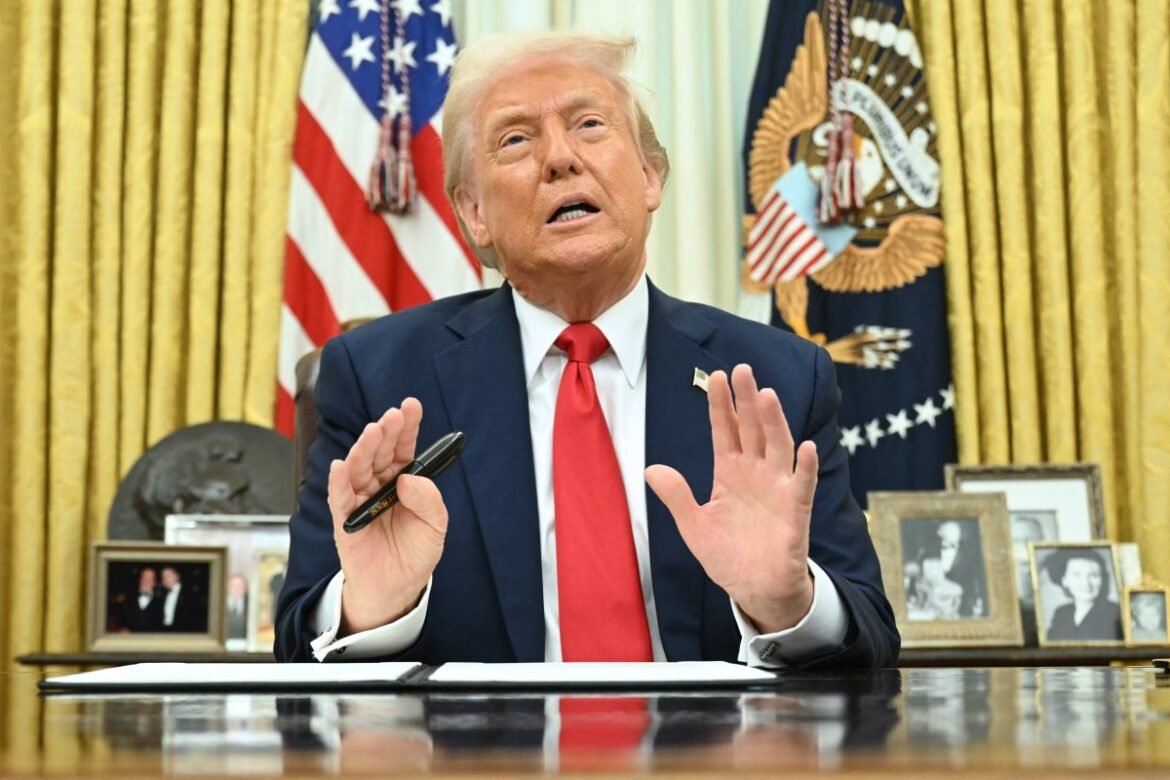
he administration of former U.S. President Donald Trump is reportedly considering the closure of nearly 30 American embassies and consulates across the globe, including several in Africa, as part of a broad plan to scale back the country’s diplomatic footprint.

According to a CNN report on Wednesday, which cited an internal U.S. State Department document, embassies in the Republic of Congo, Central African Republic, Lesotho, and South Sudan are among those proposed for closure. A U.S. consulate in South Africa is also reportedly on the list.

The document reportedly recommends the closure of 10 embassies and 17 consulates. The targeted posts span across Europe, Africa, Asia, and the Caribbean, with embassies in Malta, Luxembourg, Lesotho, the Republic of Congo, the Central African Republic, and South Sudan specifically mentioned.

The proposal is said to be part of a broader initiative by the Trump administration—allegedly influenced by the Elon Musk-backed Department of Government Efficiency—to significantly reduce the size and expenditure of federal agencies, including the State Department.

The document also suggests a reduction in U.S. diplomatic presence in countries such as Somalia and Iraq, both of which have played key roles in America’s counterterrorism strategy.
April 17, 2025 0 comments
0 FacebookTwitterPinterestThreadsBlueskyEmail
Preventing military coups in Africa: Attention, Nigeria Leading Reporters
HeadlinesOpinion

Preventing military coups in Africa: Attention, Nigeria

by Leading Reporters September 3, 2023
written by Leading Reporters


 By Tonnie Iredia
 
Two recent military coups in neighbouring Niger and Gabon have heightened discussions in Nigeria of the possibility of military intervention in the politics of the nation. The feeling appears so palpable considering the commonality of causative factors which over the years always influenced military rule in Africa: societal restiveness, poor economy, failed elections, pervasive corruption, extravagance of politicians and the helplessness of civic society accentuated by the disappearance of the middle class. In Nigeria, the division of society into two classes only; that is those who have everything and those who have nothing is more visibly felt than anywhere else. This has left many people to pray not just for something to change but for it to come through the efficacy of a military coup. The recent decision of the military hierarchy in Nigeria to formally dismiss such undemocratic undertones in the land is instructive.
 
Democracy is no doubt acclaimed world-wide as the best form of government, but then democracy is not a matter for claims. Rather, it is a system of government which is based on freedom and the politics of equality. Its features are not only sacred; they are offensive when adulterated. There are 5 such critical features, namely: the sovereignty of the people, the rule of law, free and fair elections, majority rule and the protection of minority rights. To qualify as a democracy therefore, the sovereignty of the people on whose behalf government functions is not negotiable. It is the people who matter and not the government. A democratic country in which everyone is equal before the law, cannot allow certain privileged citizens to use law enforcement agencies to detain their opponents or critics without trial. To manipulate an election process for losers to become winners nullifies real majority rule just as democracy as a game of numbers is contingent upon the protection of minority rights.
 
What the above features suggest is that those who are anxious to prevent military coups in Nigeria must first endeavour to make Nigeria a democracy. It is erroneous to continue to argue that the worst form of democracy is better than the most benevolent military rule because there is no difference between military rule and civilian rule or fake democracy. Those who argue that soldiers who shoot their way into government were not elected by the people must be fair enough to agree that those who come into office through the manipulation of the votes of citizens were also not elected by the people.  Soldiers in government are not accountable to the people because they were not elected by the people. Similarly, election riggers in government only mouth service to the people; rather than serve, they amass wealth in readiness for the manipulation of the next set of elections. It is therefore undemocratic to have elections that are neither free nor fair.
 
In truth, Nigerian politicians do not believe in hitch-free elections. They prefer to devote all their energies towards circumventing electoral laws and guidelines. Although the constitution provides for an electoral body made up of persons who are transparently non-partisan, many electoral officials in Nigeria are card carrying members of the ruling party. By so doing, some players in the game of election are also referees in the same game. Again, our constitution provides for a democratically elected system of local government, yet our governors always ensure that government at that local level is run by caretaker committees made up of party members. Where local government elections are organized, the state electoral bodies are directed to ensure the election of all chairmen and councillors of the ruling party.  The goal is to divert public resources accruing to them at that level from the federation account to the personal use of governors and their parties.

In a democracy, everything is scheduled. For example, after electioneering comes governance. In Nigeria’s democracy, every time is for electioneering. As soon as one election ends, electioneering begins for the next election due in 4 years. Already, state governors who came into office a few months ago are currently busy leading the campaign teams in other states whose elections are holding soon. When will such governors govern their states? Why can’t such governors concentrate on governance while their party officials use the party machinery for the current campaigns? In Edo state, for instance, governorship elections are holding not this year but next year, yet the matter of the, moment in that state is the number of governorship aspirants that are already engaged in open campaigns. If Kogi, Imo and Bayelsa with nearby governorship elections are doing nothing else but electioneering, should that also be the fate of others such as Edo whose elections are not immediately around the corner?
 
The result of our culture of “electioneering without end” is poor governance which makes it virtually impossible for the living standards of the ordinary people to improve. Nigeria’s electioneering is not only long and capital intensive; it is also bastardized. To start with, incumbents are busy placing hurdles in the way of their opponents during campaigns. This short-changes the electorate because state facilities do not belong to a ruling political party; they belong to the people and ought to be used for public enlightenment. Level playing field which guarantees the politics of equality is distorted when opposition parties are precluded from using public facilities such as stadium or any other platform. Indeed, state media outfits are propelled to shut their gates to opposition political parties in breach of the electoral law which directs the public media to provide equal time for all.
 
Poor governance in society frustrates all and sundry such that aggrieved soldiers think of nothing but coups while traumatized citizens troop out to rejoice and embrace military intervention in politics. To prevent Africa’s wind of coups from blowing towards Nigeria, so much has to be done to keep the society on good footing. First, it is necessary to draw a fine line between electioneering and governance. A presidential or governorship candidate has to be loyal to his party but when he becomes president or governor, his oath of office demands that his loyalty shifts to the general public. The trend in Nigeria in which members of the ruling party want to constitute government alone is parochial. In the last few days some APC members had openly condemned the appointment of a non-party member into a newly constituted board. The posture works against inclusivity as the office-holder was not elected by members of only one party.
 
Monopoly which members of a ruling party seek to exercise over government is particularly dangerous as it has capacity to swell up the numerical strength of ordinary people who feel aggrieved against government.  It is in fact offensive for a government to allow itself to be seen as not belonging to all. Some non-partisan citizens especially notable technocrats must be included in any government that intends to succeed in developing society. After all, the most effective members of successive governments in Nigeria were sourced on the basis of their track records of service and not because they were card-carrying members of the ruling party. Except government follows such well tested pattern of leadership recruitment, conducive environment would be created for civil society groups to distract government with criticisms only.
 
It is also important for government to depoliticise the security agencies as well as the military. Ironically, those who went to court in the past against the use of the military in our elections have since 2015 consolidated the same anomaly. But when it is convenient it is said that the military must not intervene in politics. There is the urgent need to equip the forces appropriately and give them attractive conditions of service. The new National Security Adviser has reportedly begun moves to reposition the police to take full charge of internal security. It is hoped that he would also sensitize them to recognise that in a democracy, public protests are allowed and not teargassed. It is also hoped that the common practice of supersession among our uniform forces would be checked. If not, those who are superseded or compulsorily retired to pave way for their chosen juniors to take control of the forces will join the army of aggrieved citizens especially the massive unemployed youths to canvass, urge and pray for military coups.  
 
 September 03, 2023

September 3, 2023 0 comments
0 FacebookTwitterPinterestThreadsBlueskyEmail
Headlines

United States ‘Democracy’ Spreading Instability In Africa – South African Minister

by Folarin Kehinde August 11, 2022
written by Folarin Kehinde

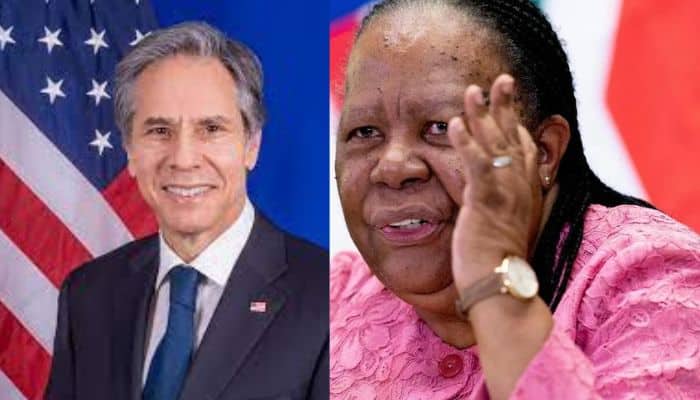
The South African minister of International Relations and Cooperation Naledi Pandor, has described the continuous conflicts in African countries as a consequence of external interference on the continent by the United States and other western countries.

She made this known in a Joint press availability with the United States Secretary of States Anthony Blinken, held in Pretoria, South Africa.

Minister Naledi accused the United States of trying to bully African nations into isolating nations like China and Russia which are at loggerheads with the USA.

A draft bill has been passed by the United States house of Representatives that seeks to penalize and sanction African countries who trade anything apart from grain with Russia. The passed bill is called ‘Containing Malign Russian Activities in Africa Act’.

While condemning the war by Russia on Ukraine, minister Naledi has called described the bill as ‘offensive legislation’. She opines that it is a bill that looks down on the sovereignty of African countries and its ability to choose who its want to relate with.

She defended South Africa’s neutrality on the conflict and called for the issue to be resolved diplomatically. She also berated the for giving lesser attention to the conflict in the middle east between Israel and Palestine. Saying all these conflicts should be giving same attention as no oppressed people is better than another oppressed people.

She said that Africa had a right to choose who it’s want to relate with and will not succumb to ‘patronizing bullying’ by the United States and other western powers.

In her words; ‘All nations are equal according to the United Nations Charter. Every nation can hold different opinions and are not under any obligation to make the United States enemies its own enemies’.

‘Though we might differ in economic might or ability to wield influence in other nations, African nations should still be treated with respect and should not be looked down upon.’

Minister Naledi went further to accused the United States of spreading instability in African countries in the guise of spreading democracy.

‘America comes to you, trying to teach you how democracy works when in reality, they are after your mineral resources in your country’.

The United States and other western powers are a destabilizing force only interested in exploiting the natural resources that can be obtained in your country.

We’ve seen this play out during the cold war era and most recently in Iraq and Afghanistan. Also in Africa, Libya has been on the receiving end of the brutality of western imperialist.

The minister opined that the presence of these mineral resources is what attracts the presence of the united states and other external influences who do not have the interest of Africa at heart.

August 11, 2022 0 comments
0 FacebookTwitterPinterestThreadsBlueskyEmail
OpinionHeadlines

Sri Lanka Crisis: “Lessons For Nigeria”

by Folarin Kehinde August 8, 2022
written by Folarin Kehinde

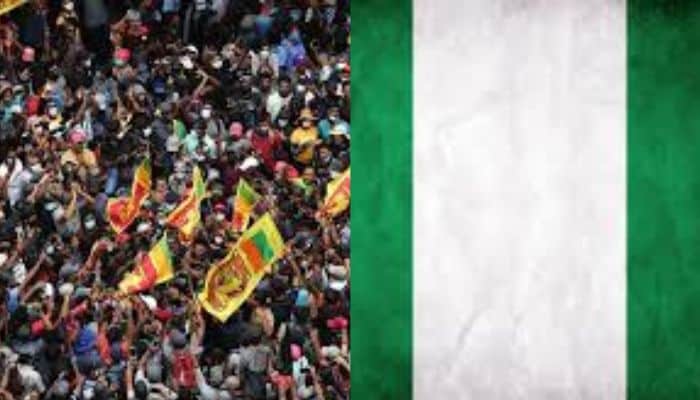
The recent crisis in Sri Lanka, a small country and developing economy with a population of 22 million people, has continued to take over a large space of world news.

A massive crowd of protesters stormed the presidential palace despite efforts by security operatives to barricade the way to the palace, but the number of protesters was overwhelming, so it didn’t work.

The protesters marched peacefully into the official residence of Rajapaska and celebrated, after sending him to exile. They swarmed, entered and tasted the luxury of his bedrooms, toilets, gyms and banquet halls, where they took selfies.

Many keen watchers of the country, famous for its elephants, said they saw the crisis coming, citing years of mismanagement of the country’s economy by a few political elites.

 Analysts said like many developing nations, Sri Lanka also suffered from a combination of external economic shocks that landed its economy into a coma.

According to them, the economic coma was mainly generated by COVID-19 pandemic, the Russian-Ukraine war and internal political dysfunction – a predicament that equally affected Nigeria and other African states.

As a result of these shocks, Sri Lanka found itself in a crisis of severe shortages of food, fuel, electricity, medicine, shrinking foreign reserves and collapse in currency value.

Prior to that, the country also succumbed to foreign debt crisis, high inflation and paucity of money to pay for basic necessities, blaming President Gotabaya Rajapaska for mismanaging the country’s finances.

Rajapaska spent more than the national income and allowed deep tax cuts, destroying the economy to a level that the government can’t afford imports or to service the external debt.

 Reflecting on these, Nigeria and other developing economies should be on the watch because the Sri Lankan crisis could mutate and more countries would fall, “Colombo is just a canary in a coalmine,” some analysts described the situation.

 How did Sri Lanka drive itself into this crisis?

Sri Lanka’s tourist trade, one of its biggest foreign currency earners and agriculture, just like the oil and agriculture in Nigeria, was affected by COVID-19 pandemic.

Tourists were frightened off by a series of deadly bomb attacks beginning in 2019.

Things were made worse by Rajapaksa’s policy on agriculture, which employed millions of peasants, which saw the banning of the importation of fertiliser in addition to his other ways of poor economic mismanagement which totally ruined the sector.

This made Sri Lanka run out of money, and its foreign reserve was depleted. As an import-dependent country that buys almost everything from outside, it spent more than it earned, while taking unsustainable loans from the IMF, World Bank and China.

The country quickly ran short of money to import oil and there were massive power cuts, students shut out of schools, parents sacked from jobs, and sales of fuel severely restricted, then the protest began and spiralled out of control.

Many other developing countries are suffering similar crises, maybe on a lower scale. But what is obvious is that if not much is done, the world will have a similar situation in its hands

Looming debt crisis in 70 nations  

On February 15, days before Russia invaded Ukraine, World Bank had issued a warning that “developing nations faced a looming debt crisis”

The bank named 70 low and middle-income countries facing debt repayment worth $11 billion, and the report clearly stated that the debt burden could crush their economy in 2022.

Few days later, Russia invaded Ukraine and disrupted the supply chains, put the financial market into disarray and triggered a global oil crisis. The economic focus became darker.

In March, the United Nations released a report that there were 107 economies that faced “severe exposure” to the consequences of the Russia-Ukraine war. And, the risks are rising food crisis, rising energy crisis, and tougher financial conditions.

 Also, the report had projected that 1.4 billion people from the 107 countries would be affected (approximately one-fifth of the world’s population).

According to the report, a total of 75 countries would go Sri Lanka’s way to face the three risks of food, energy and finance crises. Twenty-five of the countries are in Africa, Twenty-five in Latin America and another Twenty-five in Asian-Pacific.

 Although the alarm bell rang in Africa, Nigeria was lucky to stand out, leaving Ghana, Kenya, South Africa and Ethiopia to be among the 25 countries to be the worst hit in sub-saharan Africa.

 In Ghana, the debt level is soaring, the interest payment is choking the economy and the debt crisis seems imminent. 

Also, in South Africa, the debt has risen 80 per cent of its economic Gross Domestic Product (GDP), despite higher revenue, which indicates that there’s a looming threat of state collapse, therefore, much needs to be done to avoid the rerun of the 2021 civil unrest.

In Kenya, the debt has also climbed to $70 billion, which is 70 per cent of the country’s Gross Domestic Product (GDP), and weeks back, Kenya secured $244 million from the International Monetary Fund (IMF) to weather its economic storm.

 Is Nigeria ready for the coming spite of the debt crisis?

Nigeria is lucky to be exempted this time around, but the World Bank report said, “Over the next 12 months, as many as a dozen of developing economies might not be able to service their debts.”

Data from Debt Management Office (DMO) has shown a sign that Nigeria is perhaps inching towards a debt crisis because as at first quarter of 2022, the country’s external debt stood at $39.96 billion with a foreign reserve of $38.483bn.

Nigeria’s inflation also spiked to 18.60 per cent and the naira slipped to N700 against the USD at the black market.

Economic analyst, Tope Fasua, has said Nigeria’s loan is already unsustainable because it is taking 95 to 97 per cent of the revenue generated. “That ratio is not sustainable,” he said.

Fasua warned that the huge debt that Nigerian government is incurring mostly is to cater for a lot of failures and they just borrow to keep some activities going.

 “How the loans are going to be paid is not in question for them and that’s very unfortunate.

“The loan is unsustainable from the perspective of revenue, from the perspective of corruption and value for money and from the perspective of project implementation.

“Only 30 per cent value for money is what we get especially on these loans, some of what we are taking is for very frivolous issues.

“In my opinion, we should take loans only for projects that have the ability to pay themselves back. If a project is not generating cash flow, it shouldn’t be taken.

“If we are taking loans for local roads and schools, who is going to pay? These are projects that should be funded from internally generated revenue,” he said.

He also attributed the currency challenges to Nigeria’s debt portfolio.

“We have a challenge with the naira presently, and one of the key things that throws your currency off is debt unsustainability.

“And mind you, most of the loans we are taking in recent times have not fallen due for payment. What we are doing is only paying the interest. Many of them have moratoriums on interest payments.

“These guys have actually booked for us a bad time and a lot of trouble upfront,” Fasua added.  Analysts said to avoid taking the path of Sri Lanka’s, African countries need multi-front solution to deal with their multi- dimensional crisis of rising food, rising energy and tougher financial conditions.

And, to achieve this, the governments must first defeat corruption and bring about reforms that would reduce their rising debt burden choking their economies, and be free from the 75 projected by the UN to go Sri Lanka’s way.

August 8, 2022 0 comments
0 FacebookTwitterPinterestThreadsBlueskyEmail
Headlines

Nigeria’s Military Strength Under PMB Government

by Leading Reporters March 4, 2022
written by Leading Reporters

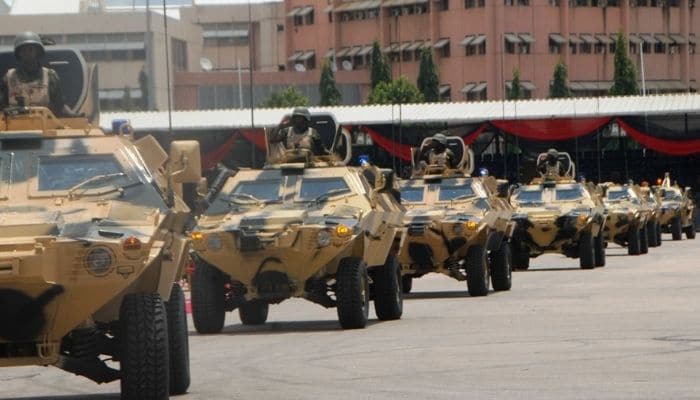
Nigeria’s military is ranked the fourth in Africa and thirty-fifth in the world with respect to strength.

This is according to data from Global Firepower. According to the data, Nigeria has had constant military growth since the beginning of the Buhari administration.

According to the Global Firepower ranking, the lower the power index of a country, the higher the military capability of such a country. 0.000 is considered a perfect power index.

The country’s military strength index currently stands at 0.5745, which is a slight improvement compared to 2021 when the power index was 0.62. 

The power index is determined by several factors which are grouped under 8 indicators. They include manpower, land system, airpower, naval power, resources, logistical, financial, and geographic.

In the last 7 years, Nigeria has maintained fourth and fifth position in Africa in terms of military strength out of the 54 countries. Egypt on the other hand has maintained the first position, making it the country with the strongest military strength in the period under review. 

Other countries that rank high on the list are Algeria, Ethiopia, South Africa, Kenya, Libya, and Morocco. 

Ranking of Military Strength of selected African Countries

Egypt ranks 12th globally in the 2022 ranking of military strength, while South Africa, Algeria, and Ethiopia, rank 26th, 31st, and 65th  respectively.  

Nigeria’s Military Strength Power Index Under the Buhari Administration

Global Firepower data shows that in 2015, Nigeria’s power index stood at 1.526, the worst in the period under review. However, in 2016, it reduced by a great deal when 0.786 was recorded. 0.575 is the latest power index recorded for Nigeria. 

Current data also reveals that Nigeria has a total military personnel of 215,000 out of which 135,000 are active and 80,000 make up the paramilitary.

So far under the Buhari Administration, the Nigerian Air force has acquired a total of 38 aircraft, the Nigerian navy acquired close to 400 new platforms since 2015 which includes 14 houseboats, 4 helicopters, 4 capital ships, 12 manta class/inshore patrol craft, and 22 fast attack boats among others. 

The president also gave a directive to the Nigerian Navy to establish a naval base in Baga, Borno State, an area prone to criminal activities near the nation’s coast. 

The President also mobilised international support for the fight against Boko Haram from countries like the United States of America, United Kingdom, France, Germany, ECOWAS, UN, and AU, which led to the United States agreeing to sell 12 Super Tucano aircrafts to Nigeria in 2017

March 4, 2022 0 comments
0 FacebookTwitterPinterestThreadsBlueskyEmail
Headlines

Nigeria economic growth lags Africa, poverty rising

by Leading Reporters June 16, 2021
written by Leading Reporters

Nigerian economic growth has resumed after the COVID shock but is lagging the rest of sub-Saharan Africa, with food inflation, heightened insecurity and stalled reforms slowing growth and increasing poverty, the World Bank said on Tuesday.

Presenting its six-monthly update on development in Africa’s most populous country, the organisation gave a GDP growth forecast for Nigeria of 1.9% in 2021 and 2.1% in 2022, compared with 3.4% this year and 4.0% next year for sub-Saharan Africa.

He said the COVID-induced crisis was expected to push over 11 million Nigerians into poverty by 2022, taking the total number of people classified as poor in the country to over 100 million. The total population is estimated at 200 million.

The World Bank expects the Nigerian inflation rate in 2021 to be 16.5%. The forecast for sub-Saharan Africa, excluding Nigeria, is 5.9%.

Hernandez said increased insecurity across the nation — ranging from mass abductions at schools, kidnappings for ransom, armed conflict between herdsmen and farmers, armed robberies and various insurgencies — was a drag on growth and job creation.

He said it was critical for the government to maintain reform momentum, but that some important reforms had stalled

He cited petrol subsidies, which have recently returned after the government had established a market-based pricing mechanism, and electricity tariff reform, an area where planned adjustments to bring prices in line with costs have been paused.

Hernandez said Nigeria had the largest number of people without access to electricity in the world, and that electricity subsidies benefited mainly richer households.

Only 22% of the poorest households have access to electricity, while 82% of the richest are able to access power.

June 16, 2021 0 comments
0 FacebookTwitterPinterestThreadsBlueskyEmail
Opinion

Contest Election: It is a Money Spinner – Reno Omokri Tells Nigeria Girls

by Leading Reporters May 19, 2021
written by Leading Reporters

Former President Goodluck Jonathan’s media aide, Pastor Reno Omokri has advised girls who live in Africa to contest elections, if they intend to make money.  He described politics in Africa as a money-spinning venture. 

Reno, in his official page advised the ladies to free their slaves (boyfriends) who they always ask money from, by either getting a job, or starting business or contesting election, which he said is a money-spinner that would give them all the money they want.

“On your birthday, your boyfriend threw a party for you.  On his birthday, you want him to take you out for a romantic dinner.  When you visit him, you ask for transport fare.  If he visits you, you demand for money. 

You use his phone and exhaust his data, then ask for more data.  Be honest with yourself, is he (your boyfriend) in a relationship, or is he in bondage? “Slavery officially ended on Monday, December 18, 1865.  Free your own slave.  If you need money, ask your father or get a job or start a business. If you live in Africa, you can also contest for election.  It is a money-spinner”

May 19, 2021 0 comments
0 FacebookTwitterPinterestThreadsBlueskyEmail
Africa & World

ECOWAS Ambassador to UN receives new Climate Clock in NYC

by Leading Reporters April 26, 2021
written by Leading Reporters

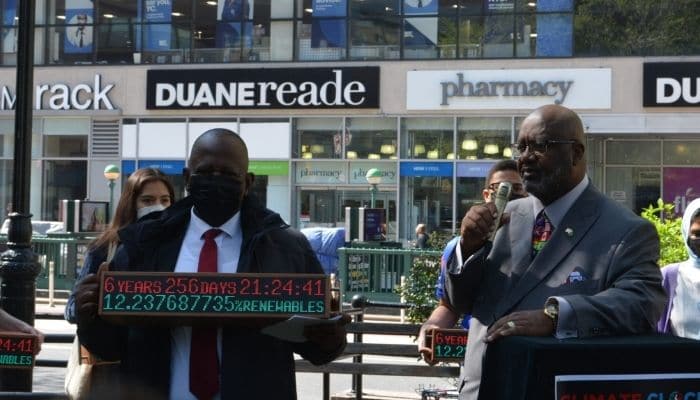
Monday morning, in advance of President Biden’s Earth Day Leaders Summit on Climate, the UN Ambassador of ECOWAS (Economic Community of West African States), which represents 15 African nations, was gifted a handheld climate clock in front of the monumental Climate Clock in Union Square, New York City.

Climate Clock Action

The clock was presented to the UN Ambassador, his excellency Mahama Kappiah, by Jerome Ringo, former chair of the National Wildlife Federation, and currently Goodwill Ambassador to the Pan African Parliament.

Kappiah is the first UN ambassador to receive a climate clock, with the hope that more of these clocks continue to spread throughout the UN. Ringo will be taking more handheld clocks to several African leaders when he travels there later this week.

Ringo stated: “This clock is a call to action. Future solutions are great, but we need NOW solutions. Solutions that create green jobs that can replace the fossil fuel economy.” The moment was celebrated by a significant change in the now famous giant clock: a sign of hope.

Climate Clock Action

The Deadline that has been displayed since it’s launch in September is now joined by a new “Lifeline” that displays the percentage of global energy currently supplied from renewable sources — 12.2 percent, and going up, but it needs to be going up much faster to meet our deadline. For more information on the science behind the clock:  https://climateclock.world/science.

Ringo used the shift in the clock to speak to the different responsibilities that different nations had for meeting our climate deadline. “Africa, like other developing regions who suffer climate impacts from CO2 historically released by industrialized nations, deserves a lifeline.

Climate Clock Action

They need countries like the US, that are the greatest contributors to the problem, to contribute the most to this renewable lifeline that is on the clock. The United States is only 5% of the world’s population but is responsible for 25% of the world’s carbon emissions.”

As President Mohammadu Buhari also took part in the the virtual Leaders Summit on Climate, being hosted by the US President Joe Biden, and attended by 40 world leaders.

Also at the event were climate activists Xiye Bastida, Alexandria Villasenor, and Ayisha Saddiqa, many of whom are also receiving clocks and taking them to the Biden Global Leaders summit in Wash. DC on Earth Day.

April 26, 2021 0 comments
0 FacebookTwitterPinterestThreadsBlueskyEmail

Recent Posts

  • Tinubu Nominates Ex-CDS Christopher Musa As Defence Minister

    December 2, 2025
  • Poor Toilets Driving GBV, School Dropouts – Wateraid

    December 2, 2025
  • BREAKING: FG Publishes List of 15 Alleged Terrorist Financers in Nigeria [SEE LIST]

    December 1, 2025
  • FG Proposes 40% Salary Increase for ASUU Lecturers

    December 1, 2025
  • Northern Governors Host Emergency Meeting Over Escalating Security Concerns

    December 1, 2025

Usefull Links

  • Contact Page
  • About Leading Reporters
  • Contact Us
  • Headlines
  • Investigation
  • Exclusives
  • Opinion
  • Business
  • Facebook
  • Twitter
  • Instagram
  • Linkedin

@2021 - All Right Reserved. Designed and Developed by PenciDesign


Back To Top
Leading Reporters
  • Featured
  • Politics
  • Opinion
  • Business
  • Entertainment
  • Sports
  • About Us
  • Contact