
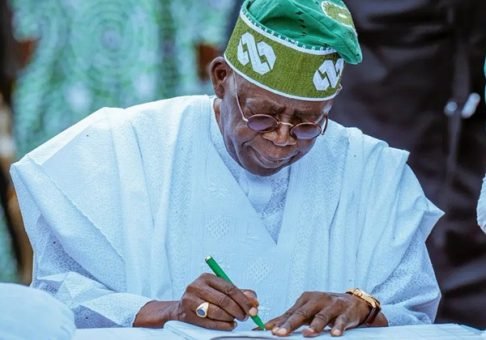
President Bola Tinubu has signed the controversial Electoral Act 2022 (Amendment) Bill into law, formally repealing and reenacting key provisions of Nigeria’s electoral framework ahead of the 2027 general election.
Leading Reporters gathered that the signing ceremony took place on Wednesday at the Presidential Villa, Abuja, hours after the harmonised version of the bill was transmitted to the Presidency by the National Assembly (NASS).
It would be recalled that the amendment sparked widespread debate across the political spectrum, particularly over provisions relating to the electronic transmission of election results. Critics argue that the new law could not provide a safeguard for real-time electronic transmission of election results from polling units.
A major flashpoint is Clause 60(3), which stops short of making electronic transmission of election results mandatory in real time, instead leaving significant discretion to the Independent National Electoral Commission (INEC) to determine the mode and procedure for result transmission.
Supporters of the amendment insist the law provides flexibility for INEC to deploy technology based on prevailing infrastructure realities, including network coverage challenges in rural communities. They argue that the changes aim to prevent logistical breakdowns that could undermine the credibility of elections.
However, opposition parties and civil society groups have warned that the amendment could erode public trust in the electoral process. A former INEC Resident Electoral Commissioner, Mike Igini, had publicly urged the President to withhold assent, describing aspects of the bill as potentially detrimental to electoral transparency.
Beyond result transmission, the new law also shortens certain pre-election timelines and adjusts procedures for candidate nomination, substitution, and dispute resolution, provisions analysts say could significantly reshape the political calendar leading into 2027.

Folarin Kehinde is an Abuja-based journalist with over 5 years of experience in journalism. His work has earned him national and international recognition across various beats, including environment, health and politics.
Spotted an error? Read our Corrections Policy or tell the editors.
Got a story or a tip? Contact Leading Reporters. We protect our sources.