
Leading Reporters
  • Headlines
  • Health
  • Business
  • Exclusives
  • Investigation
  • Entertainment
  • Opinion
Tuesday, January 27, 2026
Hot
FCTA Workers, NLC Storm Industrial Court, Demand Wike...
DisCos reject FG’s free meter plan
Nigerian-born nurse loses licence in Australia for sleeping...
BREAKING: Kano Gov Abba Yusuf dumps NNPP
National Grid Collapse For First Time in 2026
BREAKING: Tinubu approves posting of Ambassadors to U.S.,...
Insecurity: Kidnappers demand 17 motorcycles for release of...
FG to Abolish Hnd-Degree Dichotomy, Allow Polytechnics to...
AFCON Initiative drives stronger Nigeria Morocco cooperation
Obasanjo: I’ll Never Stop Having Children
  • About Leading Reporters
  • Contact Us
Leading Reporters
Advertise With Us
  • Headlines
  • Health
  • Business
  • Exclusives
  • Investigation
  • Entertainment
  • Opinion
Hot
FCTA Workers, NLC Storm Industrial Court, Demand Wike...
DisCos reject FG’s free meter plan
Nigerian-born nurse loses licence in Australia for sleeping...
BREAKING: Kano Gov Abba Yusuf dumps NNPP
National Grid Collapse For First Time in 2026
BREAKING: Tinubu approves posting of Ambassadors to U.S.,...
Insecurity: Kidnappers demand 17 motorcycles for release of...
FG to Abolish Hnd-Degree Dichotomy, Allow Polytechnics to...
AFCON Initiative drives stronger Nigeria Morocco cooperation
Obasanjo: I’ll Never Stop Having Children
Leading Reporters
Leading Reporters
  • Headlines
  • Health
  • Business
  • Exclusives
  • Investigation
  • Entertainment
  • Opinion
Copyright 2024 - All Right Reserved
Home > Supreme Court of Nigeria
Tag:

Supreme Court of Nigeria

Leading Reporters Six States Ask Supreme Court To Cancel Presidential Election Image
Headlines

Supreme Court to abrogate presidential election

by Leading Reporters March 3, 2023
written by Leading Reporters

Adamawa, Akwa-Ibom, Bayelsa, Delta, Edo and Sokoto states have dragged the Federal Government before the Supreme Court over the conduct of the February 25, 2023 presidential and National Assembly elections.

The suit filed by the Attorneys General of the six states has the Attorney General of the Federation as sole respondent.

The plaintiffs on February 28 predicated their case on the grounds that, “The collation of the national election results from the 36 states of the Federation, and that of the Federal Capital Territory, for the said 2023 presidential and National Assembly elections have not been carried out in compliance with the mandatory provisions of relevant sections of the Electoral Act, 2022; the INEC Regulations and Guidelines for the Conduct of Elections, 2022, made pursuant to the provisions of the Electoral Act, 2022; and the INEC Manual for Election Officials, 2023.”

In the suit filed by their lawyer, Mike Ozekhome, SAN, the states said the agents and officials of the Federal Government and INEC failed to transmit the collated result as prescribed by the provisions of the Electoral Act, 2022; the INEC Regulations and Guidelines for the Conduct of Elections 2022; and the INEC Manual for Election Officials requiring transmission of the results by the use of Bimodal Voter Accreditation System in flagrant breach of the relevant provisions of the Electoral Act, 2022; the INEC Regulations and Guidelines for the Conduct of Elections, 2022; and the INEC Manual for Election Officials, 2023.

They stated that, “non-compliance with the due process of law has led to a widespread agitation, violent protests, displeasure, and disapproval from a wide spectrum of the Nigerian populace, including international observers, political parties, well-meaning Nigerians and former Head of States of the Federal Republic of Nigeria”.

The plaintiffs argued that the federal government through INEC, “is empowered by law to correct the elections due to technical glitches and errors arising from the conduct of the elections with substantial effect on the electoral process in line with the provisions of Section 47 (3) of the Electoral Act, 2022; and other relevant sections thereof.

“Whilst queries were being raised as to the failure or deliberate refusal of INEC to transmit the results electronically, INEC suddenly pulled down its portal harbouring the Regulations and Guidelines, thus leaving the plaintiffs in the dark

“Most Nigerians, including the governments and peoples of Adamawa State, Akwa Ibom State, Bayelsa State, Delta State, Edo State, and Sokoto State, are entitled to a proper and electoral lawful process and procedure that guarantees a free, fair, transparent and credible election”.

Amongst the issues raised for determination by the apex court were: Whether having regard to the provisions of the Electoral Act, 2022, governing the 2023 nationwide general elections, particularly paragraphs 38 of the INEC Regulations and Guidelines for the Conduct of Elections, 2022; and paragraphs 2.8.4; 2.9.0; and 2.9.1 of the INEC Manual for Election Officials, 2023 thereof, the electronic transmission of votes collated at polling units and the use of the Bimodal Voter Accreditation System (BVAS) in the transmission of collated result is made mandatory.

“Whether the Federal Government of Nigeria through presiding officers of its executive body, Independent National Electoral Commission was bound to electronically transmit or transfer Polling Unit Results in Form EC8A using BVAS by uploading Scanned Copy of the said Unit Results to the Independent National Electoral Commission Result Viewing Portal (IReV) in the course of the General Elections held on the 25th of February, 2023 throughout the Federation.

“Whether the Federal Government of Nigeria in the recently held Presidential and National Assembly elections conducted nationwide on 25th February, 2023 through INEC, complied with the mandatory provisions of extant laws, INEC Regulations and Guidelines for the Conduct of Presidential Elections, 2022″.

“Whether the failure of the Federal Government of Nigeria through the Defendant and INEC to electronically transmit or transfer Polling Unit Results in Form EC8A using BVAS by uploading Scanned Copy of the said Unit Result to the Independent National Electoral Commission Result Viewing Portal (IReV) after the counting and announcement of the Polling Units results on 25th of February, 2023, violates the provisions of Sections 25; 47(2); 60 (1), (2), (4) & (5); 62; 64(4)(a) & (b); 70; and 148 of the Electoral Act, 2022, governing the 2023 nationwide general elections, particularly paragraphs 38 of the INEC Regulations and Guidelines for the Conduct of Elections, 2022; and paragraphs 2.8.4; 2.9.0; and 2.9.1 of the INEC Manual for Election Officials, 2023, for the conduct of the presidential election.

“Whether the failure of the Federal Republic of Nigeria through INEC to comply with the provisions of Section 60 of the Electoral Act, 2022 and the Regulations and Guidelines for Conduct of Elections, 2022 made pursuant to the Electoral Act and the Constitution of the FRN, 1999, as amended, in collating and announcing the results of the Presidential and National Assembly Elections render the already announced results and the elections conducted as a whole a nullity”.

“Whether the entire results of the presidential election conducted on the 25th of February, 2023, as announced by the Chairman of INEC at the National Collation Centre, Abuja in flagrant provision of Sections 25; 47(2); 60 (1), (2), (4) & (5); 62; 64(4)(a) & (b); 70; and 148 of the Electoral Act, 2022, governing the 2023 nationwide general elections, particularly paragraphs 38 of the INEC Regulations and Guidelines for the Conduct of Elections, 2022; and paragraphs 2.8.4; 2.9.0; and 2.9.1 of the INEC Manual for Election Officials, 2023, for the conduct of the Presidential Election, were valid.”

The plaintiffs urged the apex court to declare, “that the Federal Government of Nigeria, through INEC was bound to electronically transmit or transfer Polling Unit Results in Form EC8A using BVAS by uploading Scanned Copy of the said Unit Result to the Independent National Electoral Commission Result Viewing Portal (IReV) in the course of the General Elections held on the 25th of February, 2023 throughout the Federation in compliance with the provision of Sections 25; 47(2); 60 (1), (2), (4) & (5); 62; 64(4)(a) & (b); 70; and 148 of the Electoral Act, 2022, governing the 2023 nationwide general elections, particularly paragraphs 38 of the INEC Regulations and Guidelines for the Conduct of Elections, 2022; and paragraphs 2.8.4; 2.9.0; and 2.9.1 of the INEC Manual for Election Officials, 2023, for the conduct of the presidential election.”

They are seeking “A declaration that the entire results of the Presidential Election conducted on the 25th of February, 2023 announced by the Chairman of INEC at the National Collation Centre, Abuja, in flagrant violation of the provisions of Sections 25 of the Electoral Act, 2022, governing the 2023 nationwide general elections, particularly paragraphs 38 of the INEC Regulations and Guidelines for the Conduct of Elections, 2022; and paragraphs 2.8.4; 2.9.0; and 2.9.1 of the INEC Manual for Election Officials, 2023, for the conduct of the Presidential Election, were invalid, null and void, and of no effect whatsoever.

“A declaration that the fundamentally flawed electoral process through the non-uploading of the results of each of the 176,974 Polling Units nationwide, in respect of the presidential election and National Assembly Elections held on Saturday, 25th February 2023 were not in accordance with the provisions of Sections 25; 47(2); 60 (1), (2), (4) & (5); 62; 64(4)(a) & (b); 70; and 148 of the Electoral Act, 2022, governing the 2023 nationwide general elections, particularly paragraphs 38 of the INEC Regulations and Guidelines for the Conduct of Elections, 2022; and paragraphs 2.8.4; 2.9.0; and 2.9.1 of the INEC Manual for Election Officials, 2023, for the conduct of the presidential election.

“The plaintiffs also brought an application praying the apex court for an order directing a departure from the rules of the apex court in the interest of justice by directing for accelerated hearing of the substantive suit. Besides, plaintiffs also filed another application seeking for an order for abridging time for parties to file and serve responses for and against the suit. No date has been fixed for hearing.
March 3, 2023 0 comments
0 FacebookTwitterPinterestThreadsBlueskyEmail
HeadlinesOpinion

Sacking Defecting Governors Deserves Supreme Court’s Support

by Leading Reporters March 13, 2022
written by Leading Reporters

By Tonnie Iredia

On March 08, 2022, a federal High Court sitting in Abuja sacked the governor of Ebonyi state and his deputy as well as a number of state legislators for defecting from the party on whose platform they were elected. Reactions to the judgment have been overwhelming.

While most people found no fault with removing the law makers from office because it tallies with the express provisions of the Constitution, opinions are divided as to the legality of the judgment concerning the governor and his deputy whose defection the same Constitution is silent on. In 2018, when the governors of Benue, Sokoto and Kwara states similarly defected, what carried the day was the argument that the Constitution did not include defection among the factors for which governors can leave office. The implication of this is that how to handle a defecting governor will for some time to come remain an unresolved issue in Nigeria’s democracy. But bearing in mind that the occurrence is patently repugnant, one would have thought that steps would have since been taken to resolve the issue, but that has not happened.

A critical objective of this piece is to draw attention to the need to punish the wrong of defection by those who appear to be inadvertently protected by the law when they are in the wrong. Perhaps an appropriate take off point is to establish that political defection is a wrong which is not a difficult task to handle because as stated earlier, there is a consensus that it is a wrong on the part of law makers. But is it not curious to describe the act of transferring votes by some actors from one political party to another as a wrong and pretend that the same act is probably not a wrong when perpetuated by another set of actors? Luckily, most people deprecate the act of political defection which short-changes a particular set of voters irrespective of who the wrong-doers are. Unfortunately, whereas the law prescribes punishment for law makers involved in the act, it does not similarly do so for governors. But considering that the failure to punish a wrong does not cure the wrong of its defects, the best way to go seems to be to seek to punish every wrong doer on the basis that under the rule of law, everyone is supposedly equal before the law.

Against this backdrop, there are several issues calling for attention. The first of such issues is ownership of votes cast in a Nigerian election; is it the property of a candidate or his/her political party or both? The Constitution has left no one in doubt that political parties are the most important actors in the nation’s electoral process. To start with, the Constitution provides that only aspirants sponsored by political parties can be candidates in an election. Put differently, no one can dispense with political parties which is why it is impossible to be an independent candidate in any Nigerian election. Besides, the Judiciary has consistently held that votes at an election belong to political parties notwithstanding that the charisma of individual candidates may have helped a party to secure victory. In recent contests (Imo North Senatorial and local elections in Abaji-FCT) INEC declared specific political parties as winners pending the determination of their authentic candidates.

The second issue of importance is the power to transfer votes from one party/candidate to another. Here, it is obvious that in view of the strategic position of political parties as owners of votes cast in elections, a candidate who has been declared winner of an election cannot later transfer his votes to another party/candidate. Anyone who does so, is involved in the wrong of defection which can hurt the interests of some persons or groups. Based on this reasoning, the logical necessary follow-up question would take this form. Is it in order for the relevant societal institution – the Judiciary to overlook the wrong of such transfer of votes which a defection of an elected office-holder may have caused? If not, how best can the subject be handled?

For long, very many senior lawyers have continued to argue that removing a defecting governor from office is unconstitutional. However, they have all been silent on the propriety of leaving a wrong without a remedy. Here, it is apt to recall the Latin maxim ‘ubi jus ibi remedium’ which is an age-long philosophy meaning “for every wrong the law provides a remedy.” It is therefore not enough to lament the failure of the Nigerian Constitution to provide a remedy for the wrong of political defection by a governor because it is not only a Constitution that has the duty to provide every remedy; in what is known as judge-made law, a Court can also interpretatively prescribe a remedy to a wrong. Surprisingly, no effort has been made in recent years to follow the clear path identified by the greatest Nigerian judges of all times on what the nation should do when confronted by the issue of lack of provisions for an inevitable cause of action. In other words, Nigerian Courts ought to inventively dispense substantive justice instead of allowing a wrong to persist without sanctions because of over-reliance on technicalities.

As Karibi-Whyte a one-time famous justice of Nigeria’s Supreme Court once explained, “… it is erroneous to assume that the maxim ubi jus ibi remedium is only an English Common Law principle. It is a principle of justice of universal validity couched in Latin and available to all legal systems involved in the impartial administration of justice. It enjoins the courts to provide a remedy whenever the Plaintiff has established a right…” Although some analysts have criticised the decision of the Supreme Court in the famous Rotimi Amaechi’s case, it is quite hard to disagree with the proactive posture of the Justices that if a court is satisfied that a person has suffered a legal injury it ought to do justice by providing “a remedy irrespective of the fact that no remedy is provided either at common law or by statute.” Indeed, a court needs to do this so as to be able to follow the persuasive dictum of another legal luminary: Justice Katsina-Alu who opined that “the law is an equal dispenser of justice which leaves no one without a remedy for his right.”

With this clear line of thought provided by judges of old, no one can defend the
current conservative approach which gives an impression that the judiciary in Nigeria has been subdued by the other arms of government. The situation is more worrisome because defecting governors have never proffered any rational motivation for their behaviour other than personal materialistic interests. For example, Governor Ben Ayade of Cross River State defected because he reportedly wanted to support the President to provide good governance. Dave Umahi of Ebonyi State on his part defected to the ruling party because he doubted if his original party would zone the presidency to the South East. In the case of Zamfara State, Governor Bello Matawalle defected to a political party which the judiciary ruled was not in existence in the eyes of the law. These bizarre defections ought not to be protected through judicial over-reliance on technicalities which can encourage other actors into seeking extra-judicial means of ventilating political grievances.

As if to reiterate the definition of law by the legendary English jurist, Lord Denning which sees law as what the Judge says it is, Justice Inyang Ekwo has taken the first crucial step in bringing to an end, the notorious wrong of Nigeria’s political defections. All Higher Courts should support him by disallowing the perpetrators from using the protection offered them by the Constitution to hide behind fraudulent activities. Any defector-governor should not be seen as someone removed from office; but one who worked away from a mandate. He should thus not be allowed to transfer the same mandate elsewhere because its owners – the electorate had instinctively determined where the mandate should be.

……..Professor Iredia, a former Director-General of the NTA, media law teacher, communication expert and broadcast manager wrote from Abuja.

March 13, 2022 0 comments
0 FacebookTwitterPinterestThreadsBlueskyEmail
Headlines

“An Indelible Karma Will Sweep Gov. Uzodinma Off Irrecoverably” – Ihedioha’s Associate

by Leading Reporters May 27, 2021
written by Leading Reporters

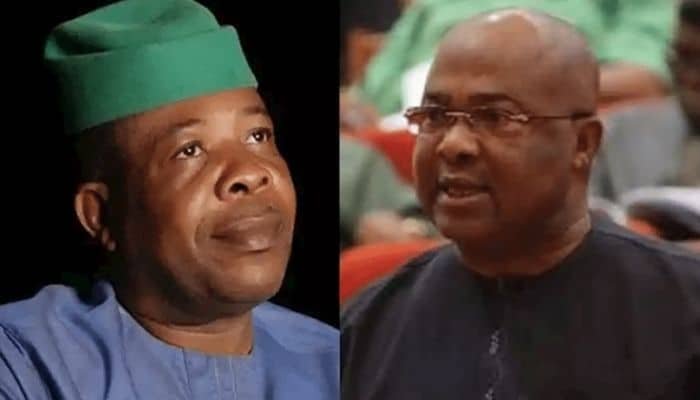
An associate of Rt. Hon. Emeka Ihedioha who does not want his name mentioned has described events unfolding in Imo State as sour ones which, according to him is indelible karma that will sweep Governor Uzodinma off irrecoverably.

The source claimed that Ihedioha has a new calling to serve, but this time in the vine yard of God. He said Ihedioha has relinquished politics for the service of God and humanity. “He will never seek any elective position in Nigeria again”. The source vowed.

Recall that events unfolding in Imo State are sour ones that involve blood, and more blood. For a while now, a once peaceful state known for its serenity has become a battle ground between members of the Nigeria armed forces and members of Indigenous People of Biafra IPOB and Eastern Security Network ESN.  Igbo-based organizations and personalities from South East are calling for caution in what is happening in Imo State.  Recently, Rev. Father Ejike Mbaka called out Imo State Governor in what seems like a lost trust between the two.

While many believe it was a battle for the soul of Imo State from the clinch of the Eastern Security Network ESN, the militia arm of Indigenous People of Biafra IPOB, one of the associates of Rt. Hon. Emeka Ihedioha described unfolding incidence of blood let and insecurity in Imo State as an indelible karma that will sweep Governor Hope Uzodinma off the political circle in no distant time. 

Rt. Hon. Emeka Ihedioha was removed as Imo State Governor in a controversial way by the Supreme Court of Nigeria.  His party, the Peoples Democratic Party claimed that Uzodinma’s victory at the Supreme Court was a by-product of a corrupt system and corrupt Judges.

According to Ihedioha’s associate, the deposed governor has accepted his fate and has entered into covenant with God.  The effect of that covenant would soon be seen from events that would unfold in Imo State.

“Ihedioha has accepted his fate.  He has left all in the hands of God.  For some of us that know him, he is a man full of gratitude for all that God has blessed him with.  He is not a do or die kind of leader.  He puts service first before his personal interest.  The twist that saw him out of us is the height of political thievery and clear human wickedness.  But he has resorted to the will of God in gratitude for all God has blessed him with”.

“For the remaining part of his life, His Excellency, Rt. Hon. Ihedioha has dedicated it to God.  He would speak less about politics and more about the Gospel of God.  It was a hard decision for someone of that political stand to relinquish politics for the service of God.

“But you don’t ridicule a man under covenant.  He has done his part by obeying God and God will do His part by honoring that covenant that says, there’s no peace for the wicked.

May 27, 2021 0 comments
0 FacebookTwitterPinterestThreadsBlueskyEmail

Recent Posts

  • FCTA Workers, NLC Storm Industrial Court, Demand Wike Sack

    January 26, 2026
  • DisCos reject FG’s free meter plan

    January 26, 2026
  • Nigerian-born nurse loses licence in Australia for sleeping on duty

    January 24, 2026
  • AI may outsmart humanity in five years — Musk

    January 24, 2026
  • BREAKING: Kano Gov Abba Yusuf dumps NNPP

    January 23, 2026

Usefull Links

  • Contact Page
  • About Leading Reporters
  • Contact Us
  • Headlines
  • Investigation
  • Exclusives
  • Opinion
  • Business
  • Facebook
  • Twitter
  • Instagram
  • Linkedin

@2021 - All Right Reserved. Designed and Developed by PenciDesign


Back To Top
Leading Reporters
  • Featured
  • Politics
  • Opinion
  • Business
  • Entertainment
  • Sports
  • About Us
  • Contact