Leading Reporters
  • Headlines
  • Health
  • Business
  • Exclusives
  • Investigation
  • Entertainment
  • Opinion
Wednesday, February 11, 2026
Hot
Engine Failure: Passengers escape death as Arik Air...
Senate adopts electronic, manual transmission of election results
BURSTED: NSITF CEO MOVES On ₦297Billion Fund, Operates...
Peter Obi joins #OccupyNationalAssembly protest over electronic transmission...
Tension As Popular Gospel Singer, 3 crew members...
2027: Wike Establishes Radio Station For Tinubu Campaign...
2026 budget: Borno Govt allocates N150m to feed...
Former NEXIM MD bags 490-year jail term
Three Die as Lassa Fever Breaks Out in...
EFCC Arrests Kannywood Actress for Using Naira to...
  • About Leading Reporters
  • Contact Us
Leading Reporters
Advertise With Us
  • Headlines
  • Health
  • Business
  • Exclusives
  • Investigation
  • Entertainment
  • Opinion
Hot
Engine Failure: Passengers escape death as Arik Air...
Senate adopts electronic, manual transmission of election results
BURSTED: NSITF CEO MOVES On ₦297Billion Fund, Operates...
Peter Obi joins #OccupyNationalAssembly protest over electronic transmission...
Tension As Popular Gospel Singer, 3 crew members...
2027: Wike Establishes Radio Station For Tinubu Campaign...
2026 budget: Borno Govt allocates N150m to feed...
Former NEXIM MD bags 490-year jail term
Three Die as Lassa Fever Breaks Out in...
EFCC Arrests Kannywood Actress for Using Naira to...
Leading Reporters
Leading Reporters
  • Headlines
  • Health
  • Business
  • Exclusives
  • Investigation
  • Entertainment
  • Opinion
Copyright 2024 - All Right Reserved
Home > NCC
Tag:

NCC

Business

FG approves 50% Tarrif increase request by network operators

by Folarin Kehinde January 20, 2025
written by Folarin Kehinde

The Nigerian Communications Commission (NCC), pursuant to its power under Section 108 of the Nigerian Communications Act, 2003 (NCA) to regulate and approve tariff rates and charges by telecommunications operators, will be granting approval for tariff adjustment requests by Network Operators in response to prevailing market conditions.

The adjustment, capped at a maximum of 50 per cent of current tariffs, though lower than the over 100 per cent requested by some network operators, was arrived at taking into account ongoing industry reforms that will positively influence sustainability.

These adjustments will remain within the tariff bands stipulated in the 2013 NCC Cost Study, and requests will be reviewed on a case-by-case basis as is the Commission’s standard practice for tariff reviews. It will be implemented in strict adherence to the recently issued NCC Guidance on Tariff Simplification, 2024.

Tariff rates have remained static since 2013, despite the increasing costs of operation faced by telecom operators. The approved adjustment is aimed at addressing the significant gap between operational costs and current tariffs while ensuring that the delivery of services to consumers is not compromised.

These adjustments will support the ability of operators to continue investing in infrastructure and innovation, ultimately benefiting consumers through improved services and connectivity, including better network quality, enhanced customer service, and greater coverage.

Recognising the concerns of the public, this decision was made after extensive consultations with key stakeholders across the public and private sectors.

The NCC has prioritised striking a balance between protecting telecom consumers and ensuring the sustainability of the industry, including the thousands of indigenous vendors and suppliers who form a critical part of the telecommunications ecosystem.

The NCC recognises the financial pressures faced by Nigerian households and businesses and remains deeply empathetic to the impact of tariff adjustments. To this end, the Commission has mandated that operators implement these adjustments transparently and in a manner that is fair to consumers. Operators are also required to educate and inform the public about the new rates while demonstrating measurable improvements in service delivery.

Additionally, the NCC reaffirms its dedication to fostering a resilient, innovative, and inclusive telecommunications sector. Beyond protecting consumers, the Commission’s actions are designed to ensure the long-term sustainability of the industry, support indigenous vendors and suppliers, and promote the overall growth of Nigeria’s digital economy.

As a regulator, the NCC will continue to engage with stakeholders to create a telecommunications environment that works for everyone—one that protects consumers, supports operators, and sustains the ecosystem that drives connectivity across the nation.

January 20, 2025 0 comments
0 FacebookTwitterPinterestThreadsBlueskyEmail
Headlines

NCC Issues Pre-Disconnection Notice to Exchange Telecommunications Limited

by Folarin Kehinde December 27, 2024
written by Folarin Kehinde

The Nigerian Communications Commission (NCC) has announced its approval for the disconnection of Exchange Telecommunications Limited (Exchange) from MTN Nigeria Communications Limited (MTN) due to unpaid interconnect charges.

In a public notice dated Friday, December 27, 2024, the NCC stated that Exchange was previously notified of the application for disconnection and was given an opportunity to respond and present its case. Upon review, the Commission concluded that Exchange had insufficient justification for its non-payment of the charges.

The NCC granted MTN Nigeria permission to disconnect Exchange Telecommunications in accordance with Section 100 of the Nigerian Communications Act, 2003, and the Guidelines for Granting Approval to Disconnect Telecommunications Operators, 2012.

MTN Nigeria will discontinue voice and data traffic through Exchange Telecommunications within five days of the notice. Alternative channels will be used to ensure continuity in interconnectivity with other network service providers.

Additionally, the disconnection will remain in effect until the Commission determines otherwise.

Furthermore, the NCC’s directive underscores its commitment to enforcing compliance within Nigeria’s telecommunications sector. Customers relying on Exchange for interconnection to MTN services may face disruptions until the issue is resolved.

The Commission emphasized the importance of adhering to financial and operational obligations to foster stability in the telecommunications ecosystem.

December 27, 2024 0 comments
0 FacebookTwitterPinterestThreadsBlueskyEmail
Business

NCC Addresses Consumer Concerns At 93rd Telecom Consumer Parliament

by Folarin Kehinde November 9, 2024
written by Folarin Kehinde

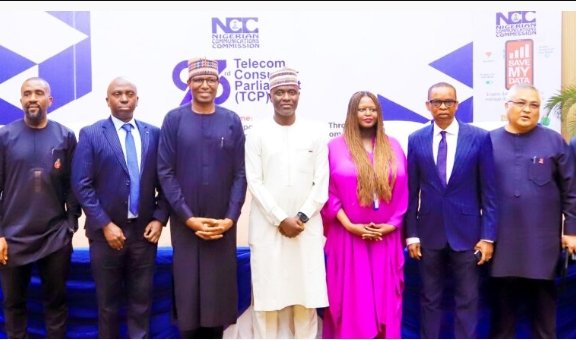
The Executive Vice Chairman, Nigerian Communications Commission (NCC), Dr. Aminu Maida, on Thursday November 7th, addressed the 93rd Telecoms Consumer Parliament, focusing on enhancing consumers’ data experiences in Nigeria’s digital landscape.

Speaking on the theme,“Optimizing Data Experience”, Dr Maida acknowledged the nation’s rapid growth in data use, fueled by digital advancements and the adoption of 4G and 5G technology.

The NCC Boss explained common consumer issues, such as unexpected data depletion, which are partly due to advanced devices and high-resolution content. He highlighted NCC’s new initiatives, including a campaign for smarter data usage and simplified billing transparency, aimed at helping consumers make informed choices.

The EVC also spoke on challenges faced by the telecom sector, such as vandalism and high operating costs, and highlighted the recent Presidential Order declaring telecom infrastructure as “Critical National Information Infrastructure.” This protection aims to curb vandalism and improve service reliability.

Concluding, the EVC reiterated NCC’s commitment to a consumer-focused telecom industry, promising new resources like incident reports and network coverage maps to empower Nigerians in their telecom choices. The parliament encouraged an open dialogue, ensuring that consumers’ voices are valued and heard.

November 9, 2024 0 comments
0 FacebookTwitterPinterestThreadsBlueskyEmail
Headlines

BREAKING: NCC flags Starlink for tariff hike without regulatory approval

by Folarin Kehinde October 8, 2024
written by Folarin Kehinde

The Nigerian Communications Commission (NCC) has disclosed that the decision by Starlink to unilaterally review its subscription packages upwards did not receive regulatory approval.

The Director of Public Affairs, NCC Reuben Muoka, made the disclosure in a statement released on Tuesday stated that the commission is surprised that the company jumped the gun by announcing price changes after filing a request to the Commission seeking approval for price adjustment for which the Commission was yet to communicate a decision.

“The action of the company appears to be a contravention of Sections 108 and 111 of the Nigerian Communications Act (NCA) 2003, and Starlink’s Licence Conditions regarding tariffs.

“The Commission will, therefore, take appropriate enforcement measures against any action by a licensee that is capable of eroding the regulatory stability of the telecommunications industry,” the statement reads.

Recall Starlink recently announced a significant price increase for its services in Nigeria, raising monthly subscription fees by as much as 97%. The standard service subscription has increased from NGN 38,000 (USD 22.8) to NGN 75,000 (USD 50) monthly.

October 8, 2024 0 comments
0 FacebookTwitterPinterestThreadsBlueskyEmail
Headlines

NCC Eyes 6GHz Spectrum to enhance connectivity across Nigeria

by Folarin Kehinde September 20, 2024
written by Folarin Kehinde

The Nigerian Communications Commission is set to unlock the 6GHz frequency band for unlicensed Wi-Fi use, marking a significant milestone in the nation’s push to enhance connectivity across the country.

By opening this spectrum, the commission says it is empowering faster, more reliable wireless internet access, paving the way for innovations in smart technologies, improved digital experiences, and bridging the digital divide.

The commission stated that the strategic move promises to boost network capacity, lower latency, and fuel Nigeria’s digital economy, fostering greater internet access for businesses, homes, and public spaces across the country.

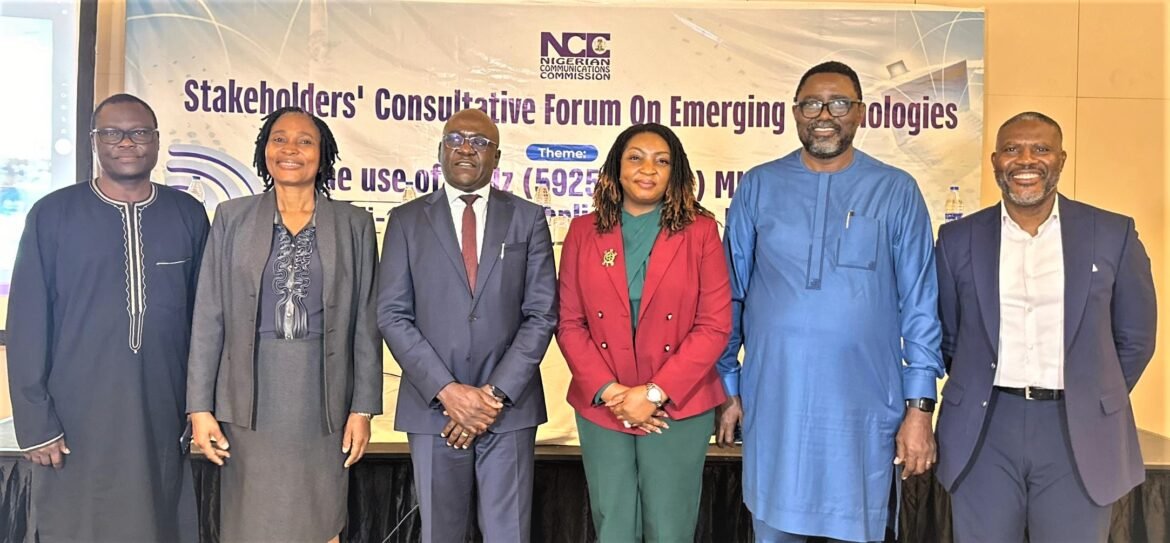
Executive Vice Chairman of NCC, Dr. Aminu Maida while speaking at the Annual Stakeholders Consultative Forum on Emerging Technologies in Lagos, highlighted the growing strain on current Wi-Fi frequencies due to rising demand
emphasizing that the 5GHz and 2.4GHz bands, commonly used for Wi-Fi 5, are becoming overwhelmed.

Maida represented by represented by Engr. Abraham Oshadami, Executive Commissioner of Technical Services, stated that operators are pushing for public-private partnerships (PPPs) to capitalize on this moment, aiming to expand their networks into underserved and vulnerable regions. They see it as an opportunity to bridge gaps in connectivity and provide crucial services where they’re most needed.

He noted that as internet usage surges, the need for additional frequency bands to ease the burden on existing ones is becoming increasingly urgent, emphasizing the importance of exploring new spectrum options for future connectivity needs.

Nigeria is set to join a growing number of countries leveraging the 6GHz band for Wi-Fi 6 technology, according to Maida. She highlighted that the 6GHz band, spanning from 5925 MHz to 7125 MHz, will unlock a vast new spectrum.

This expansion is crucial for accommodating the increasing demand for high-speed internet and advanced applications, marking a significant step in Nigeria’s digital evolution.

September 20, 2024 0 comments
0 FacebookTwitterPinterestThreadsBlueskyEmail
Headlines

BREAKING: NCC Announces Deadline for NIN-SIM linkage Compliance

by Folarin Kehinde August 28, 2024
written by Folarin Kehinde

The Nigerian Communications Commission (NCC) is pleased to announce significant progress in the Federal Government’s 2020 policy to link all Subscriber Identification Modules (SIMs) to National Identity Numbers (NINs).

To date, over 153 million SIMs have been successfully linked to a NIN, reflecting an impressive compliance rate of 96 per cent, a substantial increase from 69.7 per cent in January 2024.

As we approach the final phase of this critical process, the NCC seeks the continued cooperation of all Nigerians to achieve 100 per cent compliance. The complete linkage of all SIM cards to NINs is essential for enhancing the trust and security of our digital economy.

By verifying all mobile users, this policy strengthens confidence in digital transactions, reduces the risk of fraud and cybercrime, and supports greater participation in e-commerce, digital banking, and mobile money services. This, in turn, promotes financial inclusion and drives economic growth.

Through collaboration with the Office of the National Security Adviser (ONSA) and the National Identity Management Commission (NIMC), the NCC has uncovered alarming cases where individuals possessed an unusually high number of SIM cards—some exceeding 100,000.

The Commission also remains committed to working with security agencies and other stakeholders to crack down on the sale of pre-registered SIMs, thereby safeguarding national security and ensuring the integrity of mobile numbers in Nigeria.

To ensure full compliance with the NIN-SIM linkage policy, the NCC has directed all Mobile Network Operators (MNOs) to complete the mandatory verification and linkage of SIMs to NINs by September 14, 2024.

Effective September 15, 2024, the Commission expects that no SIM operating in Nigeria will be without a valid NIN.

We urge all members of the public who have not yet completed their NIN-SIM linkage, or who have faced issues due to verification mismatches, to visit their service providers promptly to update their details before the deadline. Alternatively, the approved self-service portals are available for this purpose.

The NCC also reminds the public that the sale and purchase of pre-registered SIMs are criminal offences punishable by imprisonment and fines. We encourage citizensto report any such activities to the Commission via our toll-free line (622) or through our social media platforms.

The Commission thanks the general public for its continued cooperation as we work together to strengthen Nigeria’s digital ecosystem.

August 28, 2024 0 comments
0 FacebookTwitterPinterestThreadsBlueskyEmail
Headlines

NCC Denies Approval of Telecom Tariff Increase, internet speed reduction

by Folarin Kehinde August 5, 2024
written by Folarin Kehinde

The Nigeria Communications Commission (NCC) has clarified that it has not approved any increase in telecom tariffs, contrary to recent misleading reports.

Dr. Aminu Maida, Executive Vice-Chairman/CEO of the NCC, issued a statement on his verified X account on Saturday addressing the false information circulating within the telecom sector.

He described the report as “fake news” and stressed that there have been no new tariff hikes for Mobile Network Operators (MNOs) or any increases in telecom services for consumers.

Leading reporters gathered that the confusion results from a document, titled, “Guidance on the Simplification of Tariffs in the Nigerian Communications Sector,” recently posted on the NCC’s website.

An online news had claimed that the NCC approved tariff increases for MTN, Airtel, Glo, and other telecom companies, affecting voice, SMS, data, and other services, adding the development had resulted in higher costs for Nigerians.

August 5, 2024 0 comments
0 FacebookTwitterPinterestThreadsBlueskyEmail
Opinion

NCC: A Digital Enabler of the Renewed Hope Agenda

by Folarin Kehinde May 30, 2024
written by Folarin Kehinde

In Nigeria, a young tech-savvy and upwardly mobile population is teeming, and exploring derivable benefits of digital technologies. They are propelled by rapidly expanding internet access and steady broadband penetration, currently about 43 per cent. Our digital economy is poised for significant growth, positively impacting various sectors and benefiting the nation through enhanced connectivity and digital skills.

Digital transformation is happening globally at a record pace. During the Covid-19 pandemic, for example, remote work and virtual collaboration tools took centre stage; platforms such as Zoom, Microsoft Teams, and Google Meet became—and still are—essential for meetings, conferences and team collaboration. E-commerce and online retail have transformed how consumers seamlessly order and receive goods and services.

Even traditionally brick-and-mortar businesses are changing the ways they engage with their customers through introduction of digital solutions to improve the customer experience. It is a no-brainer that Artificial Intelligence (AI) and the Internet of Things (IoT) are revolutionising our lives for the better, whether in education, healthcare delivery, living, public services, energy management, and much more.

Suffice to say, that underpinning this global digital transformation is the indispensable role of telecommunications infrastructure. Universal, affordable, reliable and fast telecom services are becoming social rights, as mobile networks and data-centres form the backbone for digital transformation by enabling the storage and processing of large amounts of data as well as the integration of digital technologies into numerous use cases.

For President Bola Ahmed Tinubu, the Renewed Hope Agenda draws us all to a more promising outlook. Inherent in his agenda is the pledge to embolden and support the youth and women by harnessing emerging sectors such as the digital economy. In delivering this vision, the Honourable Minister of Communications, Innovation and Digital Economy, Dr. Bosun Tijani unveiled a blueprint appropriately titled – “Accelerating our Collective Prosperity through Technical Efficiency” with the goal of supporting Nigeria’s economic growth by enhancing productivity, facilitated by digital innovation.

Acknowledging the criticality of resilient telecommunications infrastructure to a robust digital economy, Dr. Tijani’s Strategic Agenda 2023 — 2027 sets targets to achieve a 50 per cent improvement in Quality of Service (QoS) by the end of 2024; to boost Nigeria’s broadband penetration rate to 70 per cent by the end of 2025; to deliver data download speed of 25Mbps in urban areas and 10Mbps in rural areas by the end of 2025; to provide coverage for, at least, 80 per cent of the country’s population, especially the underserved and unserved populations by the end of 2026; to reduce the gap of unconnected Nigerians in rural areas from 61 per cent to less than 20 per cent by 2027; and to secure between 300 per cent to 500 per cent increase in broadband investment by the end of 2027.

Drawing from the Strategic Agenda of the Ministry, Dr. Aminu Maida, the Executive Vice Chairman and Chief Executive Officer of the Nigerian Communications Commission, (NCC) has emplaced three Strategic Focus Areas for the Commission: The Consumers, the Industry and Licensees; and the Government.

Dr. Maida’s approach to delivering on President Bola Tinubu’s Renewed Hope Agenda comes from the recognition that each of these stakeholders has a unique perspective and different, occasionally-paradoxical expectations of the Commission. His goal is to forge a path that carefully balances each stakeholder’s needs while meeting their expectations.

Consider the Consumers—who are central to Dr. Maida’s focus—for example. His approach focuses on ensuring that they receive an enhanced Quality of Experience, beyond the narrow and very technically-evaluated Quality of Service. Quality of experience takes into account all touch points along the consumers journey in using telecom services from selection, through on boarding, usage, support and even off-boarding.

This means that, consumers are empowered to make the right network selection, enjoy a seamless onboarding into the network of their choice, enjoy quality service at fair costs, receive responsive customer service and enjoy protected off-boarding where they chose to leave the network.

To address consumer complaints on data depletion, the Commission has directed Mobile Network Operators (MNOs) to conduct an independent audit of their billing systems and is concluding a consultation process to simplify tariff plans. These initiatives would provide enhanced transparency to the consumer.

The Commission, under Dr. Maida, rather than taking a national outlook on data collection for Quality-of-Service delivery, has adopted an approach where more granular data is collected from operators and analysed to determine quality of service at very small, local levels, to allow the deployment of optimised solutions or regulatory actions where needed.

On the side of the Industry and Licensees of the Commission, Dr. Maida’s focus is aimed at forging a resilient industry and enhancing the delivery of regulatory services. Since he came on board, the Commission has shown commitment to tackling industry debt issues more seriously. It has also embarked on critical advocacy initiatives to address long-term challenges in the sector, including advocacy for designating telecom infrastructure as Critical National Infrastructure, as well as successfully persuading over six states to waive Right of Way (RoW) fees, even as he initiates discussions with more states.

The Commission, under Dr. Maida’s leadership, is equally engaging with the Presidential Committee on Fiscal Policy and Tax Reforms towards addressing multiple taxation issues in the telecoms sector.

In order to ensure that the industry is in line with current realities, the Commission is also undertaking a review of its extant Regulatory Instruments and Licensing Frameworks. For instance, Quality of Service Regulations have been reviewed to incorporate Key Performance Indicators (KPIs) for 5G and other participants that are critical to the Quality of Service.

By achieving expected QoS KPIs, high-speed internet connectivity, and forging a resilient and innovative telecommunications industry, the Commission is actively supporting the Ministry’s vision of boosting economic growth and productivity through technological innovation, delivering on the promise of Renewed Hope for all Nigerians.

May 30, 2024 0 comments
0 FacebookTwitterPinterestThreadsBlueskyEmail
Headlines

NIMC Server Hacked, As Millions of Nigerian NIN Stolen

by Leading Reporters February 9, 2022
written by Leading Reporters

Over three million National Identity Numbers of Nigerians have been stolen after a hacker known only as Sam broke into the server of the National Identity Management Commission.

Revealing how easy it was for him to breach the NIMC server and access personal information of millions of Nigerians in an article he shared on infosecwriteups.com, the hacker boasted that he got access to “juice” on the Nigerian Government agency’s server and that he could go ahead to do whatever he desired with other sensitive data at his disposal.

As the technical hitch that has bedeviled the portal of the National Identity Management Commission (NIMC) persisted yesterday, it is feared that the portal may have been compromised by hackers, data security experts have said, However, Engr. Aliyu A. Aziz DG/CEO is yet to commit.

It was revealed that telcos had continued to turn back subscribers seeking to retrieve lost, damaged or stolen SIM cards due to their inability to verify their customers’ NIN.

Responding to complaints from Twitter users, MTN Nigeria said it could not process SIM swap and update requests due to challenges with the NIMC portal.

“We are sorry we currently cannot process SIM swap and update requests due to external challenges. We appreciate your understanding and will post an update once this has been resolved,” MTN said.

Agencies such as immigration, police and road safety are among government agencies affected, according to officials.

Staffs of the Nigeria Immigration Service who spoke to Leading Reporters, that their are people who have been waiting for over 7 months for their NIN verifications to drop for international passport processing.

Displaying a defaced National Identity card of a Nigerian alongside the article, the hacker said, “I’ve got one more output for s3 bucket, I casually tried to access it without any hope, and damn! The s3 bucket is full of juice.

“I just simply got access to their (Nigeria) data of internal files, users and everything they have. I can download everything, even the whole bucket. I am sure that the bucket is full of juice.

“I wanted to look at more files but as we have to follow bug bounty rules I stopped doing more. 

“I’ve got one more s3 bucket with nuclei and it also contained about 4–5 gigs of data.

“I’ve rewarded 5250$ for only one report and 0$ for the second one even it contained so much sensitive data,” the hacker wrote in the article that has continued to generate reactions from some Nigerians on Twitter especially tech enthusiasts.

A user on the micro-blogging platform with the handle @isidags while reacting to the development said, “I’m shocked Nigerians are shocked.

“Seems you people don’t know the government and country you’re involved with.”

Another user known as @boluxxxx while commenting said, “Jokes aside, this is enough reason for Buhari to sack Pantami.”

Berating Nigeria’s weak cyber security, another Twitter user, @bespokeKENErd, said, “It was only a matter of time before this happened.

“Nigeria’s information security is ridiculously lax. So careless with sensitive data.”

@St_Gothica while reacting to the issue said, “This is exactly why I never wanted to do the NIN registration. Delayed it as long as I could.”

Another Twitter user, @The_Jonathanian, said, “Somebody should tell Sheik Pantami that the most sensitive data of Nigerians under his care have been compromised and floating in the wild.”

The hacking of the NIMC server has not only exposed Nigeria’s weak cyber security but also highlighted the danger the country’s residents and investments were currently under.

The latest cyber attack comes less than two months after the Nigerian Communications Commission in November 2021 issued a warning that an Iranian hacking group was planning to carry out cyber espionage across Africa.

A statement from the agency had further disclosed that the hackers were targeting telecoms, Internet Service Providers, and Ministries of Foreign Affairs in Nigeria and other African countries.

The incident also comes months after the President Muhammadu Buhari administration while mandating Nigerians to enroll for National Identification Number claimed that it was going to stop crimes in the country including those perpetrated via the Internet.

Speaking during the launch of the National Policy for the Promotion of Indigenous Content in Nigerian Telecoms Sector and Revised National Identity Policy for SIM Cards registration in May 2021, President Buhari said, “The NIN will cover one of the weaknesses in our security structure. We will be able to easily identify and know the personality of Nigerians.

“We will identify people easily, including the crooks.”

Assuring Nigerians of how vital the new system would be to crime fighting in the country, Minister of Communications and Digital Economy, Isa Pantami, in June 2021, claimed that incidents of terror such as banditry and kidnapping in the country had significantly reduced as a result of the insistence by government for persons in Nigeria to register for NIN.

Pantami went further to say that the improved database will protect Nigerians more than ever before.

But despite those assurances, the latest attack has exposed the failure of the President Buhari administration to protect Nigerians from cyber criminals.

Over 60 million Nigerians had so far been captured on the national identity database, according to the NIMC. 

NIMC denies hacking

NIMC debunked the notion that its portal has been hacked, but that the portal was only undergoing routine maintenance.

Over 60 million Nigerians and legal residents of the country have been registered and given their unique identity numbers otherwise known as NIN.

We further reports that some banks and telecommunication operators in the country have refused to attend to some customers since last week due to the “maintenance” being carried out on the identity portal. 

The federal government has made it compulsory for Nigerians to supply their NIN before they can access certain services offered by some private companies and government agencies.

When the NINs are supplied, the companies and agencies will then verify the unique numbers using the NIN verification portal of NIMC. 

However, NIMC’s portal has been down since last week and the development is said to have affected the issuance of international passport, account opening at banks and SIM replacement by telecommunications operators.

NIMC, in a statement on Monday by its spokesperson, Kayode Adegoke, said it was an unreasonable action for the organisations to shirk their duties.

The commission said these organisations had an alternative platform through which they could render services. The alternative platform according to NIMC is TOKENISATION. “Tokenization is working!!!”. Declare NIMC.

Adegoke, who is the NIMC Head Corporate Communications, said:  “Even though the NIN verification service (NVS) might be down due to maintenance by one of our service providers of its infrastructure, the alternative platform – TOKENISATION is up and running. No one should be debarred of any service on the guise of NIN not being verified”.

“The NVS issue has not in any way affected our other operations and services-Enrollment/issuance of NIN and other services going on”.

“There is the need to ask questions from the Telcos, The Nigerian Immigration Service (NIS), Banks and others on the reason for turning down customers in the guise of NIN not being verified due to the temporary unavailability of the NVS, while the alternative platform- Tokenization is working!!!

“NIMC NVS platform is not the only verification platform available for use, but Tokenisation which protects the identity of NIN holders is also up and running!!!

“And for accurate information, it is not a NIMC problem, rather, a government service provider has embarked on maintenance of its infrastructure, which has affected most government agencies that rely on it for the provision of IT service.”

Galaxy Backbone contradicts NIMC claims on maintenance

Galaxybackbone, a government agency which mandate is to store all data for MDAs and provide backup for their data, apologised for the temporary service outage on the network.

“The management of Galaxy Backbone Limited (GBB) regrets the temporary outage of some of its services and the inconvenience being experienced by some of its customers across the country”, the agency said in a statement signed by its Head of Communications, Chidi Okpara. News Credit: saharareporters/dailytrust

February 9, 2022 0 comments
0 FacebookTwitterPinterestThreadsBlueskyEmail

Recent Posts

  • Engine Failure: Passengers escape death as Arik Air makes emergency landing

    February 11, 2026
  • Tinubu Welcomed into Labour Party – Abia Deputy Governor Emetu

    February 10, 2026
  • Senate adopts electronic, manual transmission of election results

    February 10, 2026
  • BURSTED: NSITF CEO MOVES On ₦297Billion Fund, Operates Over 100 Bank Accounts Linked To One BVN

    February 9, 2026
  • Peter Obi joins #OccupyNationalAssembly protest over electronic transmission of results

    February 9, 2026

Usefull Links

  • Contact Page
  • About Leading Reporters
  • Contact Us
  • Headlines
  • Investigation
  • Exclusives
  • Opinion
  • Business
  • Facebook
  • Twitter
  • Instagram
  • Linkedin

@2021 - All Right Reserved. Designed and Developed by PenciDesign


Back To Top
Leading Reporters
  • Featured
  • Politics
  • Opinion
  • Business
  • Entertainment
  • Sports
  • About Us
  • Contact