
Leading Reporters
  • Headlines
  • Health
  • Business
  • Exclusives
  • Investigation
  • Entertainment
  • Opinion
Thursday, March 12, 2026
Hot
Reps prescribe 2-year jail term, 10m fine for...
Row In Senate As Natasha Akpoti-Uduaghan Dropped From...
Fire Breaks Out At Federal Head Of Service...
Police reportedly remove force PRO Hundeyin 6 months...
BREAKING: Tinubu appoints Taiwo Oyedele as Minister
“If I Run for President, Nigerians Will Vote...
Fuel Price in Nigeria Set to Increase amid...
INEC Shifts 2027 General Elections to January, February...
TINUBU DECORATES DISU AS ACTING INSPECTOR GENERAL OF...
Gunmen invade church in Ondo, abduct six worshippers
  • About Leading Reporters
  • Contact Us
Leading Reporters
Advertise With Us
  • Headlines
  • Health
  • Business
  • Exclusives
  • Investigation
  • Entertainment
  • Opinion
Hot
Reps prescribe 2-year jail term, 10m fine for...
Row In Senate As Natasha Akpoti-Uduaghan Dropped From...
Fire Breaks Out At Federal Head Of Service...
Police reportedly remove force PRO Hundeyin 6 months...
BREAKING: Tinubu appoints Taiwo Oyedele as Minister
“If I Run for President, Nigerians Will Vote...
Fuel Price in Nigeria Set to Increase amid...
INEC Shifts 2027 General Elections to January, February...
TINUBU DECORATES DISU AS ACTING INSPECTOR GENERAL OF...
Gunmen invade church in Ondo, abduct six worshippers
Leading Reporters
Leading Reporters
  • Headlines
  • Health
  • Business
  • Exclusives
  • Investigation
  • Entertainment
  • Opinion
Copyright 2024 - All Right Reserved
Home > IMF
Tag:

IMF

IMF
Business

IMF Projects Nigeria’s Inflation to Rise to 37% in 2026

by Nelson Ugwuagbo April 23, 2025
written by Nelson Ugwuagbo

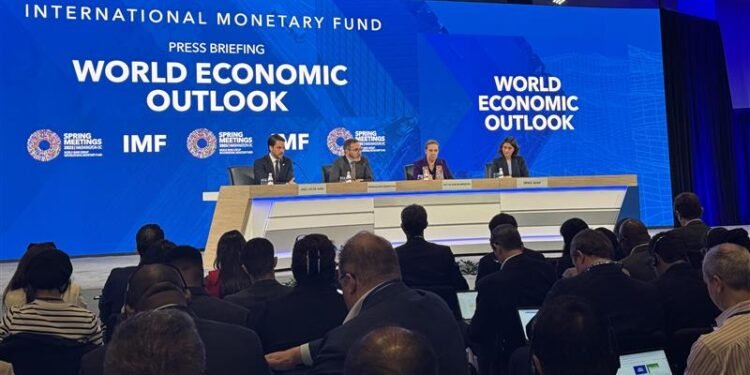
The International Monetary Fund (IMF) has forecast that Nigeria’s headline inflation will climb to 37.0 percent in 2026, highlighting persistent concerns over price stability in the country.

The projection was revealed in the IMF’s April 2025 World Economic Outlook (WEO), which outlines Nigeria’s macroeconomic outlook amid ongoing structural reforms and global economic uncertainties.

The Fund had earlier projected a temporary easing, with inflation expected to average 26.5 percent in 2025, down from 33.2 percent in 2024. However, the anticipated rebound in 2026 signals that underlying inflationary pressures remain unresolved.

The IMF warned that, despite short-term adjustments, sustained efforts will be required to address the structural factors driving inflation and to stabilise the country’s economy.

April 23, 2025 0 comments
0 FacebookTwitterPinterestThreadsBlueskyEmail
Tinubu
Business

“We strongly support Tinubu’s Economic Reforms” – IMF

by Nelson Ugwuagbo November 21, 2024
written by Nelson Ugwuagbo

Kristalina Georgieva, Managing Director of the International Monetary Fund (IMF), has expressed strong support for Nigeria’s economic reforms under President Bola Tinubu’s administration.

Georgieva made the statement on Thursday via her official X account following a meeting with Tinubu on the sidelines of the G20 Summit in Brazil.

“Excellent meeting with 🇳🇬 President @officialABAT at the #G20 Summit,” Georgieva wrote. “Commended Nigeria’s decisive actions to reform the economy, accelerate growth, and generate jobs for its vibrant population. The IMF strongly supports Nigeria on this journey.”

The Tinubu administration has implemented several key reforms, including the removal of the petrol subsidy, liberalisation of the foreign exchange system, and deregulation of the petroleum downstream sector. These measures are aimed at resetting Nigeria’s economy, rebuilding investor confidence, and attracting investments in critical sectors.

In a speech on June 12, marking Nigeria’s 25th Democracy Day, Tinubu acknowledged the country’s economic instability and highlighted the urgency of implementing long-overdue reforms. He assured Nigerians that his administration was working to address the nation’s economic challenges.

The World Bank also lauded the reforms during the launch of the Nigeria Development Update (NDU) report on October 17 in Abuja. It noted that while the policies have begun yielding positive outcomes, widespread economic hardship persists. The World Bank warned that reversing the reforms would have devastating consequences for Nigeria.

The IMF and other global financial institutions continue to advocate for the continuity of these reforms to ensure long-term economic stability and growth for the country.

November 21, 2024 0 comments
0 FacebookTwitterPinterestThreadsBlueskyEmail
Headlines

Tinubu’s Reforms Not Working, IMF Report Reveals

by Folarin Kehinde November 16, 2024
written by Folarin Kehinde

The International Monetary Fund (IMF) has raised concerns about the effectiveness of Nigeria’s ongoing economic reforms under President Bola Tinubu.

In its latest report on the economic outlook for sub-Saharan Africa, the IMF revealed that Nigeria is struggling to achieve significant progress 18 months after implementing key reforms.

Nigeria is grappling with its worst economic crisis in nearly 30 years. In May last year, the president announced the abrupt removal of fuel subsidy. Subsequently, he unified the exchange rates among other economic policies implementation.

The recent report by IMF, presented on Friday at the Lagos Business School by Catherine Patillo, IMF Deputy Director, highlighted successes in countries such as Côte d’Ivoire, Ghana, and Zambia. Unfortunately, Nigeria was notably absent from the list of nations demonstrating positive outcomes from reform efforts.

The report projected an average economic growth rate of 3.6% for sub-Saharan Africa in 2024. However, Nigeria’s growth rate is expected to lag at 3.19%, placing the country below the regional average. The IMF noted that while many African nations are reducing macroeconomic imbalances, Nigeria remains an outlier in its struggle to stabilize its economy.

Inflation remains a pressing issue in Nigeria. Although there was a brief slowdown in July and August, inflation resumed its climb in September and October, reaching 33.8%. This figure is far above the 21% target set for 2024, and analysts expect further increases before the year ends.

The IMF also pointed out Nigeria’s exchange rate instability as a significant challenge. Unlike other nations in the region that have reduced foreign exchange pressures.

Another major issue highlighted in the report is Nigeria’s heavy debt servicing burden. The IMF revealed that Nigeria, alongside Angola, Ghana, and Zambia, spends an alarming 15% of total revenue on interest payments. This high level of debt servicing limits the country’s ability to invest in critical areas such as infrastructure and social programs.

The IMF has advised Nigeria to rethink its approach to reforms. Recommendations include improving communication, offering compensatory measures to ease the impact of reforms, and designing policies that address public concerns.

“This will require greater attention to communication and engagement strategies, reform design, compensatory measures, and rebuilding trust in public institutions,” the report advised.

November 16, 2024 0 comments
0 FacebookTwitterPinterestThreadsBlueskyEmail

Recent Posts

  • Reps prescribe 2-year jail term, 10m fine for dual party membership

    March 11, 2026
  • Row In Senate As Natasha Akpoti-Uduaghan Dropped From UN Summit Delegation

    March 10, 2026
  • Energy Crisis: Restore Fuel Subsidy, Fix Refineries Now — Faduri

    March 10, 2026
  • Tatum Bank Meets CBN’s New Recapitalization, within 10 Months of Operation

    March 10, 2026
  • Fire Breaks Out At Federal Head Of Service Building In Abuja

    March 9, 2026

Usefull Links

  • Contact Page
  • About Leading Reporters
  • Contact Us
  • Headlines
  • Investigation
  • Exclusives
  • Opinion
  • Business
  • Facebook
  • Twitter
  • Instagram
  • Linkedin

@2021 - All Right Reserved. Designed and Developed by PenciDesign


Back To Top
Leading Reporters
  • Featured
  • Politics
  • Opinion
  • Business
  • Entertainment
  • Sports
  • About Us
  • Contact