
Leading Reporters
  • Headlines
  • Health
  • Business
  • Exclusives
  • Investigation
  • Entertainment
  • Opinion
Thursday, March 12, 2026
Hot
Reps prescribe 2-year jail term, 10m fine for...
Row In Senate As Natasha Akpoti-Uduaghan Dropped From...
Fire Breaks Out At Federal Head Of Service...
Police reportedly remove force PRO Hundeyin 6 months...
BREAKING: Tinubu appoints Taiwo Oyedele as Minister
“If I Run for President, Nigerians Will Vote...
Fuel Price in Nigeria Set to Increase amid...
INEC Shifts 2027 General Elections to January, February...
TINUBU DECORATES DISU AS ACTING INSPECTOR GENERAL OF...
Gunmen invade church in Ondo, abduct six worshippers
  • About Leading Reporters
  • Contact Us
Leading Reporters
Advertise With Us
  • Headlines
  • Health
  • Business
  • Exclusives
  • Investigation
  • Entertainment
  • Opinion
Hot
Reps prescribe 2-year jail term, 10m fine for...
Row In Senate As Natasha Akpoti-Uduaghan Dropped From...
Fire Breaks Out At Federal Head Of Service...
Police reportedly remove force PRO Hundeyin 6 months...
BREAKING: Tinubu appoints Taiwo Oyedele as Minister
“If I Run for President, Nigerians Will Vote...
Fuel Price in Nigeria Set to Increase amid...
INEC Shifts 2027 General Elections to January, February...
TINUBU DECORATES DISU AS ACTING INSPECTOR GENERAL OF...
Gunmen invade church in Ondo, abduct six worshippers
Leading Reporters
Leading Reporters
  • Headlines
  • Health
  • Business
  • Exclusives
  • Investigation
  • Entertainment
  • Opinion
Copyright 2024 - All Right Reserved
Home > climate crisis
Tag:

climate crisis

Africa & WorldBusiness

Among 20 Companies Behind World Environmental Pollution, One Operates in Nigeria

by Leading Reporters May 20, 2021
written by Leading Reporters

In 2019, more than 130 million metric tons of single-use plastics were thrown away, with most of that waste burned, buried in a landfill or dumped directly into the ocean or onto land.

Now, a new report finds that just 20 companies account for more than half of all single-use plastic waste generated worldwide. One of the companies, according to the study is Exxon Mobil, an oil exploration company operating in Nigeria through its affiliate company, Mobil Producing Nigeria Unlimited.

The report, published Tuesday by Australia’s Minderoo Foundation, offers one of the fullest accounting, to date, of the companies behind the production of single-use plastics that researchers believe could account for as much as 10% of global greenhouse emissions by 2050.

Single-use plastics are meant to be thrown out immediately after use, such as bags, drinking straws, bottles and packaging.

The study identifies 20 companies as the source of 55% of the world’s single-use plastic waste, while the top 100 companies account for more than 90%.

Nearly all the single-use plastic manufactured by these companies — 98% according to the report — is made from ” ‘virgin’ (fossil-fuel-based) feedstocks” rather than recycled materials.

At the top of what the foundation calls its “Plastic Waste Makers Index” is the energy giant Exxon Mobil, followed by the Dow Chemical Co. and China’s Sinopec. The report found that Exxon Mobil was responsible for 5.9 million metric tons of such waste in 2019, while Dow and Sinopec contributed 5.6 million and 5.3 million, respectively. Taken together, the three companies account for 16% of all waste from single-use plastics such as bottles, bags and food packaging, according to the report.

In a statement, Exxon Mobil said it “shares society’s concern about plastic waste.” The company said it is “taking action to address plastic waste” but said the problem requires collective action from “industry, governments, nongovernmental organizations and consumers” alike.

The report also traced the money invested in the production of single-use plastics, finding that 20 institutional asset managers hold shares worth close to $300 billion in the parent companies that make up the foundation’s rankings. The top three investors are U.S.-based Vanguard Group, BlackRock and Capital Group, which according to the report have an estimated $6 billion invested in the production of single-use plastics.

“The trajectories of the climate crisis and the plastic waste crisis are strikingly similar — and increasingly intertwined,” former Vice President Al Gore said in a statement that accompanied the report.

“Since most plastic is made from oil and gas — especially fracked gas — the production and consumption of plastic are becoming a significant driver of the climate crisis, already producing greenhouse gas emissions on the same scale as a large country and causing the emission of other harmful toxins from plastics facilities into nearby communities — disproportionately harming people of color and those in low-income communities,” he wrote.

The report warned that in the next five years, the global capacity to produce the materials needed for single-use plastics could grow by more than 30%.

“An environmental catastrophe beckons: much of the resulting single-use plastic waste will end up as pollution in developing countries with poor waste management systems,” according to the report.

Solving the issue will require drastic changes from producers, investors and banks, the authors wrote. The report said that producers of polymers — known as the building blocks of plastics — should begin disclosing their single-use plastic waste “footprint,” while banks and investors should move to “phase out entirely” any financing that goes toward the production of single-use plastics.

But confronting the challenge will also require “immense political will,” according to the authors, who noted that roughly 30% of the sector, by value, is state-owned.


May 20, 2021 0 comments
0 FacebookTwitterPinterestThreadsBlueskyEmail
Africa & WorldBusiness

World’s third Climate Clock arrives in South Korea

by Leading Reporters May 14, 2021
written by Leading Reporters

Herald Corp. installs Climate Clock on roof of Seoul headquarters to raise awareness about climate crisis…

At a glance, the series of numbers — six years, 235 days, six hours, four minutes and 55 seconds — makes little sense.

But they are arguably the most important numbers for humanity. They represent the time we have left until the Earth’s deadline: the “point of no return” in the climate crisis.

The monument-sized Climate Clock showing the numbers was unveiled Thursday on the roof of the Herald Corp. headquarters in Seoul, sending a chilling warning that the Earth is racing toward catastrophe.

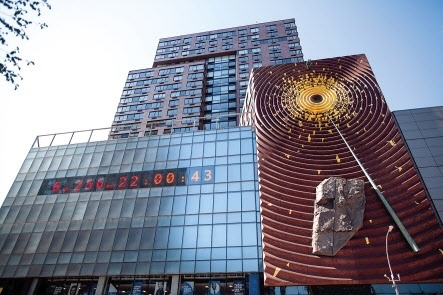
The digital clock, which is 8.5 meters wide and 1.8 meters long, is the first permanent Climate Clock in Asia and the third in the world. The first was set up in Berlin in 2019 and the second in New York in 2020. 

With South Korea’s landmark N Seoul Tower in the background, the Climate Clock in Seoul shows that as of Thursday the Earth had about six years, 235 days, six hours, four minutes and 55 seconds before global warming reaches irreversible levels, based on current emission rates.

The Climate Clock installed in Berlin, Germany in 2019. (The Climate Clock)
The Climate Clock installed in New York City, the US in 2020. (The Climate Clock)

Created by artists Gan Golan and Andrew Boyd, the Climate Clock counts down how much time is left before we deplete the Earth’s carbon budget — that is, the amount of carbon dioxide we can still release into the atmosphere while limiting global warming to 1.5 degrees Celsius above preindustrial levels.

According to scientists, keeping the world from warming by more than 1.5 degrees Celsius from preindustrial levels is crucial if we are to avoid the catastrophic impact of climate change — rising sea levels, flooding, droughts, extreme heat waves, wildfires and other disasters.

“Grounded in the latest climate science, the Climate Clock tells us what we need to do by when,” Boyd told The Korea Herald. “In short, we need to build a 100 percent renewable-powered future in less than seven years.”

The numbers on the Climate Clock are based on the amount of global carbon emissions as well as the amount of the world’s energy supplied from renewable sources, currently at 12 percent and slowly rising. The data comes from the Mercator Research Institute on Global Commons and Climate Change, and from One World in Data, respectively.

The arrival of the Climate Clock is part of the Herald Corp.’s campaign to address the climate emergency, which the company sees as the defining challenge of our time.

Through the campaign, Herald Corp., which owns two of Korea’s major newspapers, The Korea Herald and The Herald Business, seeks to draw attention to the climate crisis and remind Koreans that the Earth has a deadline, it said. 

The monument-sized Climate Clock, which is the third of its kind in the world and the first in Korea, is set up on the roof of the Herald Corp. headquarters office in Huam-dong, Yongsan-gu, Seoul. (Park Hae-mook/The Herald Business)

The Climate Clock’s co-creators welcomed its presence in Seoul.

“After too many years where governments and major media platforms did not take the climate crisis seriously enough, it is incredibly heartening to partner with Herald Corp., who are making the climate emergency a priority focus of their reporting and advocacy,” Boyd said.

“Media companies and organizations such as The Korea Herald play an indispensable role in highlighting the urgency of the climate crisis as well as the many solution pathways, particularly the rapid deployment of renewable energy, available to address it,” he added.

The installation of the Climate Clock comes at a critical point for the global efforts to combat the climate crisis.

This year is marked by significant political events, including the P4G summit — Partnering for Green Growth and the Global Goals 2030 — to be held in Seoul on May 30-31, as well as the UN Climate Change Conference, also known as COP26, set for Glasgow on Nov. 1-12.

“We hope the Seoul Climate Clock will serve as a lightning rod for South Korea’s climate movement and raise the country-wide emission-reduction targets that South Korea brings to the COP26 UN Climate Summit in Glasgow, Scotland later this year,” said co-creator Golan.

“With luck, Seoul’s Climate Clock will not only spark momentum nationally, but also encourage other key countries in East Asia to raise their climate ambitions,” he added. 

The monument-sized Climate Clock, which is the third of its kind in the world and the first in Korea, is set up on the roof of the Herald Corp. headquarters office in Huam-dong, Yongsan-gu, Seoul. (Park Hae-mook/The Herald Business)

The Climate Clock project, which involves a team of artists, scientists, engineers, designers and activists from around the globe, is an open-source project presenting a “critical window” for internationally-coordinated action to reduce emissions and avert climate disaster.

According to the founders, the Climate Clocks — some small, others large — are being built temporarily or permanently at homes, schools and public spaces all over the world from Sydney to Istanbul. Another monumental clock is set to be unveiled in Rome in May at the earliest.

The creators said they had previously made a small-sized climate clock for Greta Thunberg, the teenage activist from Sweden, before her appearance at the United Nations Climate Action Summit in 2019.

In an effort to contribute to achieving climate equity and justice, the Climate Clock team charges licensing fees to for-profit organizations, municipalities and governments that want to set up the clocks. The funds are spent on activists seeking to bring the Climate Clocks to their cities, according to the organization.

For individuals hoping to make their own watches or portable clocks, free kits are available on its website.

By Ock Hyun-ju (laeticia.ock@heraldcorp.com)

May 14, 2021 0 comments
0 FacebookTwitterPinterestThreadsBlueskyEmail

Recent Posts

  • Reps prescribe 2-year jail term, 10m fine for dual party membership

    March 11, 2026
  • Row In Senate As Natasha Akpoti-Uduaghan Dropped From UN Summit Delegation

    March 10, 2026
  • Energy Crisis: Restore Fuel Subsidy, Fix Refineries Now — Faduri

    March 10, 2026
  • Tatum Bank Meets CBN’s New Recapitalization, within 10 Months of Operation

    March 10, 2026
  • Fire Breaks Out At Federal Head Of Service Building In Abuja

    March 9, 2026

Usefull Links

  • Contact Page
  • About Leading Reporters
  • Contact Us
  • Headlines
  • Investigation
  • Exclusives
  • Opinion
  • Business
  • Facebook
  • Twitter
  • Instagram
  • Linkedin

@2021 - All Right Reserved. Designed and Developed by PenciDesign


Back To Top
Leading Reporters
  • Featured
  • Politics
  • Opinion
  • Business
  • Entertainment
  • Sports
  • About Us
  • Contact