Leading Reporters
  • Headlines
  • Health
  • Business
  • Exclusives
  • Investigation
  • Entertainment
  • Opinion
Tuesday, January 27, 2026
Hot
FCTA Workers, NLC Storm Industrial Court, Demand Wike...
DisCos reject FG’s free meter plan
Nigerian-born nurse loses licence in Australia for sleeping...
BREAKING: Kano Gov Abba Yusuf dumps NNPP
National Grid Collapse For First Time in 2026
BREAKING: Tinubu approves posting of Ambassadors to U.S.,...
Insecurity: Kidnappers demand 17 motorcycles for release of...
FG to Abolish Hnd-Degree Dichotomy, Allow Polytechnics to...
AFCON Initiative drives stronger Nigeria Morocco cooperation
Obasanjo: I’ll Never Stop Having Children
  • About Leading Reporters
  • Contact Us
Leading Reporters
Advertise With Us
  • Headlines
  • Health
  • Business
  • Exclusives
  • Investigation
  • Entertainment
  • Opinion
Hot
FCTA Workers, NLC Storm Industrial Court, Demand Wike...
DisCos reject FG’s free meter plan
Nigerian-born nurse loses licence in Australia for sleeping...
BREAKING: Kano Gov Abba Yusuf dumps NNPP
National Grid Collapse For First Time in 2026
BREAKING: Tinubu approves posting of Ambassadors to U.S.,...
Insecurity: Kidnappers demand 17 motorcycles for release of...
FG to Abolish Hnd-Degree Dichotomy, Allow Polytechnics to...
AFCON Initiative drives stronger Nigeria Morocco cooperation
Obasanjo: I’ll Never Stop Having Children
Leading Reporters
Leading Reporters
  • Headlines
  • Health
  • Business
  • Exclusives
  • Investigation
  • Entertainment
  • Opinion
Copyright 2024 - All Right Reserved
Home > CBN Governor Godwin Emefiele
Tag:

CBN Governor Godwin Emefiele

Headlines

BREAKING:Tinubu Appoints Jim Obazee, EX-FRCN Boss to Probe CBN

by Leading Reporters July 30, 2023
written by Leading Reporters

Tinubu Appoints Jim Obazee, EX-FRCN Boss Who Almost Sacked Pastor Adeboye From RCCG To Probe CBN

President Bola Tinubu has appointed a Special Investigator to probe the Central Bank of Nigeria (CBN) and Related Entities.

In a letter sighted by Leading Reporters, the president named Jim Osayande Obazee, the Chief Executive Officer, Financial Reporting Council of Nigeria (FRCN), as the investigator.

The President asked the Special Investigator to investigate CBN and key Government Business Entities (GBEs).

He also said Obazee would report directly to his office.

“In accordance with the fundamental objective set forth in Section 15(5) of the Constitution of the Federal Republic of Nigeria 1999 (as amended), this administration is, today, continuing the fight against corruption by appointing you as a Special Investigator, to investigate the CBN and Related Entities. This appointment shall be with immediate effect and you are to report directly to my office.”

“The full terms of your engagement as Special Investigator shall be communicated to you in due course but, require that you immediately take steps to ensure the strengthening and probity of key Government Business Entities (GBEs), further block leakages in CBN and related GBEs and provide a comprehensive report on public wealth currently in the hands of corrupt individuals and establishments (whether private or public).

“You are to investigate the CBN and related entities using a suitably experienced, competent and capable team and work with relevant security and anti-corruption agencies to deliver on this assignment. I shall expect a weekly briefing on the progress being made,” the letter read.

The president also sent a copy of his directive suspending Godwin Emefiele as Governor of the CBN on June 9, 2023.

Emefiele has been in DSS custody since then. He was arraigned in court last week and granted bail but the secret police rearrested him.

Obazee had in the past led major investigations Central Bank of Nigeria (CBN); Bank of Industry (BOI); Zenith Bank of Nigeria Plc; Guaranty Trust Bank Plc and Access Bank Plc.

He has also participated in 16 technical committees including 1. Technical Committee on Accounting in the Petroleum Industry – Upstream Activities; Technical Committee on Accounting for Insurance Business; Technical Committee on Accounting for Statement of Cash Flows; Committee on Implementation Guide to Accounting for Leases and Technical Committee on Accounting in the Petroleum Industry – Downstream Activities among others.

Recall that Obazee, in connection with the implementation of the controversial corporate Governance Code 2016 made the headlines when Pastor Enoch Adeboye relinquished his position as the General Overseer of RCCG and announced Pastor Joseph Obayemi as the new overseer of the church.

The code limits the tenure for heads of religious groups and civil rights organisations to 20 years. He pushed for the implementation against Buhari’s wish.

July 30, 2023 0 comments
0 FacebookTwitterPinterestThreadsBlueskyEmail
Documents Reveal How Fmr CBN Governor, Emefiele Launder Public Funds Using Family's Account leading Reporters
Headlines

BREAKING: Documents Reveal How Fmr CBN Governor, Emefiele Launder Public Funds Using Family’s Account

by Leading Reporters July 14, 2023
written by Leading Reporters

It is not yet uhuru for the embattled former Central Bank of Nigeria Governor, Mr. Godwin Emefiele has Incriminating documents has revealed high level of corruption, nepotism, favoritism and gross abuse of office while he reigned supreme as the Governor of the Central Bank of Nigeria.

Discreet information gotten from this online revealed that Emefiele laundered money through a company registered in the name of his wife and other members of his family.

According to our findings, the company, Maggo Farms Limited was registered on October 18th 2018, with RC number 1533205 and address as 33, Ikorodu crescent, Dolphin Estate, Lagos State.

Those listed as directors and shareholders are; Magaret Emefiele Dunbiri, Ucheonye Anthony Mary, Godwin Emefiele Pammichukwu Junior and Andrew Emefiele Andres Olisehike.

It was gathered that even though the suspended CBN Governor’s wife claimed to have registered the Maggo Farms Limited in 2018, she actually registered the company on 19th May 2014, few months after the husband was named the substantive CBN Governor with the name, Maggo Farms.

Our findings revealed that instead of using her name, she fraudulently used one Oriekose Augustine as the director. She added another director with the same name but twisted it this time as Oriekose Oriekose Augustine as the second director. Ironically, the Maggo Farms has same 33, Ikorodu crescent, Dolphin Estate, Lagos State as its registered address in CAC with RC number 2301316.

Meanwhile, in Maggo Farms Limited website (www.maggofarms.com), the about us section agreed that “Maggo farms had been in existence since the February 2015”, thus confirming that the one bearing Augustine as director is owned by the Emefiele family.

Investigations revealed that this same Maggo Farms which is a business name with the Emefieles as beneficial owners is what they consistently used to collect the CBN Anchor borrowers fund. The account used in accessing the funds is 1014400833 with Zenith Bank.

The phone number attached to the bank statement to receive alerts is 08179564031. This number incidentally is registered to Mrs. Margaret Emefiele. Similarly, documents revealed that on 5th October 2021, the embattled CBN Governor’s wife secretly registered a company in the United Kingdom, which is not included in CCB asset declaration form.

The company named Coats Investment Group Limited has her and two others namely, Albert Kwabena Williams and Dan Wangi as directors. It has company number 13662708 and registered address as Flat 3, Dexter Court, Diary close, London, SW6 4HA, England. we also unearthed how the governor exercised impunity by collecting double money for himself and his wife from CBN. On November 11, 2020, Godwin Emefiele was paid the sum of N16,181,850 from CBN account into his Zenith Bank account number 2020000064.

It was titled ‘Board holiday pay for self to USA’. On the same day, another N16,181.850 was paid into the same Zenith Bank account belonging to Godwin Emefiele but this time, titled as ‘Board holiday for spouse to USA’.

In another incriminating document, this online medium discovered that despite collecting salaries from CBN, Emefiele received payments from the Nigerian Security Printing and Minting. One of such payments was made on 15th December 2020 to the tune of N9,988,000. More so, it was gathered that Emefiele entrenched NEM Insurance where his younger brother, George Augustine Emefiele is DGM (Marketing) as the major insurance company in CBN/NSPM.

Some of the payments made to the insurance company under Emefiele’s instruction are; on 5th March 2020, the CBN under Emefiele paid NEM Insurance N31,496,300.

On the same day, Emefiele ordered another payment of N135,628,125 from CBN account into NEM Insurance. NSPM on 3rd February 2020 also paid the insurance company N11,340,355. On 31st December 2020, NSPM also paid N31,479,123 while CBN on 10th November 2020 paid N17,938,375 to the company.

Meanwhile, Federal High Court in Abuja on Friday ordered the DSS to release the governor claiming that his detention is not just illegal but null and void. News Credit: Secret Reporters

July 14, 2023 0 comments
0 FacebookTwitterPinterestThreadsBlueskyEmail
ExclusivesHeadlines

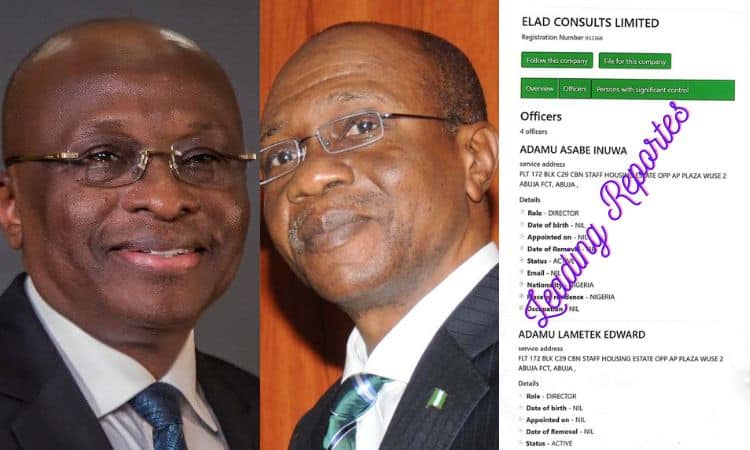
Corrupt CBN Deputy Governor Adamu Lametek schemes to replace Emiefele: Holds secret meetings with power brokers

by Leading Reporters January 18, 2023
written by Leading Reporters

That the times are rough for the Central Bank Governor Godwin Emiefele is not in doubt.  Aside from being on the radars of Nigeria’s secret police on allegations of terrorism financing, his closest associates are already selling out in a bid to drown him and take over the mantle of leadership in the apex bank.  At the fore of this betrayal journey, according to information unveiled LeadingReporters is Mr. Edward Lametek Adamu.

Information unearthed by LeadingReporters revealed that Mr. Lametek had previously retired from the Central Bank of Nigeria.  However, the Central Bank Governor Godwin Emiefele, in a bid to retain him rushed to President Muhammadu Buhari upon Lametek’s retirement and urged the President to extend a political appointment to Mr. Adamu as Deputy Governor of the Central Bank of Nigeria.  A request, President Muhammadu Buhari granted him.

Our findings however revealed that the retention of Mr. Adamu is in violation of the Nigeria Civil Service circular dated 27th July, 2009, Ref No. HCSF/EMS/EIR/B.63694/T2/96 with the subject “INTERPRETATION OF PUBLIC SERVICE RULES ON COMPULSORY RETIREMENT AGE/YEARS OF SERVICE IN RELATION TO TENURED APPOINTMENT OF the SERVICE OFFICERS.

The circular stated that career officers who have not retired or choose not to retire from service, before the commencement of their tenured appointment must leave office on the attainment of the mandatory AGE/YEAR of service for retirement.

Investigation launched by concerned Nigerians revealed that Lametek upon retirement was paid all his entitlements and retirements benefits, despite staying put in office.  He attained the age of 60 on the 22nd of June, 2019 and did not exit office before being appointed a Deputy Governor of CBN.

Between 15th of March, 2018 and 6th of November, 2018, Mr Lametek received N645,546,983 as part of his severance package, through his GTBank Account No 0023956749. Till date, Mr. Adamu has been in the employ of CBN collecting all entitlement and waiting for another severance package and entitlement at the expiration of his tenure as deputy governor.

Other allegations of corruption are that Adamu Lametek sits on the board of other private companies, which is contrary to the Code of Conduct Act (CCB&T Act, 5th Schedule, Part 1, Paragraph 1-11 to the 1999 Constitution of the Federal Republic of Nigeria which specifically bars civil and public servants from engaging in professions, trade and other enterprises that puts his activities against his official duties.  One of the companies is ELAD CONSULTS LTD.  The company, according to an investigation has been used for activities that contravene the laws of the Federal Republic of Nigeria.  

January 18, 2023 0 comments
0 FacebookTwitterPinterestThreadsBlueskyEmail
Sports

Eagles To Face Tunisia As Emefiele Promises $50,000 For Each Goal

by Folarin Kehinde January 21, 2022
written by Folarin Kehinde

Following their emergence as the leader of group G, the Super Eagles of Nigeria have been drawn to play 2004 African champions Tunisia in the round of 16 at the ongoing 2021 Africa Cup of Nations.

The match is expected to be played on Sunday at the Roumdé Adjia Stadium in Garoua, Cameroon.

Poor form Tunisia had finished third in Group F behind Mali and The Gambia after losing 1-0 to the West African nation in their final Group F encounter.

The team qualified to the round of 16 as one of the best losers after gathering just three points.

Tunisia recorded one win in the group against Mauritania and lost to Mali in controversial circumstances before a 93rd minute goal from Musa Barrow condemned them to third place in their group.

The Eagles are familiar opponents with the North Africans, having defeated them 1-0 in the third-place match of the 2019 tournament in Egypt, with Odion Ighalo scoring the only goal of the encounter.

Meanwhile billionaire businessman, Femi Otedola, has promised the Super Eagles the sum of $250,000 (N102.89m) if they win the 2021 Africa Cup of Nations in Cameroon.

The Eagles will also receive N49,389,600 ($120,000) for the six goals they scored in the group stage of the competition based on the promise made by the Coalition Against COVID-19.

CACOVID is a private sector-led platform established to assist the government in combating Coronavirus in the country.

The Coalition had promised to reward the squad with the $20,000 for each goal scored in the group stage.

The Eagles finished the group stage with six goals, which amounted to $120,000.

The Governor of the Central Bank of Nigeria, Godwin Emefiele, who represented CACOVID during a visit to the team’s camp in Cameroon, said their impressive group stage performance convinced CACOVID to increase the amount for every goal scored to $50,000 in the round of 16.

He said, “I came with a message from the CACOVID. The CACOVID is the coalition of private-sector companies that was set up to fight COVID-19 in Nigeria and they have been happy with the performance of the team

“During the meeting I had with the captain (Ahmed Musa) and the coach (Austin Eguavoen), I delivered a message from CACOVID and the message is that, for every goal that is scored, the team will receive the naira equivalent of $20,000 so far, you have earned for yourself the naira equivalent of $120,000.

“We held a CACOVID meeting again because everyone is overjoyed for everything you’ve done so far, CACOVID has asked me to raise the ante.

“From the round of 16, for every goal scored, you will earn for yourselves as a team the naira equivalent of $50,000.

“Also, Femi Otedola, who is a member of CACOVID, has asked me to tell you that if you lift the trophy, he has in the bank for you, the naira equivalent of $250,000. This is just the beginning and I can assure you that if you win your round of 16 games, another promise might be made.”

January 21, 2022 0 comments
0 FacebookTwitterPinterestThreadsBlueskyEmail
InvestigationHeadlines

Exposed! Alleged N150bn fraud rocks NIRSAL

by Leading Reporters August 18, 2021
written by Leading Reporters

.. As MD, son, cronies allegedly embezzle intervention funds meant for farmers

.. Acquire luxury cars, choice properties, hotels in Abuja, Lagos, Germany, UK, Dubai, South Africa

.. Abdulhameed awards son N2bn contract for supply of laptops, iPhones, drones, ICT software

.. Godwin Emefiele allegedly shields NIRSAL’s boss as Malami forbids police probe of alleged fraud

An alleged monumental fraud involving a whopping sum of N150billion is currently rocking the Nigeria Incentive-Based Risk Sharing System for Agricultural Lending, popularly known as NIRSAL, with the Managing Director, Aliyu Abbati Abdulhameed; his son, Imran and cronies in the agency accused of looting the intervention fund meant for farmers in the past five years.

First News learnt that the NIRSAL MD and his allies allegedly fraudulently rake in about N204, 203,000million on a monthly basis and a total sum of N2,450,436,000billion annually from the payroll of the consultants engaged at the 37 Project Monitoring and Remediation Offices across the country.

The fraud allegedly perpetrated by AbdulHameed, his son and some top officials and senior consultants to the agency, First News learnt, is already causing disquiet among the staff at its head office located in Abuja, the Federal Capital Territory.

In June last year, angry farmers from across the country stormed Abuja to protest the large scale fraud allegedly being perpetrated by the NIRSAL boss.

The protesting farmers, who carried placards with various inscriptions such as: “Government should stop the stealing of farmers money by NIRSAL,” “NIRSAL is killing farmers,” “Anchor Borrowers programme is a lie,” had besieged the agency’s head office on Plot 1581 Tigris Crescent, Maitama, Abuja, to demand AbdulHameed’s immediate sack and prosecution.

But inspite of this large scale allegation of corruption, First News learnt that the NIRSAL MD has been enjoying some protection from investigation and prosecution by the Attorney General of the Federation and Minister of Justice, Abubakar Malami and the Governor of the Central Bank of Nigeria, Mr Godwin Emefiele, who is the chairman of the Agency’s Board.

NIRSAL was incorporated in 2013 by the Central Bank of Nigeria with a take-off grant of $500million and given the mandate to de-risk agriculture and promote credit to the sector from the commercial banking system. But going by the happenings within the agency in the past five years, NIRSAL, according to financial analysts, has allegedly become another conduit for corruption and fraud.

The NIRSAL MD, whose five-year tenure officially lapsed since December 2020, First News gathered, once awarded to his son, Imran Aliyu AbdulHameed, N2billion contract for the purchase of MacBook Air laptops, iPhones, drones, and ICT software for the staff of the agency.

AbdulHameed and his cronies at NIRSAL are alleged to have also purchased a number of choice properties for his son, Imran, in Dubai and elsewhere across the world.

He is also alleged to be in the habit of grossly violating due process in the disbursement of the agency’s funds. It was learnt that there is a backlog of operating and capital expenditures already approved by him but which are above his approval limits and for which no board approval was obtained. Most of such contracts said to be worth tens of billions of Naira were never executed, it was learnt.

The NIRSAL MD, it was learnt, caused the agency to invest directly in a number of projects called Farmsmart, which gulped the sum of N402, 521,056million but were allegedly deliberately designed to fail.

These projects, which were scheduled for execution in 10 states, it was learnt, have now been reclassified by the agency as “technical assistance” (also known as proof of concept projects) to allow the funds to be written off. Two of the companies involved in the failed project are: SCAGRIC Ltd and Tradeco Ltd, which got investment worth N348.2 million and N54.3 million, respectively, from NIRSAL.

The NIRSAL MD is also allegedly said to have been using the agency’s Head of Finance, Idris Issa Aweda, as a conduit for receiving alleged proceeds of fraud through three personal bank accounts: FCMB (4986133010), GTB (0245155058), and Stanbic IBTC.

Despite not being a security agency, the NIRSAL boss, First News further learnt, has in the past years allegedly been ordering the payment of hundreds of millions of Naira for such phantom items under different headings, including “Advance for security challenge in the North-East on the farms fields”, “Security challenge in the North- Central on the farms fields”, “Advance for external security issue armoured car” and “Advance for security challenge in the South-East on the farms fields”.

These illegal funds, it was learnt, are directly wired into the private bank accounts of the NIRSAL head of finance, Aweda. It was gathered that he allegedly received in his personal accounts the sum of N784,549,773.45 between August 2017 and October 11, 2019 as “security imprests” and other expenses.

The NIRSAL MD, it was learnt, allegedly procured illegally two armoured vehicles (Toyota Landcruiser JTMHX09J5F4083758 and Lexus LX 570 JTJHY00W2J4260990) at the cost of N180million without approval from the Office of the National Security Adviser. These are in addition to the nine official vehicles allocated to him in various locations across the country.

The proceeds from these financial crimes, First News learnt, have been used by the NIRSAL MD to acquire choice properties, including a hotel and resort in South Africa as well as exotic automobiles in different states in Nigeria and countries across the world through his Personal Assistant, Muhammed Abdulkadir, and the agency’s National Coordinating Consultant on Project Monitoring and Remediation Offices (PMRO), Dr. Olusegun Steven Ogidan, under the name of his cronies.

Some of the properties which purchase was allegedly facilitated by Abdulkadir for the NIRSAL MD include mansions in Maitama, Katampe, Eko Atlantic, Lagos, Germany (through one Baba Ali), the United Kingdom, Dubai, and South Africa as well as a massive plot of land on Airport Road, Abuja, formerly owned by Diff Hospital, and a farmland in Gembu, Taraba State.

NIRSAL’s consultant on PMRO, Ogidan, it was learnt, has been used by the agency’s MD, AbdulHameed to divert over N30billion from NIRSAL’s coffers, which he has allegedly in turn diverted to purchasing choice properties both within and outside Nigeria.

Ogidan, First News gathered, is solely in charge of all NIRSAL’s operations across the 36 states and the Federal Capital Territory, Abuja, through his company, Successory Limited, with headquarters at 54B Abidjan Street, Wuse Zone 3, Abuja. Ogidan is also the owner and a director of Beresh Consulting, registered in South Africa. The company also has Aluko Akinyele Oluwole, Makolo Samuel Omakoji, and Bamigboye Anthony Akinloye as directors. But while Akinyele is the coordinator of NIRSAL PMRO in the South West, Samuel also work as a PMRO consultant in the same agency.

First News findings revealed that in the past four years, the NIRSAL MD has used Ogidan to divert a total sum of N8.5billion with over N204million and N2.4billion, respectively, illegally taken from the agency’s coffers monthly and annually.

“This is done through the ghost-worker scheme and slashing of PMRO staff salaries. The total amount of money being spent by the Central Bank on PMRO monthly is about N309million. This is allocated to the 12 Zonal Coordinating Consultants (ZCCs) in charge of the 36 state offices across the country. Head PMROs receive the sum of N350,000.00 as monthly salary instead of N850,000.00 as outlined in the subsisting contract representing 41 per cent of salary sum payable. This implies that the sum of N181million, representing 59 per cent of funds due to PMRO is continually diverted on a monthly basis since inception,” a top official of the agency said.

The NIRSAL MD, it was learnt, has also allegedly used Ogidan to repatriate millions of dollars to the Middle East, South Africa, United States, and Europe, where such illegal funds had been invested in the purchase of choice properties, luxury vehicles and other items, including a five star resort in South Africa, Vivari Hotel, where substantial shares of the hotel were purchased for the sum of $5million. The NIRSAL national coordinating consultant is a shareholder and a director of the hotel located at 30 Bryanston Drive, Sandton, Johannesburg.

The NIRSAL funds are laundered and repatriated abroad by Ogidan through an Utako, Abuja based microfinance bank said to be virtually under the control of the NIRSAL MD, to escape detection.

Three other companies also owned by Ogidan, including Successory Nigeria Limited, Beresh Consulting and Global Knowledge, are also allegedly used to perpetrate fraud at NIRSAL.

Ogidan’s Beresh Consulting registered in South Africa, it was learnt, was once awarded over N2billion contract by NIRSAL to organise a training programme for 100 of its staff in Johannesburg.

It was further learnt that NIRSAL expends the sum of N40million to organise training session every quarter for key persons from every PMRO, but much of the fund is allegedly diverted by Ogidan.

“For instance, a Head of PMRO is entitled to the sum of N57,600 per night (N172,800 for 3 nights) as duty tour allowance, but ends up being paid N20,000 (N60,000 for 3 nights) – the sum diverted in this case is calculated as N8,288,000 (i.e. N112,000 X 74 attendees) per event. The bulk of the money (N21 million) is usually spent on training manuals that are never printed (5,200 copies at the rate of N4,200 each),” a source at NIRSAL told First News.

The NIRSAL boss, AbdulHameed, First News also gathered, maintains a permanent apartment in Ikeja, Lagos, allegedly owned by him but for which the agency pays N60million rent on a yearly basis.

KEYSTONE BANK’S AUDIT INQUIRY ON DIVERSION OF N5.488BN WHEAT PROJECT FUND

Audit inquiry by Keystone Bank in 2019 over the diversion of the sum of N5.488billion budgeted for NIRSAL’s 20,000-hectare wheat project in Kano and Jigawa allegedly indicted the agency’s MD, AbdulHameed, and his Senior Technical Assistant, Oluwatosin Ariyo, who executed the dry season project, and Ogidan, the national coordinating consultant.

Ariyo, it was gathered, who is one of the major conduit allegedly used by the NIRSAL MD to siphon funds, also serves as a signatory to many of the agency’s accounts with commercial banks, which have allegedly been used for fixed deposit investments and the diversion of the interest accruing to the fixed deposits. The funds raked in from these illegal transactions are allegedly kept in accounts directly controlled by Ariyo.

“An example is over N4 billion invested, at one time, in fixed deposit with the old Skye Bank (now Polaris Bank). This fixed deposit scheme has been perfected by Mr. Oluwatosin Ariyo and other staff close to the MD as they use this scheme to divert and gain interest on funds released for the Anchor Borrowers Programme,” a reliable source at the agency said.

First News learnt that the Keystone Bank audit inquiry found that only about N112,000,000 was actually disbursed to the farm sites in Kano and Jigawa states for the project, leaving a whopping N5.488 billion or 98 per cent of the total project sum diverted to personal use, including the alleged acquisition of a house in the United Kingdom for the NIRSAL MD by Ariyo and one of the friends of AbdulHameed.

A reliable source privy to the report of the Keystone Bank’s inquiry told First News that, “Three companies were responsible for the receipt of the loan, namely: Forest Hill, Mainframe and Woodfarm. However, huge fraud characterised the utilization of the loan as the MD and his cronies perfected a fraudulent act of round tripping the loans meant for farmers for the MD’s personal use. The project is not hinged on NIRSAL’s Anchor Borrowers programme, but on a corporate participation programme. Officers at NIRSAL who planned the programme understood that NIRSAL’S operating guidelines has a single obligor limit which does not allow for a single company to be supported to execute a N5.6 billion project.

“To get around this impediment, the planners engaged these three companies, which then splits the total sum of the project into three with respective amounts not exceeding the single obligor limit of NIRSAL. This is the first grave infringement on this package.

“The Managing Director of NIRSAL, Aliyu Abbati Abdul Hameed, has substantial business interests in at least two of the companies. The arrangement was for the three companies to work out for respective agricultural instrument facilities with a commercial bank, which they did, to execute the 20,000-hectare wheat programme. NIRSAL’s role, as defined in the books, is dual: to guarantee up to, but not more than 70% of each of the instrument facilities, and then to also use its Interest-Drawback principle to offset a certain percentage of the interest paid by the borrower to the lending bank so long as the borrower is quarterly up to date with its loan obligations.”

He added, “Keystone Bank offered the instrument facilities to the participating companies squarely as an agricultural facility for a wheat production programme. The participating companies “approached” NIRSAL for its dual role of guaranteeing such loans, as well as for the application of its InterestDrawback principle. NIRSAL got involved, and then Keystone began its disbursements to the participating companies (loanees). The administrative setting is done with, and the field work for a wheat production set to commence.

“A short length into the field work, Keystone Bank observed actions which may be defined as potential infringements of the agreements entered into between it and the three companies, variously. Keystone Bank, in July 2019, then launched an audit enquiry into its dealings with the three companies. Keystone Bank was concerned that the terms of its dealings with Forest Hill Agricultural Development Limited, for instance, had been breached, and so the Bank had stopped further transfers of funds between Forest Hill and its other partners.

“In the present instance, Forest Hill had requested Keystone Bank to transfer, from Forest Hill’s account, the sum of five hundred and forty-three million naira (N543,000,000.00) to Mainframe, to cover for expenses incurred by Mainframe on behalf of Forest Hill on the wheat project under consideration. “…Exceptions noted in our enquiry” is what Keystone Bank stated as reason for declining further transfer transactions between Forest Hill and Mainframe.

The source further stated, “Keystone Bank noted these exceptions as: (1) That Forest Hill had “mentioned” that it had cultivated and harvested 1,060 hectares of wheat in the initial planting season which ended April 2019, which was in line with the approved transaction cycle. However, the sales proceeds for this harvested wheat did not reflect in Forest Hill’s bank account with Keystone Bank, thus violating the irrevocable letter of domiciliation executed by Forest Hill to the effect that all proceeds of the wheat in this programme shall be deposited in the account of Forest Hill domiciled with Keystone Bank. This means that Forest Hill either did not sell the harvested wheat or that it sold the wheat but diverted the proceeds away from Keystone Bank. But Keystone Bank’s enquiry did not find the wheat! This only suggests that the proceeds have been diverted. This is a gross violation of the terms of agreement between the Bank and Forest Hill.

“Equally, Keystone Bank noted that, Forest Hill “mentioned”, during the enquiry, that it planted rice during the period of this contract. This has modified the project scope as there was no rice in the original contract agreement between the Bank and Forest Hill. Keystone Bank was not informed of this modification. Thus, this spells out another gross violation on the part of Forest Hill. Experts say investigators may not buy this explanation, as it will be viewed as diversionary.

“Keystone Bank, in the enquiry, reviewed the Forest Hill’s bank account in question, and then “observed numerous transactions between Forest Hill, Mainframe and Woodfarm,” noting that these transactions “were not as per the approved utilization schedule”, since the companies are separate entities with different directors, which cannot be viewed as a group

“Keystone Bank found that the Forest Hill made out, from its loan account, to pay ACT Agribusiness Limited the sum of three hundred million naira (N300,000,000.00) for Land Preparation and Irrigation (Mechanisation) for a land area of 6,500 hectares. Keystone Bank, in its audit enquiry, found that the agreement between Forest Hill and ACT Agribusiness Limited was for 1,060 hectares. Hence, Keystone Bank required Forest Hill to either provide contract documents obligating ACT Agribusiness to complete the outstanding 5,440 hectares, or that the balance of payment for the outstanding hectares be refunded into the loan account. Investigators know very well that this is one of the commonest methods of stealing public money in Nigeria – documenting “payments” for jobs that are never done, which is a major financial crime.

He also said, “Also, in relation to the mechanisation defence put forth by Forest Hill, Keystone has argued that this actual cost of mechanisation is incurred on behalf of Mainframe. Hence, passing this cost to Forest Hill, as it is in this case, while Forest Hill itself has its own cost of Mechanisation to the tune of N300,000,000.00, would bring the total cost of mechanisation to six hundred million naira (N600,000,000.00). This figure exceeds the five hundred and forty million naira (N540,000,000.00) budgeted for mechanisation in the Utilisation Schedule submitted to the Bank.

“In the case of the purchase of seeds, Forest Hill claims paying N117.45 million. This figure reflects the seeds to cover 6,500 hectares while the mechanisation process was only done on 1,060 hectares. Hence where is the balance payment for the outstanding 5, 440 hectares, since that has not been paid back into the Bank account?

“Mainstreet Capital paid NIRSAL fees and Insurance Premium of N120 million on behalf of Woodfarm Project. Forest Hill, from its loan account, made a refund of this amount to Woodfarm. But both NIRSAL and the insurance company refunded this total amount after cancelling such payments, but such a refund is yet to be reflected in Forest Hill’s account. Suffice to note here that Mr. Oluwatosin Ariyo’s brother is a portfolio manager at Mainstreet Capital.

“There is no doubt that the monies budgeted for the wheat project were laundered. Investigation revealed that the shea seeds bought above were actually bought for a shea butter processing factory in New Bussa, Niger State, owned by Mr Abdulhameed. The Shea butter factory was set up for Mr Abdulhameed by Mr Oluwatosin Ariyo, a Senior Technical Assistant to Mr Abdulhameed. To perfect the criminality, Mr Ariyo used his brother’s company, Agriable Limited, to set up Mr Abdulhameed’s Shea butter company in New Bussa. Agriable Limited is not the only company that Mr Ariyo used to launder NIRSAL money for Mr Aliyu. Sheaco Nigeria Limited is another!

“There is an emphatic allegation that the proceeds from the fraudulent bungling of this wheat project have been channelled, by Mr Ariyo and one other Architect Ibrahim Abdullahi, to buying a house for Mr Abdulhameed in the United Kingdom. Mr Ibrahim Abdullahi is also alleged to have supervised the building of a luxury home for Mr Abdulhameed, in Yola, Adamawa State, with the funds from the bungled Kano-Jigawa wheat project. Mr. Oluwatosin Ariyo was (and possibly still is) a signatory to Mainframe and has signed the bank mandates of Mainframe (the company used for the wheat transaction).”

“For instance, the sum of N618 million was single-handedly approved by the MD as cost of design, implementation and management of a call centre and service delivery (N292,247,230.70) and design, implementation and support of enterprise network infrastructure (N326,175,894.37) without the board’s approval. The MD’s approval limit for this category of transaction (capital expenditure) is N20million. The call centre and enterprise network infrastructure do not exist anywhere in the country as at today.”

Concerning AbdulHameed’s approval of contracts beyond his limits without carrying along NIRSAL’s Board, an insider told First News, “Contracts worth tens of billions have been awarded by the MD without the jobs or contracts ever done. One of such is an ERP contract of about N1.3 billion. Other expenses (since 2017) include; N122million training expenses awarded to Wildleaf Ltd., In January 2017, N263 million was awarded to Bamili for Study Tour. In December 2017, N227million training expenses was awarded to Bokadi, while N154million was awarded to EPMS for General Management. N107 million was also awarded to Freshvine as Training expense, while Data Acquisition and Software contracts were awarded to inteliwork (N66.2m), Circus Advance (N58m) and Bokadi Links (N55 million).

“In the bid to be compliant with approval limits as from 2019 following years of breaches of approval processes, the Procurement Department guided by the MD resorted to contract splitting; most of these contracts were also never executed. Examples: AVC Capacity Development contract totaling N953m was split into 64 contracts of less than N15m each. In August 2019, AVC Gap Assessment contract which worth N119m was also split into 8 contracts of less than N15m per contract, while in September 2019, Specialized Risk Management Services had its N136 million contract split into 3 contracts.”

First News also learnt that the NIRSAL MD, in connivance with the Head of Travel, has allegedly been creating fake travel transactions for the staff of the agency to justify the illegal transfer of hundreds of millions of funds from NIRSAL to some travel agencies without the actual trips undertaken.

A NIRSAL senior staff, who pleaded anonymity, said, “Such instances include the disbursement of N1,462,480 for the travels of Oluwatosin Ariyo to South Africa for risk management training and that of Abdulkadir Muhammad for another N1,462,480 made to Alfa Global. Another such fraudulent transaction is that of Imran Aliyu (the son of the MD) for N2,197,000.00 for a First Class return ticket on Emirate Airline from Lagos to Dubai on the 15th of June, 2019. Another such transaction is that of N2,257,087.00 for the same Imran Aliyu for a First Class ticket from Dubai to Munich to Barcelona and then back to Dubai on the 18th of June, 2019, a few days after arriving Dubai.

“Other fraudulent transactions include the payment of funds to the above mentioned travel agencies for the Airtime of the MD that runs into millions of Naira. Samil Asha who is a front of the MD has also been enjoying such travel tours by the MD of NIRSAL through the above mentioned travel agencies. Another Such travel is that of a first class ticket purchased for Aishatu Deal Hamidu, wife of the MD, on Emirates from Abuja to Dubai to Delhi, back to Dubai to Abuja on the 17th of March 2019 by Alfa Global. Multiple of such transactions and fraudulent transactions that never occurred have been used to divert and siphon hundreds of millions of Naira from NIRSAL by the MD.”

SUPPRESSION OF PETITIONS TO EFCC, ICPC, CBN BOARD AUDIT REPORT ON ALLEGED FRAUD

However, despite these allegations of large scale corruption and fraud being levelled against the NIRSAL MD, First News gathered that he’s being shielded by both Malami and the CBN governor.

It was gathered that none of the petitions written to the two anti-graft agencies – the Economic and Financial Crimes Commission and the Independent Corrupt Practices and Other Related Offences Commission – over the monumental fraud illegal diversion of funds allegedly perpetrated over the years by the NIRSAL MD has ever seen the light of day.

First News learnt that a Board Audit Report commissioned by the CBN governor under the chairmanship of the apex bank’s Deputy Governor, Edward Adamu, and which confirmed many of the fraud allegations against the NIRSAL MD, has been suppressed and not implemented by Emefiele inspite of his position as the chairman of the agency’s Board.

AGF’S ALLEGED INTERVENTION

Similarly, First News gathered that AGF Malami, in his bid to continue to protect the NIRSAL MD, has forbidden the police from investigating his alleged fraudulent activities at the agency.

AbdulHameed, it was learnt, has been in the habit of engaging the office of the AGF with a view to frustrating any attempt by security agencies to conduct a probe into the alleged large scale fraud at NIRSAL.

AbdulHameed, in a letter written to Malami entitled, “Request for Intervention on Unwarranted and Multiple Investigations of NIRSAL PLC By Law Enforcement Agencies,” with reference: NIR/MD/GEN/TAPD/24/20/03, and dated 29th January, 2020, requested the AGF’s intervention in an ongoing investigation of NIRSAL by security agencies.

Following the NIRSAL MD’s appeal to Malami, the Office of the Attorney General, through the Department of Public Prosecution of the Federation, wrote to the Nigeria Police in a letter with reference: DPPA/NIRSAL/110/20, and dated 4th of February, 2020, and forbade the security agency from carrying out any investigation of the alleged fraud at the agricultural intervention agency.

NIRSAL SPOKESPERSON, COORDINATING CONSULTANT KEEP MUM, REFUSE TO PICK CALLS

Efforts by our correspondent to speak with the NIRSAL spokesperson, Hauwa Noroh-Ali, since Sunday, were spurned as she continued to cut the calls put through to her phone after she had refused to reply to text messages sent to her phone on the matter.

On Monday, calls were again also put through to the NIRSAL spokesperson’s phone at about 4:40pm, but after several attempts it was discovered that she had placed our correspondent’s calls on “permanent busy” mode.

Similarly, the NIRSAL National Coordinating Consultant, Ogidan, accused of aiding and abetting the agency’s MD in perpetrating the alleged fraud and serving as his front for the purchase of properties in Nigeria and abroad, refused to pick his calls on Sunday and Monday.

He also did not reply to the text messages sent to him since Sunday, as of Monday evening.

AGF MALAMI’S REACTION

Also, efforts to speak with Dr Umar Gwandu, the media aide to the Malami was unsuccessful, but the AGF had in reaction to the farmers’ protest in Abuja in June 2020, denied stopping the anti-corruption agencies from investigating alleged fraud at NIRSAL.

Malami had in a statement by Gwandu dismissed any claim of offering any protection to AbdulHameed as “baseless falsehood” mischievously spread to tarnish his reputation.

The statement had read, ‘‘For the records, we quote verbatim, the directive of the AGF, from the letter dated 4th day of February, 2020, reads:`After a careful study of the petition, we found that NIRSAL is being investigated by several agencies.

“‘The Nigeria Police, the Economic and Financial Crimes Commission (EFCC), the Independent Corrupt Practices and other Related Offences Commission (ICPC).

“‘The State Security Services (SSS), and Nigerian Financial Intelligence Unit (NFIU), in respect of the same subject-matter which is not only an unhealthy competition among the agencies of the same Federal Government of Nigeria, but a sheer waste of government resources.

“’In view of the foregoing, you are requested to conclude your own investigation on the matter and forward the outcome of your investigation on the matter to the Office of the Honourable Attorney General of the Federation for legal advice and further necessary action.’”

Gwandu stressed that the statement did not in any way convey the conclusion that the probe of NIRSAL be stopped as being misconstrued by some media organisations.

It added, “The clear and unambiguous directive of the Minister was that the other agencies conducting parallel investigations on NIRSAL in respect of the same subject matter should stay action to allow the Nigeria Police to continue and conclude the investigations it had started. The directive is by implication that of continuation and not stoppage of the investigation.

“After all, only one charge can be competently filed against the entity in respect of the same subject/facts being investigated by the multiple agencies, if NIRSAL is found wanting at the end of the investigations.

“The office of the Attorney General wishes to point out that the Police, which was directed to take control of the investigations is a body legally recognised and empowered under Section 214(1) and Section 29 of the Constitution of Nigeria and the Police Act, respectively.” New Credited firstnewsonline.ng.

August 18, 2021 0 comments
0 FacebookTwitterPinterestThreadsBlueskyEmail
Business

CBN’s decision on Naira to unlock $1.5 bln loan from IMF

by Leading Reporters June 2, 2021
written by Leading Reporters
  • In the last five years, Naira has been officially depreciated more than 92% from N197 to a United States dollar in 2015 to N379 as of April but then scrapped and replaced by NAFEX rate priced at N410.25.
  • CBN will continue to drive the Naira-for-Dollar scheme to foster the inflow of dollar from abroad

Nigeria’s central bank decision to unified foreign exchange (FX) rates is expected to unlock a $1.5 billion loan from the International Monetary Fund (IMF) which required the convergence of the monetary policy authority’s multi-tiered exchange rates as a pre-condition for disbursement.

Move to unified rates comes after the Federal Government of Nigeria officially asked the Lawmakers to approve $6.18 billion foreign loans to shore up weak revenue amidst a heavy capital spending plan, and budget 2021 deficit financing.

As the Central Bank heeds the call for unification of its multi-tiered exchange rates, analysts said the convergence will partially resolve Nigeria’s foreign currency (FCY) liquidity challenges.

MarketForces Africa reported the monetary authority has replaced the official rate for which government conducts transactions with Nigerian Autonomous Foreign Exchange (NAFEX) rate. The CBN also adjusted the rate quoted on its website to reflect its non-lousy devaluation.

In the last five years, Naira has been officially depreciated more than 92% from N197 to a United States dollar in 2015 to N379 as of April but then scrapped and replaced by NAFEX rate priced at N410.25.

The Nigerian external reserves continue free-falling due to scarcity of foreign currency inflow, dropping to $34.3 billion, which barely covers 5 months of import for a nation that relies solely on foreign inputs for further production.

In the first quarter of 2021, Nigeria’s economic size grew marginally at 0.51% as against 0.11% reported in the fourth quarter of 2020. Analysts believe growth remains tepid on account of the widened output gap.

Both inflation and unemployment rate have been high, resulting in stagflation but the CBN remains unfazed by this weak macro condition as policy rates were held steady for the next two months

Nigeria’s FX Rates Convergence Will Partially Solve FCY Challenges Godwin Emefiele, CBN Governor
The MPC Decisions

The Monetary Policy Committee (MPC) maintained status quo on all policy rates at the end of the 2-day MPC meeting, which ended yesterday, 25th May 2021.

Meanwhile, the decision to hold rates steady was unanimous, based on the fact that the committee members considered achieving high economic growth to be a major priority at an early post-recession phase, regardless of the above-trend inflation rate.

Thus, the Monetary Policy Rate was maintained at 11.5%. The asymmetric corridor around the MPR was retained at +100bps/-700bps. The Committee also voted to retain the Cash Reserve Requirement (CRR) at 27.5%, and liquidity ratio at 30.0%.

Key considerations of the MPC

Chapel Hill Denham noted that the key considerations of the MPC include surge in Covid-19 cases in Brazil and India and the emergence of vaccine-resistant variant of the virus in some African countries like Tanzania and South Africa.

“This poses a threat to the reality of IMF’s growth projection of 2.5% for 2021. On one hand, India, being a major buyer of Nigeria’s crude oil has cut back on demand, and Nigeria is at risk of new cases if international travel is not properly managed”, analysts said.

Policymakers believe that economic growth will foreshadow a slowdown in inflation rate as the apex bank reiterated that rising inflation trend was due to pandemic-driven supply chain disruption.

The committee discussed that the fundamentals for growth in 2021, which they consider strong and a low MPR will foster the pace of growth, which will increase domestic production and decelerate the inflation rate.

However, there was concerns about stagflation, representing a mutual co-existence of high inflation rate and low production in Nigeria amidst high record of joblessness.

In addition, the monetary policy committee factored in the fragile economic recovery, lagging population growth, saying the Q1-2021 growth of 0.51% remains fragile and insufficient to match the 2.6% population growth in 2020/21.

It also put into consideration the impressive performance of CBN intervention programmes, which require low-interest rates for subsistence.

The Anchor Borrowers’ Programme, National Youth Investment Fund, Mass Metering Programme, and others have helped to engender economic recovery in Q1-2021, and enabling them through an abased interest rate environment is critical at a time like this.

Meanwhile, there was apparent worry about persisting security challenges, which have fallout on food production as they noted that abating the impact on food security will require a ‘generous’ interest rate environment to maintain agricultural financing.

Chapel Hill Denham said the CBN is enthralled by the fragile economic recovery and the presence of shocks hence, the decision to hold rates steady to realise more growth before tilting monetary policy focus back to inflation.

It recalled three committee members had, in the last MPC meeting, voted for a rate hike on the back of escalating inflation rate and the need to nip the growth in the bud to avoid spiraling the existing case of stagflation.

Analysts said with inflation rising from 16.47% in Jan-2021 to 18.17% in Mar-2021, the justification to take a hawkish monetary policy stance was ominous.

“Our view prior to the MPC meeting was that the committee members will place a higher weight on inflation as a basis to vote a rate hike. Besides, the decline in headline inflation rate by 5bps to 18.12% in Apr-2021 was not considered significant to sway the conviction of a rate hike.

“However, the language of the MPC on Tuesday is that growth is a top priority in a post-recession phase and since the current MPR had supported recovery, it is in the best interest of the economy to maintain this position”, Chapel Hill Denham stated.

The firm said the CBN will continue to monitor inflation development in the coming months with the expectation that the retention of the MPR will drive domestic production activities, which will result in a drop in the inflation rate.

Besides, given the decline in the Apr-2021 inflation rate, Chapel Hill Denham’s analysts said there is a possibility of another marginal drop in inflation in May and June 2021, given the base effect. Subsequently, inflation can pick up and the CBN would be ready for another MPC meeting by then.

The investment firm said with the CBN updating the NAFEX rate of N410.25 on its website, the much anticipated convergence between the official and NAFEX rate has been achieved. The Minister of Finance, Zainab Ahmed, said the government had also adopted the NAFEX rate for government transactions.

While the CBN is yet to make an official statement, the Governor stated that the managed-float system will not be replaced with a freely-floating exchange rate, but the market will be monitored to adopt the right FX strategies for the economy.

Furthermore, the convergence between the official and the NAFEX rate is expected to partially resolve some of the liquidity challenges experienced by the CBN and also reduce pressure on the external reserves.

However, analysts added that the CBN will remain enmeshed in a complex policy ‘triangle’ of trying to achieve a single-digit inflation rate, high rate of economic growth sufficient for post-recession and exchange rate stability.

“Against these odds, what we think the CBN will do ahead of the next MPC meeting is to continue to intervene in the foreign exchange market to keep rates stable while leveraging on external support (remittances and foreign portfolio investment) to achieve reserve accretion.

“The CBN will continue to drive the Naira-for-Dollar scheme to foster the inflow of dollar from abroad.

“While doing this, the CBN will strategically allocate capital across different sectors under its different real sector interventions. With an attempted grasp on GDP and exchange rate, inflation rate is expected to maintain the April-2021 downside inflection”, Chapel Hill Denham said.

“While the CBN might have kept policy rate constant at the MPC meeting, we note that financing conditions remained considerably tight, owing to weaker level of liquidity in the money market, as well as a more hawkish balance sheet policy by the CBN”, it added.

Analysts explained that the CBN has used its balance sheet to tighten bank and non-bank liquidity, specifically using the issuance of Special bills, Cash Reserve Requirements (CRR debit), and OMO auctions to mop up liquidity in the financial system and raise market interest rates.

As a result, the one-year open market operations and Nigerian Treasury bill auction stop rates have risen to 10.10% and 9.75% from 6.75% and 0.15% in November 2020, respectively.

“We do not expect to see a reversal in this trend and retain our expectation of a 50-100bps rate hike in 2021. In our view, the consolidation of additional growth in the coming quarters will provide enough incentive for a more hawkish policy era, already signaled by some Central Banks globally.

“We see a very strong possibility of a 50-100bps rate hike at the July/September MPC meeting if the economy maintains a strong and positive GDP growth momentum in Q2-2021”, analysts at Chapel Hill Denham said.

June 2, 2021 0 comments
0 FacebookTwitterPinterestThreadsBlueskyEmail
Business

CBN needs bankable policy to reduce Nigeria’s $1.5 billion import bill on Wheat

by Leading Reporters May 27, 2021
written by Leading Reporters

Nigeria boasts of 34 million hectares of arable land area, with about 6.5 million hectares for permanent crops. Little wonder, Agriculture serves as the country’s main driver of the economy after oil.

But despite the goodies in the sector, the country imported wheat worth N2.2 trillion in the last four years.

According to data from the Food and Agriculture Organization (FAO) of the United Nations, Nigeria has witnessed low wheat yields amidst declining production in the last ten years. Within the period, the wheat area harvested reduced significantly. It also propelled the wheat yield to drop to the level of 10,678 hectograms (100 grams) per hectare (Hg ha) in 2018, the lowest since 1991 and one of such decline ever.


Between 2010 to 2019, wheat production was also on free fall, dropping to the range of 60,000 tonnes per annual from 165,000 tonnes production capacity in 2011. These staggering statistics (area farmed, yield, production) are the reasons why the country imported about 98 per cent of its total consumption. By implication, there are a vast population (market) but less capacity to produce one of its significant interest crops.

Why so much dependence on import Nigeria’s Minister of Agriculture and Rural Development, Mr Sabo Nanono, recently identified seeds’ unavailability as one major factor hampering investment and low production in the wheat value chain. He, however, said the ministry would provide quality seeds and agricultural inputs to Nigerian farmers.

Challenges facing the value chain include limited access to improved seed varieties, high production cost, inadequate irrigation infrastructure, insufficient funding systems, lack of a cohesive national strategy on wheat development, and unclear role of government and other stakeholders. These challenges factored in how Africa’s biggest economy managed to produce an average of 107,000 tonnes of wheat between 2001-2014. Africa produces more than 25 million tons of wheat on 10 million hectares (Mha) of land area, per FAO. Ethiopia and South Africa account for the largest production area with 1.7 Mha and 0.5 Mha, respectively.

Nigeria ranks low compared to other African peers in area harvested, yield, and production of wheat. While South Africa, Kenya and Ethiopia harvested hundreds of thousands of arable land, Nigeria only harvested on an average of 70,000 to 80,000 per annum.

What factors responsible for low local production
The reasons for low local production can be categorised into two main areas; technical and economic challenges. Analysis of the FAO data for sub-Saharan Africa showed that these factors influence farmers’ low yields in Nigeria’s wheat market. In 2011, when Nigeria harvested 128,992 hectares, its recorded peak production levels at 165,000 tonnes.

On the technical side, farmers in Nigeria have limited access to improved seed varieties, fertilizers & chemicals, high cost of production, and inadequate irrigation infrastructure, often leading to low yields. On the economic side, lack of investment opportunities, insufficient funding systems for research, and lack of a coordinated national strategy resulted in Nigeria’s dependence on imported wheat to meet its large population’s growing demands.

A Financial Derivatives Company’s report cited insecurity in Nigeria’s wheat belt, the lack of mechanized and modernized farming techniques, and uncompetitive pricing as challenges facing low wheat production.

Similarly, the International Food Policy Research Institute attributed a lack of policy support and support from international organisations to be responsible for low domestic production.

Low yield propels lack of investment despite the massive market for wheat in Nigeria, a perennial low yield often leads to low revenue and profits. This situation discourages the cultivation of wheat by farmers.

They instead divert their funds into more rewarding agricultural produce. Several reports, including direct comments from farmers, have decried the government’s lack of commitments as one significant factor. Due to this, farmers have shifted focus towards the cultivation of rice, while bakers go after imported wheat because it is cheaper.


A look at the 2011 figure of the FAO data showed that yield dictates the propensity for investment (Area farmed/harvested). Also, the area planted, in turn, determines output (production). A classic case is Ethiopia’s wheat value chain, which shows consistency in growth in the last decade. The country’s healthy production is influenced by its continued investment in seeds, fertilizers, and mechanization, according to the OECD-FAO Agricultural Outlook 2018-2027.


Presently, Nigeria has no actionable policy for its wheat market. The Anchor Borrowers’ Programme (ABP) captured wheat production, but the approach was mere paperwork for wheat farmers. Alhaji Salim Mohammed, the National President of the Wheat Farmers Association of Nigeria (WFAN), told Dataphyte that there is no specific outlined policy for Nigeria’s wheat market. He said both the FMA&RD and CBN have no serious concern about it. Wheat is an essential grain belonging to the grass family. When milled into flour, it makes a wide range of foods, including bread, noodles, pasta, biscuits, cakes, cookies, pastries, cereal bars, sweets and crackers. On another aspect, it is one of the most common grains which serve as feed for livestock. Research also suggests grain improves the calcium and energy status of cows to help them in transition.

Per a report by Emerald, Nigeria’s wheat importation stood at 4.2 MMT on average annually, costing $1.5 billion in import bill. For Nigeria to grow its wheat market, it needs to close the production gap and reduce the import bill as essential ingredients for best agric practices. These include improvement in seedlings, mechanizations, commercial agriculture, addressing insecurity in the North-East, a significant zone for Nigeria’s wheat.

The central bank and policymakers can also learn from Ethiopia and Egypt’s wheat value chain by giving full attention to crop production to ensure food security. The Nigerian Bureau of Statistics (NBS) recent report shows that crop production remains a significant portion of Nigeria’s GDP. In the fourth quarter, the Nigerian economy grew by 0.11% (year-on-year) in real terms, representing the first positive quarterly growth in the last three quarters. Quarter-on-quarter, crop production grew by 3.42 per cent compared to 1.39 per cent in Q3, nearly double the increase.

Investment and funding are also critical factors in expanding the wheat value chain, especially by supporting Lake Chad Research Institute in research and development to improve wheat seeds.

May 27, 2021 0 comments
0 FacebookTwitterPinterestThreadsBlueskyEmail
Africa & WorldHeadlines

BREAKING: EU reports Nigeria to WTO

by Leading Reporters March 16, 2021
written by Leading Reporters

The European Union has reported Nigeria to the World Trade Organisation (WTO).

The complaint was about Nigeria’s policy on dairy.

Director General of the WTO Dr. Ngozi Okonjo-Iweala made this disclosure in Abuja on Tuesday when she visited the Central Bank of Nigeria (CBN).

Okonjo-Iweala said the WTO has received a letter from the European Union complaining about Nigeria’s restrictions on milk and diary products.

She said the WTO will look into the complaint but urged Nigerian to take advantage of the trade remedy initiative in place at the WTO to protect local industries.

Reacting, CBN Governor Godwin Emefiele, said the process to bring milk and dairy producers has been on for six years with the milk and diary producers treating the matter with levity.

One of the producers, he said, has been in Nigeria for over 60 years and has not deemed it necessary to engage in backward integration rather but is comfortable importing products.

Details shortly…

March 16, 2021 0 comments
0 FacebookTwitterPinterestThreadsBlueskyEmail

Recent Posts

  • FCTA Workers, NLC Storm Industrial Court, Demand Wike Sack

    January 26, 2026
  • DisCos reject FG’s free meter plan

    January 26, 2026
  • Nigerian-born nurse loses licence in Australia for sleeping on duty

    January 24, 2026
  • AI may outsmart humanity in five years — Musk

    January 24, 2026
  • BREAKING: Kano Gov Abba Yusuf dumps NNPP

    January 23, 2026

Usefull Links

  • Contact Page
  • About Leading Reporters
  • Contact Us
  • Headlines
  • Investigation
  • Exclusives
  • Opinion
  • Business
  • Facebook
  • Twitter
  • Instagram
  • Linkedin

@2021 - All Right Reserved. Designed and Developed by PenciDesign


Back To Top
Leading Reporters
  • Featured
  • Politics
  • Opinion
  • Business
  • Entertainment
  • Sports
  • About Us
  • Contact