
Leading Reporters
  • Headlines
  • Health
  • Business
  • Exclusives
  • Investigation
  • Entertainment
  • Opinion
Monday, February 23, 2026
Hot
CBN Governor sacks Adesoji Ogungbesa, Mustapha Oladeji Jimoh...
FCT Poll: PDP defeats APC in Gwagwalada
APC Wins AMAC Chairmanship Election
Ramadan: Hisbah arrests nine in Kano for allegedly...
37 Miners Die, 25 Hospitalised After Suspected Carbon...
FCT Polls: PDP candidate steps down for APC’s...
BREAKING: Tinubu signs controversial Electoral Act amendment bill...
Kano govt ban Dj, music till after Ramadan
Kaduna Terror Victims Demand Accountability for Rights Abuses...
BREAKING: DSS Sues El-Rufai for Intercepting NSA Ribadu’s...
  • About Leading Reporters
  • Contact Us
Leading Reporters
Advertise With Us
  • Headlines
  • Health
  • Business
  • Exclusives
  • Investigation
  • Entertainment
  • Opinion
Hot
CBN Governor sacks Adesoji Ogungbesa, Mustapha Oladeji Jimoh...
FCT Poll: PDP defeats APC in Gwagwalada
APC Wins AMAC Chairmanship Election
Ramadan: Hisbah arrests nine in Kano for allegedly...
37 Miners Die, 25 Hospitalised After Suspected Carbon...
FCT Polls: PDP candidate steps down for APC’s...
BREAKING: Tinubu signs controversial Electoral Act amendment bill...
Kano govt ban Dj, music till after Ramadan
Kaduna Terror Victims Demand Accountability for Rights Abuses...
BREAKING: DSS Sues El-Rufai for Intercepting NSA Ribadu’s...
Leading Reporters
Leading Reporters
  • Headlines
  • Health
  • Business
  • Exclusives
  • Investigation
  • Entertainment
  • Opinion
Copyright 2024 - All Right Reserved
Home > BVN
Tag:

BVN

InvestigationHeadlines

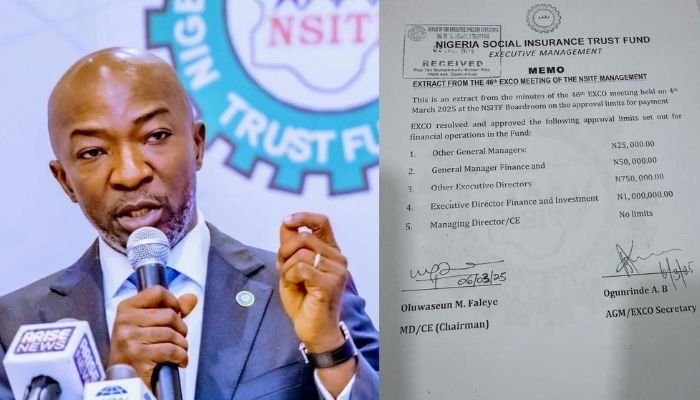
BURSTED: NSITF CEO MOVES On ₦297Billion Fund, Operates Over 100 Bank Accounts Linked To One BVN

by Leading Reporters February 9, 2026
written by Leading Reporters
The Managing Director/Chief Executive Officer of the Nigeria Social Insurance Trust Fund (NSITF) Oluwaseun Mayomi Faleye, is accused of operating more than 100 bank accounts linked to a single Bank Verification Number (BVN) and granting himself “unlimited spending powers” to siphon and misappropriate funds belonging to Nigerian workers.

Multiple internal documents, bank records, and testimonies obtained by allege that Faleye unilaterally conferred these powers on himself and authorised the disbursement of hundreds of billions of naira belonging exclusively to Nigerian workers, without lawful approval, board oversight, or adherence to federal financial regulations.

₦297 Billion Workers’ Funds, ₦243 Billion Allegedly Spent Without Approval

According to documents reviewed by US, between January 2 and October 9, 2025, the NSITF recorded total lodgments of ₦297,019,145,288.60.

The funds, insiders stressed, were derived entirely from compulsory employer contributions under the Employees’ Compensation Act (ECA), a statutory scheme designed to protect Nigerian workers injured, disabled, or killed in the course of employment.

Within the same period, records show that ₦243,203,518,621.17 was spent. Multiple senior officials alleged that a significant portion of this expenditure was carried out without the approval of the NSITF Management Board, in violation of the Act establishing the Fund and existing federal financial regulations.

“This is not government money. This is workers’ money, contributed mandatorily under the law,” one senior NSITF official said.

“Every kobo is supposed to be protected by layers of checks and balances. What we are seeing here is a complete collapse of those safeguards.”

‘No Approval Limit’: How Faleye Allegedly Gave Himself Unchecked Spending Powers

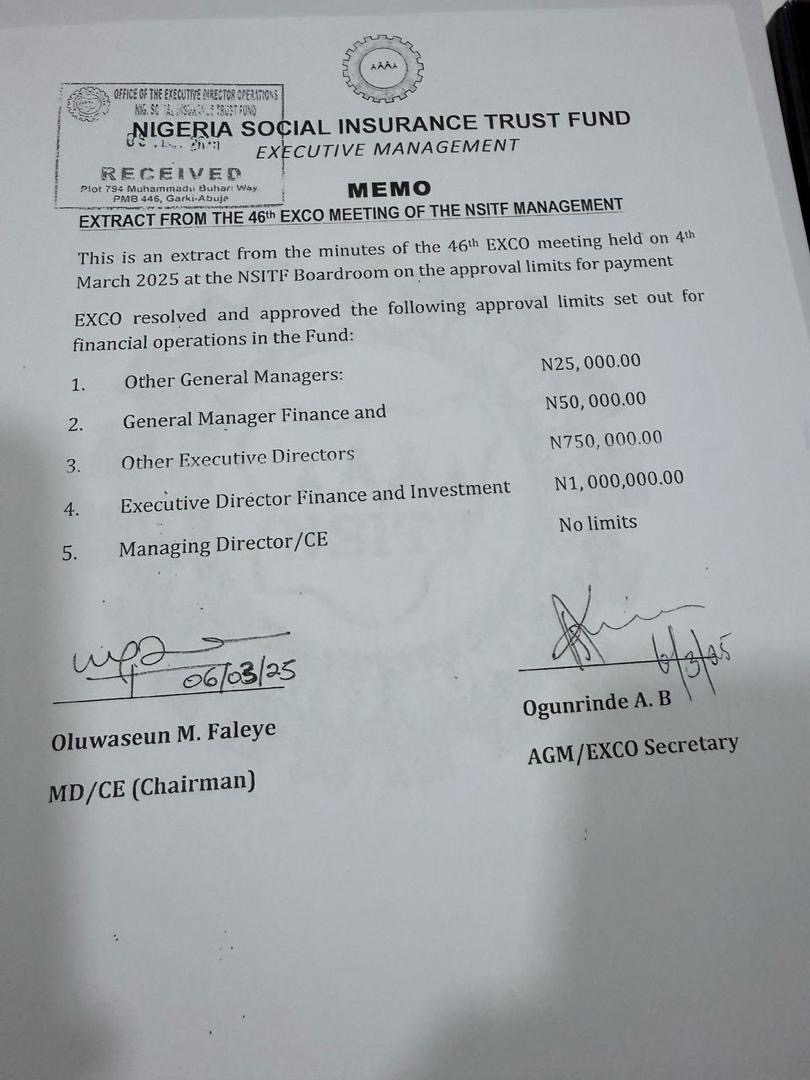
Central to the allegations is a document dated March 4, 2025, signed by Mr. Faleye and obtained by .

The document is an extract from the minutes of the 46th Executive Committee (EXCO) meeting held at the NSITF Boardroom, and chaired by Faleye, detailing approval limits for financial transactions within the Fund.

According to a document obtained by US, the EXCO resolution set clear limits for other officials: other general managers, ₦25,000; General Manager (Finance), ₦50,000; other executive directors, ₦750,000; and the Executive Director (Finance and Investment), ₦1,000,000.

However, under the same resolution, the Managing Director/Chief Executive Officer, Mr. Faleye, and the chairman, approved no limit for his own spending authority.
Nsitf

According to multiple sources, this effectively gave Mr. Faleye unrestricted power to approve payments of any amount, without recourse to the Management Board or external oversight.

“He simply wrote and signed a document granting himself ‘No Approval Limit’,” a senior official disclosed. “There is absolutely no legal basis for this in the NSITF Act or in federal financial regulations.”

Another insider added, “This amounts to usurping the powers of the President of the Federal Republic of Nigeria. Under existing rules, even Managing Directors of parastatals are capped. They cannot wake up and approve unlimited spending.”

Current federal thresholds reportedly allow Managing Directors to approve up to ₦30 million for works and ₦10 million for goods and services, and even those approvals remain subject to board oversight.

“What happened here defies every known rule of public finance management,” a source said.

Several NSITF insiders described deep distress over the alleged abuses.

“This is the most reckless abuse of power I have witnessed in over 20 years in the public sector,” a senior official told Our Reporters.

“He effectively sidelined the Board, ignored the law, and treated workers’ funds as personal cash. The emotional toll of witnessing this level of corruption is enormous. I can’t even sleep.”

Millions of Dollars Allegedly Traced to Faleye, Linked Entities

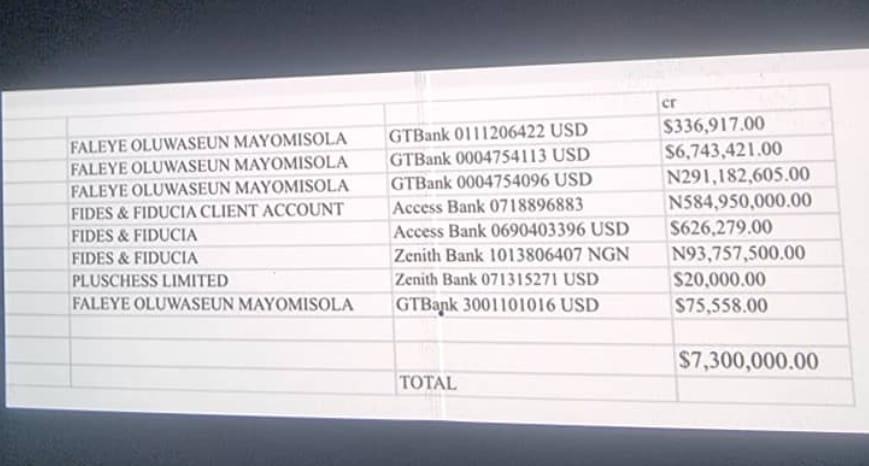
In a separate document exclusively obtained by SaharaReporters, investigators traced alleged inflows of millions of dollars and hundreds of millions of naira into bank accounts linked directly to Mr. Faleye and entities reportedly associated with him.

The transactions listed include: Faleye Oluwaseun Mayomisola, GTBank USD Account 0111206422 – $336,917.00

Faleye Oluwaseun Mayomisola, GTBank USD Account 0004754113 – $6,743,421.00

Faleye Oluwaseun Mayomisola, GTBank NGN Account 0004754096 – ₦291,182,605.00

Fides & Fiducia Client Account, Access Bank NGN Account 0718896883 – ₦584,950,000.00

Fides & Fiducia, Access Bank USD Account 0690403396 – $626,279.00

Fides & Fiducia, Zenith Bank NGN Account 1013806407 – ₦93,757,500.00

Pluschess Limited, Zenith Bank USD Account 071315271 – $20,000.00

Faleye Oluwaseun Mayomisola, GTBank USD Account 3001101016 – $75,558.00
Nsitf

The total dollar inflow alone is estimated at over $7.3 million, excluding naira-denominated transactions.

“These are not small transfers. The volume, frequency, and structuring suggest deliberate efforts to move and possibly conceal funds,” a source familiar with the documents said.

Over 100 Bank Accounts, One BVN

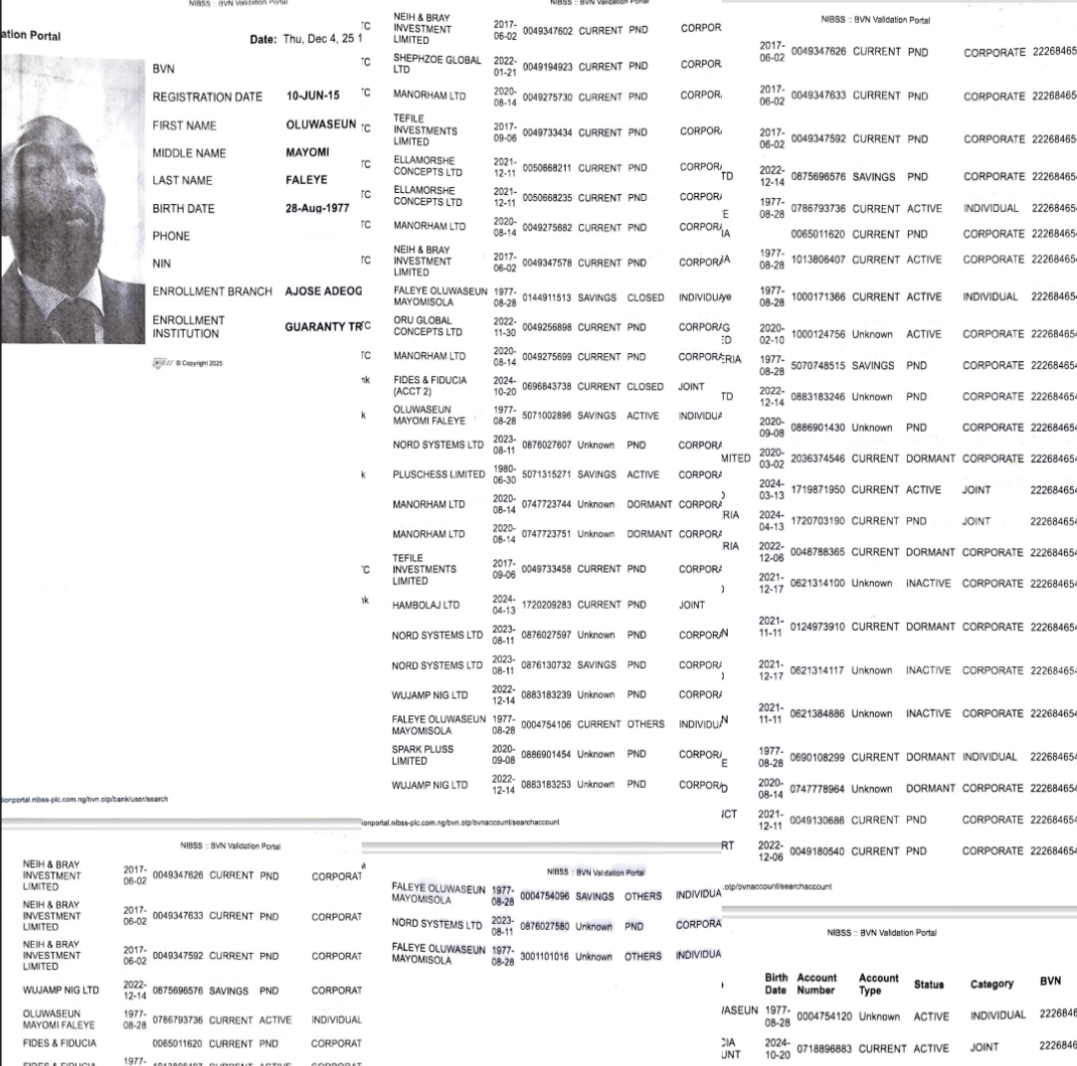
Perhaps most alarming is another document obtained by US, which reportedly shows more than 100 active bank accounts linked to a single BVN belonging to Mr. Faleye.

The BVN profile details are as follows: The registration date is June 10, 2015. The first name is Oluwaseun, the middle name is Mayomi, and the last name is Faleye.
Ndit

The date of birth is August 28, 1977. The enrollment bank is Guaranty Trust Bank, and the enrollment branch is Ajose Adeogun.

Sources allege that many of these accounts received funds traceable to NSITF operations.

“The scale is staggering,” one insider said. “You don’t run over 100 accounts accidentally. This points to systematic structuring.”

‘₦5.5 Billion Commission Payments Approved Without Board or Ministry’

Beyond personal accounts, sources allege that Mr. Faleye authorised speculative commission payments totalling over ₦5.53 billion without approval from either the NSITF Management Board or the Ministry of Labour.

The payments, allegedly ranging between 15% and 20% commission, include: “09/10/2025, Assurance Services ST ADBA Ltd: ₦1,379,186,010.00, 18/03/2025, TAGG Global Resources Ltd: ₦865,000,000.00, 17/09/2025, Rate Seal Support & Project Ltd: ₦683,777,666.40, 16/05/2025, Rate Seal Support & Project Ltd: ₦659,303,810.50.

“16/05/2025, Rate Gold Solution Nig Ltd: ₦648,750,000.00, 01/08/2025, Gold Solution Nig Ltd: ₦648,750,000.00, 01/08/2025, TAGG Global Resources Ltd: ₦648,750,000.00, Total: ₦5,533,517,486.90.

“This money was approved and paid without lawful authority,” a source said. “No board resolution. No ministerial approval.”

Board Absence and Alleged Exploitation of Governance Gap

Sources further disclosed that Mr. Faleye was appointed Managing Director in July 2023, while the NSITF Management Board was not constituted until around January 2025, a gap of more than one year.

“NSITF is not meant to operate without a board,” a top official explained.

“The Act expressly forbids Executive Management from spending funds without board approval. If there is no board, spending should not take place.”

Although the Ministry of Labour has historically attempted to fill temporary governance gaps, insiders insist this does not override the law.

“At no point has Executive Management been allowed to approve financial transactions for itself,” a source said.

“What happened here is unprecedented. This is not mismanagement. It is misappropriation and outright theft.”

‘This Is Workers’ Money, Not National Cake’

Multiple officials emphasised that NSITF funds are distinct from regular government revenue.

“Government contributes nothing except as an employer like everyone else,” one source said.

“Under the law, every employer pays one percent of payroll. The money belongs to Nigerian workers, not the government.”

However, to safeguard this fund, the Act established a strict tripartite governance structure. This structure involves three key stakeholders: the Nigeria Employers’ Consultative Association (NECA), the Nigeria Labour Congress (NLC), and the Federal Ministry of Labour.

“These stakeholders jointly crafted the law,” a source said. “The structure was deliberately designed to prevent exactly this kind of abuse.”

When we contacted the NSITF Chief Executive Officer, Faleye, he said he was not aware of the allegations.

However, when asked about the dollar account and how $7.3 million was allegedly transferred into it, he abruptly hung up the call.

Efforts to get him to respond to the allegations afterward were unsuccessful.

We also reached out to the Permanent Secretary of the Ministry of Labour, Salihu Usman, to ask whether they approved a ₦5 billion commissioning project and how ₦240 billion was allegedly mismanaged.

He denied being aware of the allegations.

When we contacted the Chairman of the NSITF Board, Shola Olofin, he said, “Please give me time to verify this information and claims.”
News credit: saharareporters.com
February 9, 2026 0 comments
0 FacebookTwitterPinterestThreadsBlueskyEmail
Central Bank of Nigeria
Headlines

CBN Launches BVN for Nigerians in Diaspora

by Nelson Ugwuagbo May 14, 2025
written by Nelson Ugwuagbo

The Central Bank of Nigeria (CBN), in partnership with the Nigeria Inter-Bank Settlement System (NIBSS), has launched the Non-Resident Bank Verification Number (NRBVN) platform, allowing Nigerians in the diaspora to obtain a BVN remotely without being physically present in the country.

The digital platform, introduced on Tuesday in Abuja, is designed to support the CBN’s goal of achieving $1 billion in monthly diaspora remittances—amounting to about $12 billion annually.

Speaking at the launch event, which drew stakeholders from the financial sector including chief executives of commercial banks, CBN Governor Olayemi Cardoso described the initiative as a significant step in Nigeria’s financial inclusion efforts and a vital link connecting the country to its global citizens.

Cardoso said the NRBVN would help reduce the high cost of remittances in Sub-Saharan Africa, which currently averages over seven percent. He added that lowering these costs would encourage the use of formal channels, improve security, and boost the impact of remittances on households and the broader Nigerian economy.

“For too long, many Nigerians abroad have faced difficulties accessing financial services at home due to physical verification requirements,” he said. “The NRBVN changes that. Through secure digital verification and robust Know Your Customer (KYC) processes, Nigerians worldwide should now be able to access financial services more easily and affordably.”

The CBN said it will continue to engage stakeholders to ensure the platform’s optimization and long-term success.

May 14, 2025 0 comments
0 FacebookTwitterPinterestThreadsBlueskyEmail
Headlines

NIN-Bank Linkage: 85.51m Bank Customers Risk Account Suspension

by Folarin Kehinde February 29, 2024
written by Folarin Kehinde

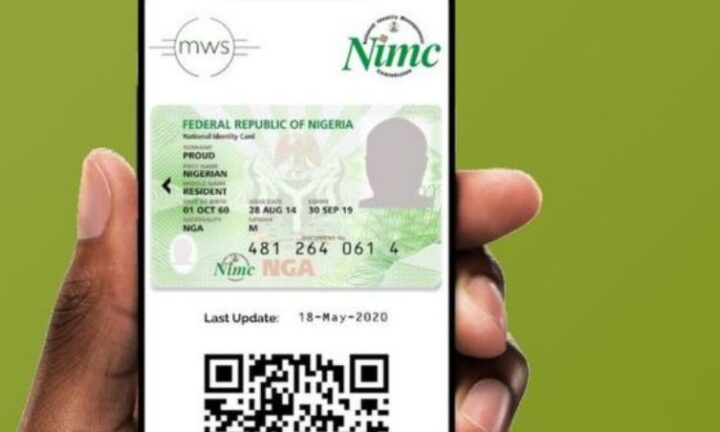
About 85.51 million bank customers may not to be able to withdraw from their bank accounts by March 1, 2024, due to their inability to link their National Identification Numbers (NINs) and/or Bank Verification Numbers (BVNs) to their accounts.

Recall that data from the Nigeria Inter-Bank Settlement System (NIBSS) shows Nigeria has 146 million active bank customers (individual) as of December 2022. As of January 26, 2024, the BVN count on the NIBSS portal was 60.49 million. On NIN, about 104 million NINs have been issued as of December 2023.

And with about 24 hours to the March 1, 2024 deadline given by the Central Bank of Nigeria (CBN) for customers to link their Bank Verification Number (BVN) and/or National Identity Number (NIN) to their bank accounts and wallets, Nigerians have raised issues surrounding verifying their NIN with the National Identity Management Commission (NIMC)

The apex bank had asked banks to restrict transactions on accounts whose NIN and BVN have not been linked, starting on March 1, 2024. On December 1, 2023, the CBN declared that any bank accounts lacking NIN and a BVN will be designated as ‘Post no Debit.’

To this effect, the central bank delivered a circular to all deposit money banks that included the new directive.

The apex bank stated that having a BVN and/or NIN is required for all Tier-1 bank accounts and wallets for people, even as it added that having a BVN and NIN is still required for Tiers 2 and 3 accounts as well as wallets for individual accounts.

If the deadline stands, about 85.51 million bank customers will be unable to withdraw money from their accounts.

Reacting to this development,, the director-general of National Identification Management Commission (NIMC), Abisoye Coker-Odusote disclosed to LEADERSHIP at the commission’s management retreat in Lagos that the commission saw numerous violations and unethical behaviour at NIN enrollment and modification procedures, hence, the reason it put a temporary stop to its NIN enrollment efforts for Front-End Partners (FEPs).

“My decision to direct the revalidation of all FEPs was not targeted at anyone or group. It was a step towards sanitising the system and processes while ensuring the integrity of data in the country’s identity database. Now that we have revalidated and re-issued licenses to about 96 FEPs, we believe NIN registration will be faster and secure,” she added.

She, however, posited that FEPs are crucial in fast tracking the NIN registration process.

“FEPs are the link between our citizens and the NIMC enrollment ecosystem. As you communicate with candidates, treat their information with care, accuracy, and thoroughness. Let us work together to protect our database from errors, fraud, and other threats to its integrity.

“While we welcome the expansion of our National Identity Database to over 104 million captured NINs, and targeting additional 20 to 25 million NINs registration by the end of 2024, we cannot rest on our laurels. Millions more are waiting to be enrolled. They include students, farmers, businesspeople, and the elderly. They are the heartbeat of our country.

“Let us reach out to all parts of Nigeria, from booming cities to isolated villages. Allow us to collaborate with schools, hospitals, and community leaders. Let us ensure that no one is left behind, including the vulnerable, people with disabilities, those living in remote locations, and so on. Let us make the NIN enrollment process accessible, fast, and inclusive.”

On NIN-SIM Linkage, the executive vice chairman/CEO Nigerian Communications Commission (NCC), Dr Aminu Maida said NIN-SIM linkage is a process of connecting one’s NIN to his phone number to authenticate and protect his identity.

To link NIN to SIM, Maida urged telecom subscribers to submit their NIN to their respective Service Provider to complete the process of NIN-SIM linkage.

For subscribers who do not have the National Identification Number (NIN), they can obtain theirs from NIMC Enrolment Centres or their Service Providers Customer Care Centres.

“A subscriber can also link his/her NIN to his/her SIM by sending NIN- your 11 digit NIN to 996 or Dial 996 Your 11 Digit NIN# and follow the prompts. A telecoms subscriber can link his/her NIN to as many as 4 mobile phone numbers per Mobile Network.

“One major objective of linking subscribers’ NIN to SIM is to help improve and enhance national security in the country. As a matter of critical National security, telecom consumers must link their NIN to the SIM. To this end, the Commission has directed all telecommunication operators to bar phone lines of subscribers whose lines are not linked to their NINs on or before February 28, 2024,” she said.

Meanwhile, a customer of a tier one bank in the country said she had received a message from her bank that asked her to visit the branch to rectify her BVN, but had ignored the message thinking it was a phishing email.

The message sighted by LEADERSHIP read: “We noticed that there is no Biometric Verification Number (BVN) linked to your account. Kindly visit any FirstBank branch close to you with a valid means of Identification to update your account information with your BVN on or before 29 February 2024.

“Please note that Central Bank of Nigeria (CBN) through its circular: PSM/DIR/PUB/CIR/001/053 dated 01 December 2023, has directed that effective, 01 March 2024, all funded accounts without BVN shall be placed on ‘Post No Debit or Credit’ and no further transactions permitted.”

Opay, a mobile money operator in the country, had posted a message on all its social media handles reading: “this is to remind you that effective March 1, 2024, all accounts without NIN or BVN will be restricted from conducting transactions on the Opay app. This complies with the CBN directive. Kindly provide the required information to continue enjoying our services.”

Some customers said they were contemplating moving their funds from accounts that have BVN/NIN issues to accounts that do not have issues, whilst some are planning to withdraw their funds so as not to be stranded

February 29, 2024 0 comments
0 FacebookTwitterPinterestThreadsBlueskyEmail

Recent Posts

  • HON. IKYAAGBA SEEKS BLESSINGS FROM MBAIKYONGO COUNCIL OF CHIEFS

    February 23, 2026
  • CBN Governor sacks Adesoji Ogungbesa, Mustapha Oladeji Jimoh from MINT’s board over criminal infractions; may hand them over to anti-corruption agencies

    February 22, 2026
  • FCT Poll: PDP defeats APC in Gwagwalada

    February 22, 2026
  • APC Wins AMAC Chairmanship Election

    February 22, 2026
  • Ramadan: Hisbah arrests nine in Kano for allegedly eating in public

    February 19, 2026

Usefull Links

  • Contact Page
  • About Leading Reporters
  • Contact Us
  • Headlines
  • Investigation
  • Exclusives
  • Opinion
  • Business
  • Facebook
  • Twitter
  • Instagram
  • Linkedin

@2021 - All Right Reserved. Designed and Developed by PenciDesign


Back To Top
Leading Reporters
  • Featured
  • Politics
  • Opinion
  • Business
  • Entertainment
  • Sports
  • About Us
  • Contact