
Leading Reporters
  • Headlines
  • Health
  • Business
  • Exclusives
  • Investigation
  • Entertainment
  • Opinion
Tuesday, January 27, 2026
Hot
FCTA Workers, NLC Storm Industrial Court, Demand Wike...
DisCos reject FG’s free meter plan
Nigerian-born nurse loses licence in Australia for sleeping...
BREAKING: Kano Gov Abba Yusuf dumps NNPP
National Grid Collapse For First Time in 2026
BREAKING: Tinubu approves posting of Ambassadors to U.S.,...
Insecurity: Kidnappers demand 17 motorcycles for release of...
FG to Abolish Hnd-Degree Dichotomy, Allow Polytechnics to...
AFCON Initiative drives stronger Nigeria Morocco cooperation
Obasanjo: I’ll Never Stop Having Children
  • About Leading Reporters
  • Contact Us
Leading Reporters
Advertise With Us
  • Headlines
  • Health
  • Business
  • Exclusives
  • Investigation
  • Entertainment
  • Opinion
Hot
FCTA Workers, NLC Storm Industrial Court, Demand Wike...
DisCos reject FG’s free meter plan
Nigerian-born nurse loses licence in Australia for sleeping...
BREAKING: Kano Gov Abba Yusuf dumps NNPP
National Grid Collapse For First Time in 2026
BREAKING: Tinubu approves posting of Ambassadors to U.S.,...
Insecurity: Kidnappers demand 17 motorcycles for release of...
FG to Abolish Hnd-Degree Dichotomy, Allow Polytechnics to...
AFCON Initiative drives stronger Nigeria Morocco cooperation
Obasanjo: I’ll Never Stop Having Children
Leading Reporters
Leading Reporters
  • Headlines
  • Health
  • Business
  • Exclusives
  • Investigation
  • Entertainment
  • Opinion
Copyright 2024 - All Right Reserved
Home > budget and national planning
Tag:

budget and national planning

Headlines

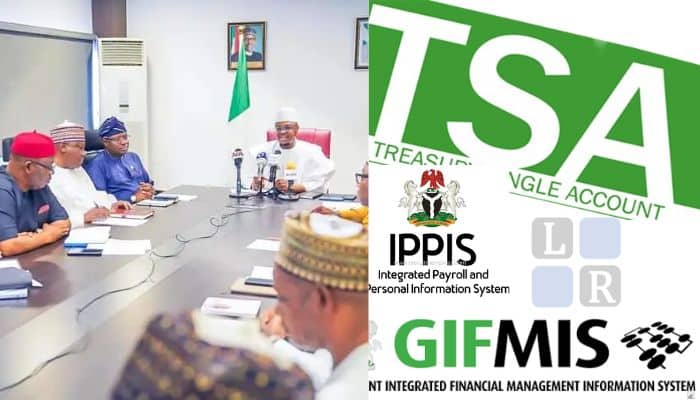
7 Years After, Deployment of IPPIS, GIFMIS, TSA, didn’t follow Nigeria’s law – Pantami

by Leading Reporters August 14, 2022
written by Leading Reporters

The latest revelations about the challenges with the IPPIS by the minister has been described as a vindication of ASUU’s position on the payment system.

The Minister of Communications and Digital Economy, Isa ‘Pantami’ Ibrahim, has said the deployment of the Integrated Personnel Payroll Information System (IPPIS), Government Integrated Financial Management Information System (GIFMIS), and the Treasury Single Account (TSA), did not follow relevant laws as put in place by the Nigerian government.

The minister said the section of the NITDA Act that requires the standardisation and certification, application and delivery of such systems in Nigeria were not followed during the deployment of IPPIS, GIFMIS and TSA.

“At the time they were deployed, the provision of NITDA Act under section A, of setting the standardisation of ICT deployment in federal public institutions was not followed. Because of this, these three systems were not subjected to government certification and IT project clearance as encouraged by law and many other government policies,” he said.

Mr Ibrahim said following allegations that the systems are being used to syphon money from the treasury, the National Information Technology and Development Agency (NITDA) reviewed the IPPIS critically, “and found errors in high, medium and low magnitudes.”

President Muhammadu Buhari has, therefore, approved the constitution of a Presidential Steering Committee on critical technical review of the three payment systems used by the government, he said.

The minister spoke on Friday while inaugurating the members of the committee on behalf of the President.

He said the results of the test conducted on IPPIS have been submitted to relevant government agencies including the Ministries of Finance, Budget and National Planning, Labour and Employment as well as the Presidency.

The minister said the tests will also be carried out on GIFMIS and TSA and the final report will be submitted to the President.

He said: “Prior to this meeting as part of the government’s processes, testing and certifying systems IPPIS was recently subjected to critical review by NITDA. A report has been submitted to the relevant ministries including Finance, Budget and National Planning, Ministry of Labour and Employment, and a copy was sent to the Presidency.

“There is no doubt, we discovered there are high errors. There are challenges with IPPIS. There is no doubt about this. But in spite of all the challenges we have recorded, there are high, medium and low errors in these systems.”

The suspended Accountant General of the Federation, Ahmed Idris, who is currently facing corruption trial, was alleged by the Economic and Financial Crimes Commission (EFCC) to have diverted funds through IPPIS, GIFMIS and TSA.

Benefits of IPPIS, others

However, despite the irregularities identified in the system, Mr Ibrahim said the systems have proved to be useful, saying they have saved the government over N10 trillion.

He said: “Inspite of that, many achievements have been recorded. For example, based on the report from the relevant institutions of government that IPPIS saved the government over N120 billion naira, while Treasury Single Account (TSA) saved over N10 trillion for the government.”

The committee

The technical committee, which was inaugurated by Mr Ibrahim, is also to be chaired by him. He said its activities will be supervised by his ministry while NITDA serves as the secretariat for the committee.

“The main work is to ensure that there is no leakage in these systems, and to ensure that the process is of high quality,” he said.

He said all the institutions managing the platforms to be reviewed must provide unlimited access to the committee to do its job.

He said any institution that fails to cooperate with the committee will report the president for punishment.

“Any institution that failed to give access to it will be reported to the President immediately. And in addition to that recommendation, a punishment is going to be recommended to the president for implementation.

“It is the mandate of this ministry and the relevant parastatals under the ministry to ensure that any system deployed in government, there is value for money and we must continue to improve on that.”

Members of the committee, according to the minister, include NITDA’s Director General, Kashifu Inuwa, who serves as the secretary; the Minister of Finance, Budget and National Planning, Zainab Ahmed; Head of Civil Service of the Federation, Folashade Yemi-Esan; Auditor General of the Federation, Aghughu Arhotomhenla; and the Chairman, Economic and Financial Crimes Commission (EFCC), Abdulrasheed Bawa.

Others include the Director General, Bureau of Public Service Reforms, Dasuki Arabi; Chairman, Salaries Income and Wages Commission, Richard Egbule; and the Managing Director, Galaxy Backbone Limited, Muhammed Abubakar, a professor.

Backstory

The striking university workers’ unions have consistently opposed the deployment of IPPIS for the payment of its members’ emoluments, saying the system is a product of fraud and an imposition by foreign economic interests.

The Academic Staff Union of Universities (ASUU) has insisted on the replacement of the payment platform with an alternative its members designed which the union tagged; University Transparency and Accountability System (UTAS).

Meanwhile, both the Senior Staff Association of Nigerian Universities (SSANU) and the Non-Academic Staff Union of Educational and other Associated Institutions (NASU) have also developed its alternative solution tagged; “University Peculiar Payroll Payment System (U3PS).

The chairman of the Lagos zone of ASUU, ‘Laja Odukoya, described as a vindication of the union’s position the minister’s latest revelation about the challenges with IPPIS.
August 14, 2022 0 comments
0 FacebookTwitterPinterestThreadsBlueskyEmail
HeadlinesOpinion

It Is Time For Legislators To Extend Their Oversight visit To Sambisa

by Leading Reporters May 14, 2021
written by Leading Reporters

Last Thursday, I was slightly amused listening to Senate President, Ahmed Lawan pouring encomiums on the service chiefs of Nigeria’s military.

When the report by the broadcast media on the event started playing, I had thought it was a valedictory session where some war veterans were taking a well-deserved bow. But when it became clearer that the day’s celebrants were the General Lucky Irabor led new service chiefs, I had to put off my initial doubt to watch more closely to find that the colorful reception by the Senate for the team was real and that it departed substantially from the old familiar song whose chorus was that no one knows into what use the military had put the huge resources appropriated and allegedly received by them.

It was as if the Senate had just discovered how well the funds had been meaningfully utilized. If so, what was the source of the new information? I mean was it credible evidence obtained from oversight function? I just hope the Senate’s position was not informed by the predictions of any of our vision-seeing members of the clergy!

Whatever the source, one thing which is certain, is that no one can blame a television viewer for being cynical; after all, the general narrative on ground has been one of despondence in which the public had been made to believe that funds meant for the military were usually diverted by the top hierarchy leaving nothing for the troops to prosecute the insurgency war.

Indeed, when the last service chiefs left office, there were reports of jubilation in military circles especially at the war front which tended to validate the rumour that military funds were truly misappropriated. Although there were official attempts to clarify the statement credited to the National Security Adviser NSA that weapons and equipment that should have been bought were not bought, the general feeling which subsisted was that the funds were missing. There was in fact the allegation by the International foundation against corruption that about N10.02 trillion spent on the security sector in Nigeria has had no audit report from 2015 till today.

So, why was the Senate President presenting a vote of thanks in favour of the military? Could it be that the legislature suddenly discovered that the military leaders were innocent of all charges against them and that the funds reportedly appropriated for the military never got to them? I found that slightly hard to believe because Zainab Ahmed, our Minister of finance, budget and national planning who should know, had confirmed two days earlier, that all the funds were released. The Minister spoke at an interactive session with members of the Senate Committee on the Army.

She also asserted that apart from funding the budget of the army almost 100 per cent, there had been a lot of instances where the security leaders went to the president, got special approvals and still got the funds. Interestingly, the Chairman of the same committee, Senator Alli Ndume had continuously complained that funds for the Army were not received by the Army. How then, can one understand our insurgency fight where the appropriation, delivery and receipt of the resources for the fight are turned into a story of several versions?

This confusion would not have arisen if oversight functions are implemented creditably in Nigeria. But painfully they are not. Elsewhere, what touches a nation most is the concern of all; in which case, Nigerians should have been mobilized by government to focus on our current major problem which incidentally concerns the security and welfare of the people. The legislature represented by her several committees on the military should have designed a monitoring framework covering when a request is made by the military, when it is approved, when it is dispatched, when it is received and how it is spent.

We ought not to have subjected our military to the distraction of spending much time pursuing approved funds. In other words, a team of legislators should have since been stationed in Sambisa by way of symbolically carrying supervision to the very point of assignment as they do, all the time, especially with lucrative agencies such as the NNPC. If that had been done, the new service chiefs would not have, on assumption of duty and indeed before settling in, be called to account for purchases made by their predecessors. Why was there no oversight at the appropriate time?

Honestly, oversight functions by the legislature have in the last one year dropped significantly. In August 2020, thirty-nine (39) Civil Society Organizations (CSOs) issued a joint statement accusing the National Assembly of not only a drop in her oversight functions but a general lack of commitment to duty. The CSOs arrived at this conclusion after a study of the performance of the lawmakers for the legislative year beginning from June 2019 to July 2020 in which they found that the legislators sat for only 149 days instead of the 181 days prescribed by the constitution. This may have been caused by the propensity of the legislators to enjoy several holidays and adjournments. For example, although all other public sector services had only two days declared as public holidays last month for Easter, the legislators were away for the same festivity for three weeks.

They have in the last three days already begun their own Sallah holidays, yet to be officially declared by government and they are not expected back till May 18th. We therefore agree with the CSOs that there ought not to be a drop in legislative activities by the National Assembly at a time when its role has become more critical than ever before, in joining the Executive to find solutions to the unprecedented challenges currently facing the country.

We also believe that our legislators should revive their mechanism for their constitutionally approved oversight functions provided, they remove from it, the tendency to commercialize the subject. The old order whereby legislators blackmailed some Ministries, Departments and Agencies into settling their travelling costs etc. must be halted. In addition, there is the need for the legislature to always get to the logical end of every investigation. Not many were pleased for instance, with how the allegations made publicly that NDDC contracts were cornered by legislators was swept under the carpet.

This attitude has always adversely affected public expectations whenever the legislature jumps into every matter as if nothing must go past them without their input. The posture no doubt has a fair share in the failure of Nigeria to have strong institutions. When for example, there is some emergency in any part of the country, and the very next day the legislature passes a resolution ‘directing’ NEMA to help the victims of the occurrence, it suggests that the entity has no capacity to independently face its mandate. It also removes from them, personal initiative and discretion. Such interventions are only rational in cases where the resolution was provoked by transparent lethargy on the part of the relevant societal institution.

It is worse when the legislature disrupts the schedule of duties of public bodies through incessant summoning of chief executives who are never allowed in what looks like ‘a show of ego’ to delegate their appearance. It is particularly offensive when it is done to the military that should be encouraged to completely face the nation’s current difficulty of incessant killings in several parts of the country.

By Tonnie Iredia

May 14, 2021 0 comments
0 FacebookTwitterPinterestThreadsBlueskyEmail

Recent Posts

  • JUST IN: Super Eagles captain Wilfred Ndidi loses father to road accident

    January 27, 2026
  • FCTA Workers, NLC Storm Industrial Court, Demand Wike Sack

    January 26, 2026
  • DisCos reject FG’s free meter plan

    January 26, 2026
  • Nigerian-born nurse loses licence in Australia for sleeping on duty

    January 24, 2026
  • AI may outsmart humanity in five years — Musk

    January 24, 2026

Usefull Links

  • Contact Page
  • About Leading Reporters
  • Contact Us
  • Headlines
  • Investigation
  • Exclusives
  • Opinion
  • Business
  • Facebook
  • Twitter
  • Instagram
  • Linkedin

@2021 - All Right Reserved. Designed and Developed by PenciDesign


Back To Top
Leading Reporters
  • Featured
  • Politics
  • Opinion
  • Business
  • Entertainment
  • Sports
  • About Us
  • Contact