Leading Reporters
  • Headlines
  • Health
  • Business
  • Exclusives
  • Investigation
  • Entertainment
  • Opinion
Monday, February 16, 2026
Hot
BREAKING: INEC announces timetable, schedule of 2027 elections
Aso Rock to disconnect from nat’l grid in...
Valentine’s Day: FG bans money bouquets, warns against...
INEC Proposes ₦873.78 Billion Budget for 2027 General...
Engine Failure: Passengers escape death as Arik Air...
Senate adopts electronic, manual transmission of election results
BURSTED: NSITF CEO MOVES On ₦297Billion Fund, Operates...
Peter Obi joins #OccupyNationalAssembly protest over electronic transmission...
Tension As Popular Gospel Singer, 3 crew members...
2027: Wike Establishes Radio Station For Tinubu Campaign...
  • About Leading Reporters
  • Contact Us
Leading Reporters
Advertise With Us
  • Headlines
  • Health
  • Business
  • Exclusives
  • Investigation
  • Entertainment
  • Opinion
Hot
BREAKING: INEC announces timetable, schedule of 2027 elections
Aso Rock to disconnect from nat’l grid in...
Valentine’s Day: FG bans money bouquets, warns against...
INEC Proposes ₦873.78 Billion Budget for 2027 General...
Engine Failure: Passengers escape death as Arik Air...
Senate adopts electronic, manual transmission of election results
BURSTED: NSITF CEO MOVES On ₦297Billion Fund, Operates...
Peter Obi joins #OccupyNationalAssembly protest over electronic transmission...
Tension As Popular Gospel Singer, 3 crew members...
2027: Wike Establishes Radio Station For Tinubu Campaign...
Leading Reporters
Leading Reporters
  • Headlines
  • Health
  • Business
  • Exclusives
  • Investigation
  • Entertainment
  • Opinion
Copyright 2024 - All Right Reserved
Home > All Progressives Congress APC
Tag:

All Progressives Congress APC

Leading Reporters INEC move to reconfigure BVAS for gubernatorial elections Image
Headlines

Confusion as INEC reconsider March 11 Election date

by Leading Reporters March 8, 2023
written by Leading Reporters

The Independent National Electoral Commission (INEC) is considering the postponement of this weekend’s Governorship elections nationwide.

Though the commission has not announced the postponement officially, sources said the body may have agreed to shift the election to March 18, 2023.

Already, INEC chairman, Prof. Mahmood Yakubu is currently in a closed-door meeting with the National Commissioners and others.

The meeting was said to have begun around 7.00pm on Wednesday.

The meeting might not be unconnected with this weekend’ governorship election nationwide.

Sources said the planned postponement is due to the Commission’s inability to promptly commence reconfiguration of the Bimodal Voter Accreditation System (BVAS) machines utilized during the February 25 presidential election to enable their use in the state elections.

The commission was earlier restrained from tampering with the information embedded in the BVAS machines until the due inspection was conducted and Certified True Copies (CTC) issued to candidates who are challenging the outcome of the presidential election.

March 8, 2023 0 comments
0 FacebookTwitterPinterestThreadsBlueskyEmail
Leading Reporters Six States Ask Supreme Court To Cancel Presidential Election Image
Headlines

Supreme Court to abrogate presidential election

by Leading Reporters March 3, 2023
written by Leading Reporters

Adamawa, Akwa-Ibom, Bayelsa, Delta, Edo and Sokoto states have dragged the Federal Government before the Supreme Court over the conduct of the February 25, 2023 presidential and National Assembly elections.

The suit filed by the Attorneys General of the six states has the Attorney General of the Federation as sole respondent.

The plaintiffs on February 28 predicated their case on the grounds that, “The collation of the national election results from the 36 states of the Federation, and that of the Federal Capital Territory, for the said 2023 presidential and National Assembly elections have not been carried out in compliance with the mandatory provisions of relevant sections of the Electoral Act, 2022; the INEC Regulations and Guidelines for the Conduct of Elections, 2022, made pursuant to the provisions of the Electoral Act, 2022; and the INEC Manual for Election Officials, 2023.”

In the suit filed by their lawyer, Mike Ozekhome, SAN, the states said the agents and officials of the Federal Government and INEC failed to transmit the collated result as prescribed by the provisions of the Electoral Act, 2022; the INEC Regulations and Guidelines for the Conduct of Elections 2022; and the INEC Manual for Election Officials requiring transmission of the results by the use of Bimodal Voter Accreditation System in flagrant breach of the relevant provisions of the Electoral Act, 2022; the INEC Regulations and Guidelines for the Conduct of Elections, 2022; and the INEC Manual for Election Officials, 2023.

They stated that, “non-compliance with the due process of law has led to a widespread agitation, violent protests, displeasure, and disapproval from a wide spectrum of the Nigerian populace, including international observers, political parties, well-meaning Nigerians and former Head of States of the Federal Republic of Nigeria”.

The plaintiffs argued that the federal government through INEC, “is empowered by law to correct the elections due to technical glitches and errors arising from the conduct of the elections with substantial effect on the electoral process in line with the provisions of Section 47 (3) of the Electoral Act, 2022; and other relevant sections thereof.

“Whilst queries were being raised as to the failure or deliberate refusal of INEC to transmit the results electronically, INEC suddenly pulled down its portal harbouring the Regulations and Guidelines, thus leaving the plaintiffs in the dark

“Most Nigerians, including the governments and peoples of Adamawa State, Akwa Ibom State, Bayelsa State, Delta State, Edo State, and Sokoto State, are entitled to a proper and electoral lawful process and procedure that guarantees a free, fair, transparent and credible election”.

Amongst the issues raised for determination by the apex court were: Whether having regard to the provisions of the Electoral Act, 2022, governing the 2023 nationwide general elections, particularly paragraphs 38 of the INEC Regulations and Guidelines for the Conduct of Elections, 2022; and paragraphs 2.8.4; 2.9.0; and 2.9.1 of the INEC Manual for Election Officials, 2023 thereof, the electronic transmission of votes collated at polling units and the use of the Bimodal Voter Accreditation System (BVAS) in the transmission of collated result is made mandatory.

“Whether the Federal Government of Nigeria through presiding officers of its executive body, Independent National Electoral Commission was bound to electronically transmit or transfer Polling Unit Results in Form EC8A using BVAS by uploading Scanned Copy of the said Unit Results to the Independent National Electoral Commission Result Viewing Portal (IReV) in the course of the General Elections held on the 25th of February, 2023 throughout the Federation.

“Whether the Federal Government of Nigeria in the recently held Presidential and National Assembly elections conducted nationwide on 25th February, 2023 through INEC, complied with the mandatory provisions of extant laws, INEC Regulations and Guidelines for the Conduct of Presidential Elections, 2022″.

“Whether the failure of the Federal Government of Nigeria through the Defendant and INEC to electronically transmit or transfer Polling Unit Results in Form EC8A using BVAS by uploading Scanned Copy of the said Unit Result to the Independent National Electoral Commission Result Viewing Portal (IReV) after the counting and announcement of the Polling Units results on 25th of February, 2023, violates the provisions of Sections 25; 47(2); 60 (1), (2), (4) & (5); 62; 64(4)(a) & (b); 70; and 148 of the Electoral Act, 2022, governing the 2023 nationwide general elections, particularly paragraphs 38 of the INEC Regulations and Guidelines for the Conduct of Elections, 2022; and paragraphs 2.8.4; 2.9.0; and 2.9.1 of the INEC Manual for Election Officials, 2023, for the conduct of the presidential election.

“Whether the failure of the Federal Republic of Nigeria through INEC to comply with the provisions of Section 60 of the Electoral Act, 2022 and the Regulations and Guidelines for Conduct of Elections, 2022 made pursuant to the Electoral Act and the Constitution of the FRN, 1999, as amended, in collating and announcing the results of the Presidential and National Assembly Elections render the already announced results and the elections conducted as a whole a nullity”.

“Whether the entire results of the presidential election conducted on the 25th of February, 2023, as announced by the Chairman of INEC at the National Collation Centre, Abuja in flagrant provision of Sections 25; 47(2); 60 (1), (2), (4) & (5); 62; 64(4)(a) & (b); 70; and 148 of the Electoral Act, 2022, governing the 2023 nationwide general elections, particularly paragraphs 38 of the INEC Regulations and Guidelines for the Conduct of Elections, 2022; and paragraphs 2.8.4; 2.9.0; and 2.9.1 of the INEC Manual for Election Officials, 2023, for the conduct of the Presidential Election, were valid.”

The plaintiffs urged the apex court to declare, “that the Federal Government of Nigeria, through INEC was bound to electronically transmit or transfer Polling Unit Results in Form EC8A using BVAS by uploading Scanned Copy of the said Unit Result to the Independent National Electoral Commission Result Viewing Portal (IReV) in the course of the General Elections held on the 25th of February, 2023 throughout the Federation in compliance with the provision of Sections 25; 47(2); 60 (1), (2), (4) & (5); 62; 64(4)(a) & (b); 70; and 148 of the Electoral Act, 2022, governing the 2023 nationwide general elections, particularly paragraphs 38 of the INEC Regulations and Guidelines for the Conduct of Elections, 2022; and paragraphs 2.8.4; 2.9.0; and 2.9.1 of the INEC Manual for Election Officials, 2023, for the conduct of the presidential election.”

They are seeking “A declaration that the entire results of the Presidential Election conducted on the 25th of February, 2023 announced by the Chairman of INEC at the National Collation Centre, Abuja, in flagrant violation of the provisions of Sections 25 of the Electoral Act, 2022, governing the 2023 nationwide general elections, particularly paragraphs 38 of the INEC Regulations and Guidelines for the Conduct of Elections, 2022; and paragraphs 2.8.4; 2.9.0; and 2.9.1 of the INEC Manual for Election Officials, 2023, for the conduct of the Presidential Election, were invalid, null and void, and of no effect whatsoever.

“A declaration that the fundamentally flawed electoral process through the non-uploading of the results of each of the 176,974 Polling Units nationwide, in respect of the presidential election and National Assembly Elections held on Saturday, 25th February 2023 were not in accordance with the provisions of Sections 25; 47(2); 60 (1), (2), (4) & (5); 62; 64(4)(a) & (b); 70; and 148 of the Electoral Act, 2022, governing the 2023 nationwide general elections, particularly paragraphs 38 of the INEC Regulations and Guidelines for the Conduct of Elections, 2022; and paragraphs 2.8.4; 2.9.0; and 2.9.1 of the INEC Manual for Election Officials, 2023, for the conduct of the presidential election.

“The plaintiffs also brought an application praying the apex court for an order directing a departure from the rules of the apex court in the interest of justice by directing for accelerated hearing of the substantive suit. Besides, plaintiffs also filed another application seeking for an order for abridging time for parties to file and serve responses for and against the suit. No date has been fixed for hearing.

March 3, 2023 0 comments
0 FacebookTwitterPinterestThreadsBlueskyEmail
Leading Reporters Election that produced Tinubu as president flawed, says Buhari
Headlines

Buhari: The Election that produced Tinubu as president was flawed

by Leading Reporters March 1, 2023
written by Leading Reporters

“If any candidate believes they can prove the fraud…, then bring forward the evidence.”

President Muhammadu Buhari has admitted the Saturday presidential poll in which former governor of Lagos Bola Tinubu emerged as the winner is flawed.

Mr Buhari also charged Atiku Abubakar of the Peoples Democratic Party and Peter Obi of the Labour Party to challenge the outcome of the poll in court if they have proof that the exercise was rigged in Mr Tinubu’s favour.

“That is not to say the exercise (Saturday’s election) was without fault. For instance, there were technical problems with electronic transmission of the results,” said the Nigerian leader. “Of course, there will be areas that need work to bring further transparency and credibility to the voting procedure. However, none of the issues registered represent a challenge to the freeness and fairness of the elections.”

Mr Buhari disclosed this in a statement by his media aide Garba Shehu, congratulating the president-elect. 

“I know some politicians and candidates may not agree with this view. That too is fine. If any candidate believes they can prove the fraud they claim is committed against them, then bring forward the evidence,” said Mr Buhari.

“If they cannot, then we must conclude that the election was indeed the people’s will – no matter how hard that may be for the losers to accept. If they feel the need to challenge, please take it to the courts, not to the streets.”

The president’s speech followed INEC chairman Mahmood Yakubu’s declaration of Mr Tinubu as the winner of Saturday’s presidential election at the National Collation Centre in Abuja.

Mr Tinubu polled 8,794,726 votes to defeat PDP’s Atiku Abubakar, winning 12 of 36 states of Nigeria. Mr Abubakar polled 6,984,520 votes. 

Peter Obi of Labour Party, came third, polling 6,101,533 votes.

The declaration of Mr Tinubu as the president-elect came amidst huge protest by PDP and Labour Party, calling for suspension of result collation and  and outright cancellation of the presidential poll due to INEC’s failure to upload election results on its server in real time. 

March 1, 2023 0 comments
0 FacebookTwitterPinterestThreadsBlueskyEmail
Leading Reporters Tinubu gives N25m “victory expenses’’ to all candidates contesting under APC
Headlines

Breaking: Tinubu gives N25m “victory expenses’’ to all candidates contesting under APC

by Leading Reporters February 19, 2023
written by Leading Reporters

Senator Bola Ahmed Tinubu, the presidential candidate of All Progressives Congress APC, in what seems like a last-minute desperate move to get the support of his party men across the board is currently transferring the sum of N25million each to party members seeking elective positions under APC. 

The first phase of the financial largesse was transferred to those contesting for the Senate and the Federal House of Assembly.  Also, those contesting for the state houses of assembly were not left out, according to a discreet source who would not want his name in print.

The largesse, according to the source was also extended to serving senators and members of the Federal House of Assembly who are not returning to the National Assembly.

While N25million was transferred to candidates contesting for the Senate and the Federal House of Assembly, contestants for state houses of assembly were gifted N20 million in what is called “Party Victory Support Fund”.

The fund transfer which commenced on Friday, the 17th of February was said to have followed an earlier request for account numbers of all APC contestants.  The Money-For-Support fund is being coordinated by Tinubu close associates, including Hon. James Abiodun Faleke. 

The source who claimed to have received his share of the fund revealed that Tinubu is using his associates’ accounts to make the transfers to avoid traces.  He said that the earlier plan was to give them cash, but the current stand of the Federal Government on Naira redesign frustrated the plan, hence the transfers to the beneficiary accounts.

When asked if he would vote and mobilize votes for Ahmed Bola Tinubu as a way of returning the favour given him by Tinubu, our source said that Tinubu made him an irresistible offer and there is nothing binding them that it must translate to voting for him or mobilizing for vote for him.

“He is just being generous.  We were told it was to support and cushion the cash-scarcity effect.  I am not bound by anything to vote for him”.  The source said.

February 19, 2023 0 comments
0 FacebookTwitterPinterestThreadsBlueskyEmail
Leading Reporters APC’s dilemma on election eve
HeadlinesOpinion

APC’s dilemma on election eve

by Leading Reporters February 19, 2023
written by Leading Reporters

By Tonnie Iredia

Too many things have since shown that in truth, there is not much difference between our ruling party, the All Progressives Congress (APC) and its biggest rival, the Peoples’ Democratic Party (PDP). Both parties have a few decent members but majority are political traders. When in power, the two parties behave exactly the same way. To start with, whereas both parties pretend that the welfare of the people matters to them, they do little or nothing to cover the pretence. Whenever an election is approaching, they create scenarios that automatically frustrate a credible contest thereby retaining office while claiming to have come in through the popular will of the people. But events have shown that the strategy has its limits. On its part, the PDP managed to hold-on for 16 years (1999-2007); but whether the APC will last beyond 8 years is becoming doubtful.

In 2015, everyone saw through the gimmicks of the ruling PDP as it struggled to postpone elections to make room for vote buying and other electoral manipulations when it became evident that it no longer enjoyed the confidence of voters. The change propaganda which thereafter brought the then opposition APC to power virtually waned even before its first term ended. First, the party showed its nervousness over the use of the Card Reader – a technological device which made rigging tedious. Hiding under the judicial ruling that the device was unknown to law, the APC made everyone to discountenance the amendment to the Electoral Act in 2015 which had recognised devices like Card Reader. From then on, the party ensured that a fresh amendment to regularize the situation was not signed into law for the 2019 elections. Although the party was declared winner of that year’s elections, some people had doubts that the victory was real following the server controversy that preceded the declaration of results.

Four years later, it has become quite clear that the APC is in trouble especially in its current atomistic state in which it is now at war with itself on a daily basis. Indeed, the party has become the greatest opposition to its own policies and leadership. Evidence that the APC was visibly scared about its chances of reelection in 2023 was mostly seen in its desperation to frustrate efforts at instituting the electronic transmission of election results – which had become a global reality. The attempt to procure officials of the National Communication Commission (NCC) to virtually commit perjury in their testimony before the legislature on the subject of electoral technology was ridiculed by the public. The electorate similarly rejected the legislature’s kangaroo voting against the innovation making it easy for the new Electoral Act 2022 to be passed along with a number of anti-rigging clauses. Apart from a few party members who remained popular in their constituencies, the ruling party has since been on edge moving from one error to another.

The new Electoral Act did well in the steps it took to sanitize party primaries, even though the ruling party turned out to be the leading culprit in electoral chicanery and the imposition of candidates. Luckily for them, for some inexplicable reasons such as the need to reduce cases in courts, the judiciary was arm twisted to allow for party supremacy in which a party’s nomination needn’t be controverted. Nigerians are however aware of the established canon that as administrative bodies, activities of political parties ought to be subjected to judicial review. This is more so as the Electoral Act had stipulated what must be done or not done to attain credible primaries. In the end, the APC subverted such guidelines only to return to the inglorious past in which a party can elect flag bearers from among party members who did not take part in the primaries and as such could not be described as aspirants. Based on the trend, can we pretend that we are on the way to free and fair elections?

In a democracy, it is the victorious party in an election that forms government; which makes the ruling party to be powerful. In Nigeria, they are not only powerful, they act quite often with impunity. The Goodluck Jonathan-led PDP government had attempted in its days in office to appoint politically tainted persons into the Electoral Commission that is world-wide known as non-partisan. Such nominees were however dropped as a result of public outcry, but the APC did not take cognizance of public outcry. So, with the recent appointment of suspected party loyalists into INEC that is supposed to be an impartial umpire, the public could not have been unaware that the objective was to use such officials to rig the 2023 general elections. This became yet another evidence that the ruling party had lost self confidence that it could win a free and fair contest. Put differently, the APC has inadvertently exposed its fear that it is at the verge of losing public support having failed to perform to public expectation. This has made the ruling party to be a suspect in every policy it enunciates towards the polls – a good example being the new naira programme.

But perhaps the best example of the dilemma of a ruling party on the eve election manifests in the unusual hostility of APC’s leading members towards President Muhammadu Buhari who was himself elected into office through the party’s banner. The severity of the attacks on Buhari’s new naira programme notwithstanding, Nigerians know that the president is the only APC member on ground today who believes in a free, fair and credible contest next Saturday. All others are locked up in schemes to gain political leverage and foreclose a level playing ground for the coming elections. Many Nigerians are persuaded that those engaged in court cases to stop the president’s plan are not doing so to alleviate public suffering as they claim, rather the goal is to buy votes – a popular method by which many elections were ‘won’ in Nigeria. Painfully, the Nigerian elites are grandstanding and eloquently displaying knowledge every evening on national television on the subject of the rule of law. Those media ‘shows’ are redundant because they have not changed the suffering of the people. If only the poor among us can get the N200 Buhari canvassed, the situation would drastically improve.

The on-going debate on the rule of law appears to have successfully diverted attention from the growing political violence in Lagos and some other cities in Nigeria. A few days ago, Usman Alkali Baba, the Inspector General of Police (IGP) did what his predecessors used to do close to elections. He rolled out law enforcement arrangements designed to curtail violence. He even listed all the newly procured modern arms and other facilities to upgrade the police. We must tell him and quickly too that the reading of such riot acts is not new and that we remain scared by daily reports of political attacks about which the police are usually silent. In Lagos, there was the report of a local leader in a community aided by another person described as SSG who allegedly summoned and threatened citizens with eviction if they failed to vote for a particular party. The promise by the police to organize what was described as a forensic analysis of the report is yet to see the light of day.

The week before, members of a political party that held a well-advertised rally at the Tafawa Balewa Square in Lagos were crudely attacked. Where was the police? If half of the people are attacked and scared away from voting which voters would the police guard on voting day with its advertised modern facilities and what evidence is there that the police are not unwittingly supporting one set of politicians against another? If so, what is all the fuss about some jaundiced rule of law principles? Somebody should help us tell our elites that as fundamental as the rule of law is, they are able to partake in the television see debates on it because it is Banks and not the Supreme Court that frustrated citizens attacked. Another well-meaning speaker should tell them that continued suffering of Nigerians cannot stop illegal contraptions such as the Interim National Government and Military rule that we all seem to deprecate

February 19, 2023

February 19, 2023 0 comments
0 FacebookTwitterPinterestThreadsBlueskyEmail
Leading Reporters Buhari's Infrastructural Development: At What Cost and Whose Expense?
HeadlinesOpinion

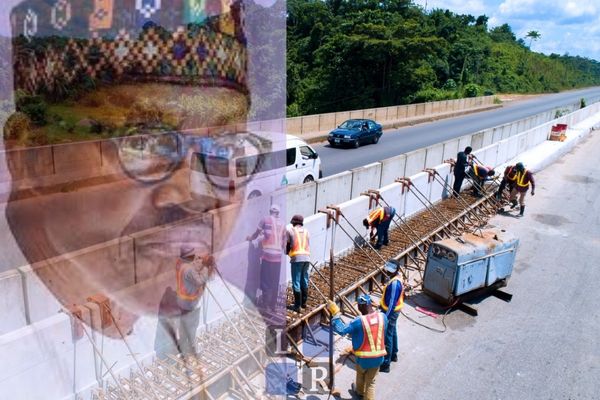
Buhari’s Infrastructural Development:  At What Cost and Whose Expense?

by Leading Reporters February 19, 2023
written by Leading Reporters

Nigeria has suffered perennial infrastructural deficiency.  From bad road to a near comatose rail transport system.  Former President Goodluck Jonathan started what looked like a revolution in the rail sector.  When President Muhammadu Buhari took over the mantle of leadership in 2015, He placed priority on infrastructural development, with a special interest in the railway, airport and road sectors.  Under his administration, the transport sector (Road, rail and airport) gulped more loans than every other sector and every other government since the advent of the current democratic experience.

There are currently ongoing road projects across many parts of Nigeria.  There is as well the 2nd Niger Bridge within the South East axis.  There are massive road constructions within the Southern and Northern axis in Nigeria. As beautiful as all these seem, the question Nigerians have failed to ask is the cost of borrowing to fund these projects.  Are these loans worthwhile?  Are they deployed for the same purpose for which they borrowed?  What are the terms and conditions of these loans?  What are the sovereign collateral and guarantees?  Are the projects for which they were borrowed feasible to bring enough returns to repay these loans?  What are the qualities and life spans of these infrastructures that we are obtaining loans for?  What effect do these untamed loans have on the economy at least within the medium and long terms?  These are questions every patriotic Nigeria should genuinely ask.

Unlike under previous governments when construction giant like Julius Berger was majorly patronized by the Federal Government, China construction companies are currently dominating construction projects in Nigeria – from rail to road, from airport to other infrastructures.  The reason for this shift is not far-fetched.  Most of the funding for these infrastructures is a “China Loan”. China would not avail of a loan that would benefit other construction companies.  Thus, Chinese Government-owned companies are having a field day in the construction sector in Nigeria.

President Buhari is currently the Nigeria President with the highest loan-take.  While many praise him for several infrastructural projects across Nigeria, others hold the view that the president’s penchant for loans may plunge Nigeria into collecting loans that may never easily be paid back.  China’s loan largesse is not limited to Nigeria.  Report has it that so many other countries have stretched to China for loans, nay, for more loans.  Loans are collected with collateral and other forms of securities and guarantees. Nigerians see roads and other infrastructures, but most Nigerians do not know the terms under which those loans were given to Nigeria. 

President Buhari APC-led government does not seem to understand jack about wealth creation or how the abundant human and natural resources Nigeria has been endowed with could be optimized for national growth and development.  The floral and faunas, the enchanting landscapes and rocks in the North Central region, the green allures of the South-South lands that stretch from land to sea, including the bodies of water that dot up that region, the historical monuments that could create research and historical tourism among countless other touristic elements lay waste without any efforts at exploring and exploiting them as major revenue earner.  What about the arable land that stretches from North to South?  Despite claims of food sufficiency, Nigeria still imports most of the food it consumes.  Where locally-made foods are available, the prices tower higher than the reach of an average Nigerian. Truly, things have fallen apart and all thanks to clueless leadership that have continued to plague Nigeria since her independence.

President Muhammadu Buhari is an expert in negotiating and collecting loans.  His advisers seem to always urge him on. Former Minister of Transport, Rt. Hon. Rotimi Amaechi stood out as one of President Buhari’s ministers who saw China loan as the be-all and did not seem to remember that loans are loans and are repayable. President Buhari believes the only way he could out-perform his predecessors is by collecting more and more loans for infrastructures.  Today in APC, infrastructural development have become a campaign slogan.  They tell Nigeria to embrace roads, and rails that have been built for them.  They however fail to tell Nigerians that their future have been sold for loans.

One of the sectors that has engulfed many loans is the railway facility.  Amaechi has severally and shamelessly portrayed the inevitability of loans for more rail tracks, including running a rail track from Nigeria to the Republic of Niger at no cost to the government and the people of the Republic of Niger. But any right-thinking Nigeria knows that the rail sector is not viable enough to repay the massive loan that has so far been obtained from China.  I do not think that the proceeds from rail transport will ever be enough to run the overhead costs, let alone repay the loans collected to build them. 

Only time will tell the damage these suspicious loans have dealt to the economy of Nigeria.  Only time may prove that these loans and the arrangement behind them were laden with corruption, and manipulation for purpose of self-aggrandizement.  Some of these loans were taken to be stolen.  Time will tell.

But do these loans have a long-term effect on the collective fortune of Nigeria and Nigerians?  It does. A disastrous effect.  Creative leaders are not those who resort to loans to bridge infrastructural deficiencies.  But they are people who optimize resources for growth and development.  Creative leadership provides an enabling environment that attracts the private sector to take infrastructural development.  What President Muhammadu Buhari, his aides and ministers have succeeded in doing in the name of infrastructural development is simply mortgaging the future of Nigerians, including an unborn generation. I am not enthused by several roads, rails and bridges built with Chinese loans, I am rather worried that Nigerians will pay dearly for the greed of a few who sold out this country by collecting loans for which their repayments do not look feasible.  …. To be continued.

Light I. Shedrack is a communication strategist, public issues analyst and an SME ideation specialist.  He writes from Abuja and can be reached via lightsheddie26@gmail.com

February 19, 2023 0 comments
0 FacebookTwitterPinterestThreadsBlueskyEmail
Najatu Mohammed dumps Tinubu, resigns from APC
Headlines

Najatu Mohammed dumps Tinubu, resigns from APC

by Leading Reporters January 21, 2023
written by Leading Reporters

She said that recent developments in the country had made it difficult for her to continue participating in partisan politics and accused the party of wickedness against the Nigerian people.

Najatu Mohammed has resigned her membership of the All Progressive Congress (APC) and announced her withdrawal from partisan politics.

Ms Mohammed also resigned from the APC presidential council campaign, where she had been the director of civil society engagement. 

Her resignation was communicated in a letter addressed to the national chairman of the party, Abdullahi Adamu. 

She indicated that recent developments in the country’s political landscape had made it difficult for her to continue participating in partisan politics.

“In line with article 9.5 (i) of the Constitution of the All Progressives Congress (APC), I am writing to you to intimate you of my resignation from the All Progressive Congress (APC).

“I am by this letter also informing you of my resignation as the Director of the Civil Society directorate of the Presidential Campaign Council of the APC.

“The challenges that Nigeria faces today require me to continue championing the struggle for a better country with a clear conscience as I remain absolutely loyal to my dear country Nigeria,” her letter read. 

Ms Mohammed also said in a statement released on Saturday that she was leaving party politics because the mainstream parties lacked an ideological foothold that distinguished them from one another.

She contended that the parties’ lack of ideological thought in their conduct and programs reduced them to mere tools that served the interests of politicians rather than the people.

“After much reflection and careful consideration, I have decided to part ways with party politics. I have come to the realization that my values and beliefs no longer align with party politics.

“Our political parties have no ideological differences and are simply robes that politicians wear to serve their personal needs and interests at any given time. As a result of which, we see politicians changing from one robe to another whenever it suits them.

“What is important at this point in time is the individual wearing the robe and not the robe itself.

She said that going forward, she would be “committed to supporting individuals that are truly interested in addressing the root causes of our challenges as a nation.

“To remain true to such commitments, one must be willing to take bold and decisive steps,” she added. 

January 21, 2023 0 comments
0 FacebookTwitterPinterestThreadsBlueskyEmail
HeadlinesOpinion

The beauty of Nigeria’s recent delegate elections

by Leading Reporters June 19, 2022
written by Leading Reporters

Tonnie Iredia

The pain of Femi Gbajabiamila, Speaker of the House of Representatives that many of his colleagues would be unable to return to the National Assembly is with due respect misplaced. While Femi as an individual is free to miss some of his close friends who could not secure their party tickets to run in next year’s general election, their loss was not against the run of play.

Indeed, failure of many lawmakers to return to the legislature has been the trend since 1999 when democracy was restored in Nigeria. At each election season, the competition to get into office grows more intense progressively. To start with, Nigerians who thought politics was a dirty game have since changed their minds by discarding the fear of political violence because of the transparent evidence that nothing in the country is as lucrative as politics. Thus, with increased interest in politics, electioneering has assumed a fiercer dimension capable of unseating several incumbents.
 
The Speaker’s conclusion that loopholes in the delegate system caused the loss of his colleagues at the party primaries is also not entirely accurate. The system may have played a role; but if the truth must be told, many legislators are undeserving of reelection. They really have no business in the legislature because they are only there to pick-up ‘basic’ salaries and humongous allowances.

Their incapacity is aggravated by their omission to appoint competent legislative aides to assist them perform their duties satisfactorily. For inexplicable reasons, they also have no viable constituency offices as demanded by law which would have positioned them to get acquainted with the real preferences of the people they represent. Many are in fact unknown to their constituents. The contributory negligence of passing a poorly worded Electoral Act 2022 was essentially the last self-inflicted injury. Just before that, there were bills with unpardonable typographical errors and sheer contradictions of the provisions in different sections that no one detected.
 
In fairness, national legislators are by far better than their colleagues in the Houses of Assembly in the states – a good example being the 24-member Kwara state legislature in which virtually every bill passed since 2019 was sponsored by the state governor. Accordingly, Nigerians should not bemoan the inability of certain legislators to return to base in 2023. The argument about continuity is essentially feeble. What should bother us now, is how to raise the level of political awareness among our people to vote for persons of substance that are passionate about making laws for good governance of society. Of course, some legislators have endeavoured to acquit themselves creditably. Gbajabiamila is in fairness one of such dutiful lawmakers, hence he got back his party ticket unopposed to contest the seat of his Surulere, Lagos constituency notwithstanding the contentious electoral bill which targeted members of the executive branch of government.
 
From the events of the last few months, the new electoral law has inadvertently helped to get many incumbents out of the legislature. In a country like Nigeria with stunted growth, it is unfair for certain persons to be in power for too long to the detriment of other citizens. It was therefore almost like a divine intervention that made the lawmakers by their own volition to pass a bill to their own disadvantage, just as it blinded them from some rather unintended errors until it was too late to act. The ‘wisdom-after-event’ thought of overriding the president was probably for self-consolation as the present legislature had no capacity during its potent days to contemplate such no-go area, let alone now that many members are nursing heart-broken injuries while vibrancy has been adjourned till after the 2023 election.      
 
One of the gains of the new Electoral Act is that it has emboldened hitherto timid people to rise up to challenge the self-made emperors in our democracy. It was quite interesting to learn that our senate president among a few others who lost out in the recent political intrigues had attempted but failed to coerce winners to step down for them. That was obviously a tall order within the context of the new circumlocutory electoral law. According to media reports, Bashir Sheriff Machina, the winner of the All Progressives Congress APC Yobe North Senatorial District primaries has said that rather than step down for Ahmed Lawan, he himself intends to become the senate president having served as a law maker earlier in 1990. Machina confirmed that it was because he never intended to step down for anyone that he declined to complete the withdrawal form attached by the party to the nomination package. Now, with the new Electoral Act, the Machinas of this world appear invigorated. 
 
As proof of the growing awareness of the muscle of the new law, aggrieved supporters of certain flagbearers in Kogi state who were being cajoled to step down stormed the APC national secretariat last Thursday, to protest attempts to substitute winners with favoured aspirants. Protesters from Abia and Ondo states had earlier demonstrated against same allegations. In the case of Enugu state, some aspirants claimed the party denied them the necessary forms to fill for the submission of candidates. They also alleged that the party instead offered them ‘withdrawal concession forms’ which they reportedly rejected. In the past, party executives implemented such anti-democratic behaviour with ease. There is doubt now if the party would not end up losing as the oppressed have provisions of the new electoral law to proceed with.
 
The situation in Akwa Ibom North-west Senatorial District does not appear different from that of Yobe state where a retired Deputy Inspector-General of Police, Udom Ekpoudom who won the party primaries has rejected pleas for him to step down for Senator Godswill Akpabio. There are few high points in the Akwa Ibom situation. First, the party having failed to get the cooperation of Udom claimed to have organized fresh primaries which Akpabio allegedly won. Second INEC monitored the first and not the second primaries. Third, the Akwa Ibom office of INEC disowned the second primaries thereby strengthening the resolve of the former police boss to hold-on to the ticket. The old attitude of putting blames on electoral officials didn’t succeed because INEC headquarters aptly discountenanced attempts to blackmail its Resident Electoral Commissioner in Uyo who testified that the only primaries monitored by his office was the one which produced the former police boss.
 
However, the development was not restricted to the ruling party. The main opposition Peoples Democratic Party PDP has had its share of the trend. Last week, the party’s candidate for the Kebbi Central Senatorial District, Haruna Dandio Saidu denied stepping down for the former Kebbi governor, Adamu Aliero who recently defected from the APC to the PDP. In a petition to INEC, Haruna warned that he was prepared to institute legal proceedings against any person who forges any document which purports that he accepted to withdraw his candidature. But for the new law, the underdogs in the two political parties would probably have been sacrificed to suit the wishes of party caucuses. This development therefore underscores the beauty of the recently conducted party primaries across the country.
 
Nigerians can now hope that elections in the country would depart, even if slightly, from the old order where we hosted failed elections. For example, the opportunity for the voices of the underprivileged people to be heard will at least stop the fake landslide victories of ruling parties whose members value party interests more than the wishes of those they are supposed to represent. In addition, our youths are now persuaded to pick up their permanent voters’ cards and vote out non-performing office holders. With this development, many contending national issues will be appropriately determined. One such issue is whether the nation is comfortable with a Northern candidate taking over from the outgoing President from the same region. This burning issue in addition to another one concerning whether a Muslim-Muslim ticket does not matter will all be determined not by political gladiators who are currently debating the issues but by eligible voters.                                                                                       

June 19, 2022 0 comments
0 FacebookTwitterPinterestThreadsBlueskyEmail
Opinion

Bello and his presidential ambition; a joke taken too far

by Leading Reporters March 25, 2021
written by Leading Reporters

I woke up one morning to my Facebook news feed ridden with all kinds of write up about governor Yahaya Bello of Kogi State nursing an ambition to become the president of the Federal Republic of Nigeria.

As usual, I thought it was one of the antics of the loafers who throng the government house to seek favour and in return write all kinds of junk. Yes, and I rightly thought. Long before then, about August 2020, a leaked WhatsApp chat circulated around social media in which Edward Onoja, Deputy governor of the state, was scolding one of their boys.

In the chat, Edward had told the boy to go and look for a decent job. This to me means a lot. Before I delve into why I called Bello ‘s ambition a joke, let me address Edward’s comment.

It appears they know that there is no future for their followers and praise singers. If following you is not a decent job, then why do you keep them? I though some youths learned from that exchange but alas I was wrong. As you read this, there are battalions of jobless layabouts singing the praises of the Bello-Onoja administration even though one of the key leaders of the administration doesn’t think it is a decent way of making money.

Secondly, by that statement, even Edward knows the Bello presidency, like an elephant, will not fly. It won’t even take off. He was so livid that he dismissed the boy’s service as ‘undelegated sycophancy’. Whatever that means.

It also means that to be an official sycophant, you have to be delegated. I believe that those delegated sycophants are those with a Tecno phone pad, a charger and N1,000 monthly data subscription to post edited pictures and write tragic English expressions such as ‘the people does not know’, ‘Kogi State is develops ‘ and other blunders.

The whole thing smacks of mediocrity. But that is beside the point. The point here is that for Bello, whose government is the most catastrophic in the new age home and abroad, to think of becoming the president of Nigeria,  we have seriously lowered the bar of governance in Nigeria.

A man whose state groans under yawning underdevelopment, the people are dying , civil servants are unpaid, health care is zero, education is comatose and roads have become death traps, should have quietly resigned, apologised and walked away in shame.

But no! Nigeria, whose political algorithm is so warped that it throws up only the mediocre to rule over the excellent, might end up throwing Bello up as the preferred candidate for the mobocratic APC.

Let me give you an instance. Before I travelled home in December 2020, I was warned to come with my drugs and first aid. That was an indication that no hospital was working. The so called hospitals are glorified halls where doctors and patients meet and probably exchange greetings. And like one popular joint at Ajaka, they just say ‘How body’?

On the day I was travelling, I got to Okene about 6 PM but between Okene and Ajaokuta, I spent an hour or more. The road was like a scene of a bombardment. It was full of craters, patches and potholes. Thank God there was no rain.

Getting to the river Niger, the entire bridge was in darkness. The street lights are all dead. Same goes for the Ganaja junction to Ganaja village roads. It is in a terrible state.

Let us talk about accountability and probity. Belloe and his deputy who have ruled Kogi State as their fiefdom have not been accountable to anyone. And the malleable State house has let them get away with it. A point in case is the opening of the Confluence University of Science and Technology. Of what use is it to a state as starved as Kogi State to have two state Universities?

Have the Kogi State University staff been well taken care of? Whatever happens to opening a school of engineering, science and technology in the school and upgrading it to a standard university instead of the poor state that it is left in?

My major concern is Bello has decided to take all of us for a ride. Forget about the photo ops. On ground, Kogi state is grossly mismanaged. We thank God for people like the Kano State governor, Umar Ganduje, a no nonsense man, who tore away the posters of the joke called Bello’s presidential campaign.

My only concern is that the lean state resources are expended on such a joke when there are shortages of infrastructure on all fronts. Who is even talking of infrastructure when the state workers haven’t been paid?

I urge everyone to call Bello and his social media hirelings to give a reasonable account of his stewardship over the years. They would resort to insults and bullying. No one would say anything that would be convincing.

If Kogi state still has elders, they must caution Bello from wasting the resources of the state in chasing a world goose. God bless Kogi State.

Alex Agbo
Public Affairs Analyst
Lagos.

March 25, 2021 0 comments
0 FacebookTwitterPinterestThreadsBlueskyEmail
Opinion

Nigeria’s Minimum Wage: Labour has a point

by Leading Reporters March 14, 2021
written by Leading Reporters

By Tonnie Iredia

Last Wednesday, state capitals across Nigeria witnessed protests by members of the Nigeria Labour Congress (NLC) against the plan to remove the country’s minimum wage from her Exclusive Legislative List.

Expectedly, several elite voices have since condemned Labour on the subject. While some, such as governors elected on the platform of the ruling All Progressives Congress APC, faulted the approach of the workers, others have described the protests as an attempt to stop the legislature from doing its work.

No one appears to remember that the National Assembly from where the bill was initiated is expected to consist of the people’s representatives whose primary obligation is to be on the side of the people. If so, which people in Nigeria requested their representatives to help them remove the minimum wage item from the exclusive legislative list or who are the legislators helping?

Opposition against the bill can hardly be surmounted. Already, many state legislators who addressed the workers’ protest last week expressed support for Labour making the reasoning of those in support of the removal to be unclear to everyone. It is argued that because some poor states may not be able to pay what others can afford, each state should have power to negotiate directly with its workers.

The argument is comical because a national minimum wage is supposed to be a figure that every state can pay; leaving more viable states with the option to pay far more than the barest minimum. In which case, is it not rational to leave the determination of such a benchmark to a central, neutral level? Against this backdrop, one is persuaded to agree with Labour that perhaps those against our apex workers’ union are yet to understand the ordinary meaning of ‘minimum’ as a term.

Why can’t Nigeria determine the least pay for her citizens in every part of the country? After all, the United States that our people constantly cite probably because our constitution is modelled after theirs has a national minimum wage. At the last count, no less than 29 American states had set their own minimum wages above the federal figure.

With respect to the reasonableness of the decision of Labour to organize protests against the bill which seeks to reorder the status of the minimum wage, one is tempted to conclude that our leaders are probably unable to appreciate that protests are legitimate and that they are covered by law in our country and elsewhere.

A peep at sections 38, 39, 40 and 41 of the Nigerian Constitution would reveal a combined effect of a fundamental human right of the people to assemble with like-minds to voice out their displeasure, disappointments and indeed their support for a policy. It is therefore unfair to echo the rather old-fashioned perspective in many parts of the country that persons who engage in protests are either unpatriotic or anti-establishment. It is hoped that this unprogressive stance will wear out soon, so that our nation is not dispossessed of what it takes to move side by side with other enlightened societies.

There is also nothing new or strange about the decision of Labour to protest. Perhaps some people would have preferred the option of dialogue, which at this point makes little sense in view of the long-drawn out dialogue which preceded the determination of the current minimum wage of N30, 000 that was done by Labour, Government at Federal and State Levels and the Private Sector. Six governors, one per geopolitical zone represented the states. The figure was negotiated over and over again and agreed upon before it was made into law. Labour imagines that it is states who have since breached the law that are now seeking a new path through a bill that removes the subject from the Exclusive Legislative list.

One would have thought that having reached a consensus earlier within the tenure of our current President, the determined minimum wage should have been allowed to work instead of looking for ways to thwart an agreement. Besides, we need to give peace medals to the current labour leaders who have not towed the path of their aggressive predecessors that harassed previous administrations on the same issues that are still begging for solution today.

We honestly cannot blame Labour now because many of the issues they have raised are not being tackled. For instance, Labour says minimum wage is a global phenomenon about which Nigeria should not seek to be an island on its own. They contend that the issue of a national minimum wage in the Exclusive Legislative List was settled as far back as June 16, 1961 when Nigeria joined other Sovereign nations to ratify the International Labour Organization (ILO) Convention 26 which prioritized the subject.

Another important point that has remained ignored is the issue of what happens to the informal sector when the minimum wage is put in disarray. Who will fix the minimum wage for the private sector and our numerous unskilled workers? In addition, if it is unfair for workers to earn same wages in different states that are not equally endowed, is it fair for governors of poor states to be equally remunerated with governors of more viable states? Would it not have been more palatable if the need to readjust wages began with our leaders who should lead by example?

The take-home pay of our national legislators has remained a disgusting issue. Each time it is raised, legislators team up as a union to place a smokescreen on the allegation. Those who publicly speak on the subject reveal only their basic salary, what about the outrageous allowances that even the body established to fix their remuneration has always disowned? Some even tell us of the ratio of funds available to the three arms of government to justify what the legislature gets. Is it only funds that should be shared by ratio, what about workforce? Those who speak privately for fear of suspension confirm millions of Naira at the disposal of federal legislators in Nigeria every month – a posture that is not amusing to the ordinary citizen. This probably explains the general belief that it is only the working class in our country particularly the lowly paid that are required to make sacrifices to stabilize Nigeria during this precarious financial situation.

History tells us how our leaders many years back without prompting, cut their expenses during periods of national financial difficulty. During the Murtala/Obasanjo military regime for example, austerity measures introduced to revitalize the nation began from the top when the most expensive official vehicle for top office holders was reduced to a Nigerian-assembled Peugeot car.

Today, the more the financial crisis, the more imported vehicles are procured for legislators and executives as if they belong to a group beyond the people they claim to represent. What this suggests is that if states are over-empowered at this point in time to determine wages, some of them will not only strangulate workers, they may procure private jets for retrieval of their own special allowances which being so high, might be in the sky. It is therefore hard to not agree that in the current agitation for workers’ survival, Labour has a strong point.

March 14, 2021 0 comments
0 FacebookTwitterPinterestThreadsBlueskyEmail
Newer Posts
Older Posts

Recent Posts

  • BREAKING: INEC announces timetable, schedule of 2027 elections

    February 13, 2026
  • Aso Rock to disconnect from nat’l grid in March – Perm Sec

    February 12, 2026
  • Valentine’s Day: FG bans money bouquets, warns against currency abuse

    February 12, 2026
  • INEC Proposes ₦873.78 Billion Budget for 2027 General Elections

    February 12, 2026
  • Engine Failure: Passengers escape death as Arik Air makes emergency landing

    February 11, 2026

Usefull Links

  • Contact Page
  • About Leading Reporters
  • Contact Us
  • Headlines
  • Investigation
  • Exclusives
  • Opinion
  • Business
  • Facebook
  • Twitter
  • Instagram
  • Linkedin

@2021 - All Right Reserved. Designed and Developed by PenciDesign


Back To Top
Leading Reporters
  • Featured
  • Politics
  • Opinion
  • Business
  • Entertainment
  • Sports
  • About Us
  • Contact