
Leading Reporters
  • Headlines
  • Health
  • Business
  • Exclusives
  • Investigation
  • Entertainment
  • Opinion
Thursday, March 19, 2026
Hot
Three security agents collapsed during Soludo’s 2nd term...
Insecurity: Tinubu orders service Chiefs to relocate to...
Petrol Subsidy Removal Pushes 63% of Nigerians Below...
“We Are Not Miyetti Allah” — Plateau Fulani...
Reps prescribe 2-year jail term, 10m fine for...
Row In Senate As Natasha Akpoti-Uduaghan Dropped From...
Fire Breaks Out At Federal Head Of Service...
Police reportedly remove force PRO Hundeyin 6 months...
BREAKING: Tinubu appoints Taiwo Oyedele as Minister
“If I Run for President, Nigerians Will Vote...
  • About Leading Reporters
  • Contact Us
Leading Reporters
Advertise With Us
  • Headlines
  • Health
  • Business
  • Exclusives
  • Investigation
  • Entertainment
  • Opinion
Hot
Three security agents collapsed during Soludo’s 2nd term...
Insecurity: Tinubu orders service Chiefs to relocate to...
Petrol Subsidy Removal Pushes 63% of Nigerians Below...
“We Are Not Miyetti Allah” — Plateau Fulani...
Reps prescribe 2-year jail term, 10m fine for...
Row In Senate As Natasha Akpoti-Uduaghan Dropped From...
Fire Breaks Out At Federal Head Of Service...
Police reportedly remove force PRO Hundeyin 6 months...
BREAKING: Tinubu appoints Taiwo Oyedele as Minister
“If I Run for President, Nigerians Will Vote...
Leading Reporters
Leading Reporters
  • Headlines
  • Health
  • Business
  • Exclusives
  • Investigation
  • Entertainment
  • Opinion
Copyright 2024 - All Right Reserved
Home > Business > Page 15
Category:

Business

Business

Presidency reveals fresh plan to increase VAT rate

by Folarin Kehinde May 8, 2024
written by Folarin Kehinde

The presidency, through its Committee on Fiscal Policy and Tax Reforms, has announced that there is a need to increase the value-added tax (VAT) rate.

Chairman of the committee, Taiwo Oyedele, disclosed this while informing Nigerians the VAT revenue-sharing formula would be reviewed.

He spoke at a policy exposure and impact assessment session organised by the committee earlier this week.

Nigeria’s VAT rate currently stands at 7.5 percent.

Oyedele, a tax expert, also said the committee has proposed reviewing state and local governments’ share of VAT revenue to 90 percent.

According to section 40 of the VAT Act, the federal government gets 15 percent of the tax revenue, states share 50 percent, and local governments share the balance of 35 percent.

However, Oyedele said the committee is recommending reducing the federal government’s share from 15 percent to 10 percent.

“We are proposing that the federal government’s portion should be reduced from 15 percent to 10 percent. States’ portion will be increased but they would share 90 percent with local governments,” he said.

Oyedele said the committee proposed adjusting the sharing formula for VAT because it is a tax of the states.

“In 1986, we had sales tax collected by states. The military came up with VAT in 1993 and stopped sales tax so they said it would collect VAT and return 15 per cent as cost of collection and that is the 15 per cent charged today came about. But we think it is too much,” he said.

The tax expert added that the burden of VAT should be on the ultimate consumer.

“So we must make it transparent and neutral and this is what over 100 countries where they have VAT are doing,” Oyedele said.

“Nigeria’s economy is more than 50 percent in services and if I just stop at this, many states will be broke because VAT collection will go down by more than 50 percent and it won’t even fly.

“So we therefore need to adjust the VAT rate upward. We would ensure that it doesn’t affect businesses. The only thing is to look at basic consumption from food, education, medical services and accommodation will carry zero percent VAT. So for the poor and small businesses, no VAT.”

Oyedele said other consumers will pay a bit more.

“We have spoken to businesses about it and they won’t increase the product price. We want to make sure when we do VAT reform, no one will increase the price of commodities. We will work the mathematics with the private sector,” he said.

Oyedele also said each state should not be granted exclusive custodianship of their collections– because it would likely result in chaos.

May 8, 2024 0 comments
0 FacebookTwitterPinterestThreadsBlueskyEmail
Business

BREAKING: CBN suspends charges on cash deposits until September 30, 2024

by Folarin Kehinde May 7, 2024
written by Folarin Kehinde

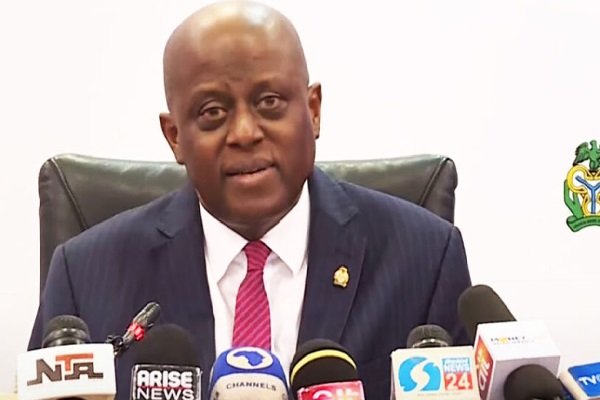
The Central Bank of Nigeria has directed banks to stop charges on cash deposits until September 30, 2024.

The apex bank disclosed this in a circular dated May 6, 2024, signed by its Director of Banking Supervision, Adetona Adedeji.

Customers of some of the Deposit Money Banks raised concerns that the banks have begun collection of processing fees for cash deposits as of May 1.

Our correspondent sighted this in an email shared by one of the customers of the banks.

Based on the bank’s move, two per cent was to be charged on deposits above N500,000 for individuals, while corporate account holders were to be charged two per cent on deposits above N3m.

According to the latest circular to financial institutions and non-financial institutions, CBN said the processing fees have been suspended.

The circular read, “Please refer to our letter dated December 11, 2023, referenced BSD/DIR/PUB/LAB/016/023 on the above subject, suspending processing charges imposed on cash deposits above N500,000 for Individuals and N3,000,000 for Corporates as contained in the ‘Guide to Charges by Banks, Other Financial Institutions and Non-Bank Financial Institutions’ issued on December 20, 2019,” CBN said.

May 7, 2024 0 comments
0 FacebookTwitterPinterestThreadsBlueskyEmail
Business

UPDATED: CBN exempts 16 banking transactions from cybersecurity levy

by Nelson Ugwuagbo May 7, 2024
written by Nelson Ugwuagbo

The Central Bank of Nigeria (CBN) has announced the exemption of 16 specific banking transactions from the recently introduced cybersecurity levy. The move aims to streamline and facilitate essential financial activities without additional costs for customers and institutions.

The exempted transactions include:

  1. Loan disbursements and repayments
  2. Salary payments
  3. Intra-account transfers within the same bank or between different banks for the same customer
  4. Intra-bank transfers between customers of the same bank
  5. Other Financial Institutions instructions to their correspondent banks
  6. Interbank placements
  7. Banks’ transfers to CBN and vice-versa
  8. Inter-branch transfers within a bank
  9. Cheque clearing and settlements
  10. Letters of Credits
  11. Banks’ recapitalisation-related funding – only bulk funds movement from collection accounts
  12. Savings and deposits, including transactions involving long-term investments such as Treasury Bills, Bonds, and Commercial Papers
  13. Government Social Welfare Programmes transactions e.g. Pension payments
  14. Non-profit and charitable transactions, including donations to registered non-profit organisations or charities
  15. Educational institutions’ transactions, including tuition payments and other transactions involving schools, universities, or other educational institutions
  16. Transactions involving bank’s internal accounts such as suspense accounts, clearing accounts, profit and loss accounts, inter-branch accounts, reserve accounts, nostro and vostro accounts, and escrow accounts.

This decision by the CBN is expected to ease the burden on customers and financial institutions engaging in these essential transactions, ensuring smooth operations and financial stability in the banking sector.

May 7, 2024 0 comments
0 FacebookTwitterPinterestThreadsBlueskyEmail
Business

BREAKING: CBN directs banks to charge 0.5% cybersecurity levy on all transactions

by Nelson Ugwuagbo May 7, 2024
written by Nelson Ugwuagbo

All commercial, merchant, non-interest, payment service banks and other financial institutions, among others got a directive from the Central Bank of Nigeria (CBN) to activate the payment of 0.5 per cent on some electronic transactions.

Others who got the CBN circular yesterday, are mobile money operators and payment service providers.

The circular outlines the implementation guidance on the collection and remittance of the National Cyber-security Levy, following the enactment of the Cybercrime (Prohibition, Prevention, etc) (Amendment) Act 2024.

Referring to previous directives and public engagements by the Office of the National Security Adviser (ONSA), the circular stressed the necessity of compliance with the amended Cybercrimes Act.

Pursuant to Section 44 (2)(a) of the Act, a levy of 0.5% (0.005) equivalent to a half percent of all electronic transactions value by specified businesses is mandatory. This levy is to be remitted to the National Cyber-security Fund (NCF) for administration by the ONSA.

The circular reads: “Following the enactment of the Cybercrime (Prohibition, Prevention, etc) (amendment) Act 2024 and pursuant to the provision of Section 44 (2)(a) of the Act, ‘a levy of 0.5% (0.005) equivalent to a half per cent of all electronic transactions value by the business specified in the Second Schedule of the Act’, is to be remitted to the National Cyber-security Fund (NCF), which shall be administered by the Office of the National Security Adviser (ONSA)”.

The key directives outlined in the circular include: the levy is to be applied at the point of electronic transfer origination, with financial institutions responsible for deduction and remittance. Deducted amounts shall be reflected in the customer’s account with the narration: “Cyber-security Levy.”

In addition, deductions are to commence within two weeks of the circular issuance, with monthly remittances to the NCF account by the fifth business day of every subsequent month.

The financial institutions are directed to complete system reconfigurations for timely submission of remittance files to the Nigeria Interbank Settlement System (NIBSS) Plc. within specified timelines. Failure to remit the levy is deemed an offence, with penalties including fines of not less than 2 percent of the annual turnover of defaulting businesses.

Certain transactions were exempted from the levy to avoid multiple applications. The Schedule of Exemptions from Cyber-security Levy, outlined transactions exempted from the levy, including loan disbursements and repayments, salary payments, intra-account transfers, and transactions involving educational institutions particularly, educational Institutions transactions, including tuition payments and other transaction involving schools, universities, or other educational institutions.

Others include, Intra-bank transfers between customers of the same bank; Other Financial Institutions (OFIs) instructions to their correspondent banks; Inter-bank placements; banks’ transfers to CBN and vice-versa; inter-branch transfers within a bank; Cheques clearing and settlements; Letters of Credits (LCs).

Banks’ recapitalisation related funding – only bulk funds movement from collection accounts; savings and deposits including transactions involving long-term investments such as Treasury Bills, Bonds and Commercial Papers; government Social Welfare Programmes transactions e.g. Pension payments; non-profit and charitable transactions, including donations to registered non-profit organisations or charities and transactions involving bank’s internal accounts.

The apex bank listed the affected accounts as: suspense accounts, clearing accounts, profit and Ioss accounts, inter-branch accounts, reserve accounts, nostro and vostro accounts and escrow accounts.

The circular directed all institutions under CBN’s regulatory control to comply with the provisions of the Act and the circular.

May 7, 2024 0 comments
0 FacebookTwitterPinterestThreadsBlueskyEmail
Business

PoS operators get July 7 deadline for CAC registration

by Folarin Kehinde May 7, 2024
written by Folarin Kehinde

The Corporate Affairs Commission and some Point of Sale operators have agreed to protect customers’ interest.

The Registrar-General of CAC, Hussaini Magaji, said this when the operators visited him in his office in Abuja.

Mr Magaji said the operators agreed to a two-month timeline to register their agents and merchants with CAC.

According to him, this is in line with the legal requirements and the directives of the Central Bank of Nigeria.

He said, “The measure is to safeguard the businesses of Fintech customers and strengthen the economy. The action is equally backed by Section 863, Sub-section 1 of the Companies and Allied Matters Act, (CAMA 2020), as well as the 2013 CBN guidelines on agent banking.’’

The registrar-general said that the deadline for the registration, which was agreed to be July 7, was aimed at providing protection for businesses in the country.

Also speaking, the Special Adviser to the President on Information and Communication Technology Development and Innovation, Peter Tokoni, restated the commitment of the government to boost the economy.

“We will ensure smooth facilitation of this process in line with the Renewed Hope Initiative of President Bola Tinubu-led administration,” Mr Tokoni said.

On their part, the Fintech operators reiterated their commitment to partner with CAC to ensure the efficient and effective implementation of the CBN directive.

They, however, urged for adequate sensitisation of the public to ensure smooth operations and to meet the desired goal.

The representatives of Opay, Momba; Palmpay Ltd.; Paystack; Fairmoney Microfinance Bank; Moniepoint, and Teasy pay were present at the event.

The highlight of the event was the signing of a document by the representatives to support the project.

The highlight of the event was the signing of a document by the representatives to support the project.

May 7, 2024 0 comments
0 FacebookTwitterPinterestThreadsBlueskyEmail
Business

Nigeria to start manufacturing cars before December 2024 – FG

by Folarin Kehinde May 3, 2024
written by Folarin Kehinde

The federal government says that Nigeria will commence local manufacturing of vehicles before the end of this year.

The Minister of Industry, Trade and Investment, Doris Uzoka-Anite, disclosed this at the African Association of Automotive Manufacturers and the Nigerian Automative Manufacturers Association’s meeting in Abuja on Friday, May 3.

Uzoka-Anite said funds to grow the nation’s automotive industry have been made available to local manufacturers.

According to the minister, it was vital to source made-in-Nigeria vehicle materials locally.

She seized the occasion to inform all stakeholders, including manufacturers, dealers, regulatory bodies, and other players in the automobile ecosystem, to key into the Nigerian Automotive Development Policy, and start making the desired contribution to the nation’s economy.

The African Association of Automotive Manufacturers is an organisation dedicated to the industrialisation and development of the automotive sector across Africa.

The association works with governments to shape policies, attract investors, and support the economic potential of the continent, by promoting sustainable and affordable mobility solutions.

Based in Johannesburg, South Africa, the association primarily serves the automotive industry, including manufacturers, investors, and policymakers.

May 3, 2024 0 comments
0 FacebookTwitterPinterestThreadsBlueskyEmail
Business

BREAKING: NDIC Raises bank depositors’ Coverage from N500,000 to N5m

by Nelson Ugwuagbo May 2, 2024
written by Nelson Ugwuagbo

The Nigerian Deposit Insurance Corporation (NDIC) has increased the maximum coverage of all deposit-taking financial institutions across all levels.

Managing director of the NDIC, Hassan Bello, who made this announcement on Thursday in Abuja, said the coverage has increased the maximum deposit insurance coverage of Deposit Money Banks (DMBs) from N500,000 to N5million, which would provide full coverage of 98.98 per cent of the total depositors compared with the current cover of 89.20 per cent.

The MD said in terms of the value of deposit covered, the revised coverage would increase the value of deposits covered by deposit insurance to 25.37 per cent compared with the current cover of 6.31 per cent of total value of deposits.

“For Microfinance bank, the maximum deposit insurance coverage was increased from N200,000 to N2 million would provide full coverage of 99.27 per cent of the total depositors compared with the current level of 98.76 per cent and would increase the value of deposits covered by deposit insurance to 34.43 per cent compared with 14.38 per cent of total value of deposit, currently covered.

“Primary Mortgage Banks (PMBs): The increase of the maximum deposit insurance coverage from N500,000 to N2 million would provide full coverage of 99.34 per cent of the total depositors compared with the current 97.98 per cent and would increase the value of deposits covered by deposit insurance to 21.04 per cent compared with 10.77 per cent.

“Payment Service Banks (PSBs): The increase of the maximum deposit insurance coverage from N500,000 to N2 million would provide full coverage of 99.99 per cent of the total number of depositors and would increase the value of deposits covered by deposit insurance to 43.10 per cent of the total value deposits from the current cover of 40.60 per cent.

“Subscribers of Mobile Money Operators: The increase of the maximum Pass-through deposit insurance coverage from N500,000 to N5 million per subscriber per MMO as the applicable coverage level for depositors of DMBs,” Bello stated.

May 2, 2024 0 comments
0 FacebookTwitterPinterestThreadsBlueskyEmail
Business

JUST IN: Glo, MTN, Airtel, Others move to Raise Tariff

by Folarin Kehinde April 25, 2024
written by Folarin Kehinde

The telecommunications companies operating in Nigeria notably Glo, MTN, Airtel and 9Mobile are asking the federal government to facilitate constructive dialogue in the industry.

According to the telcos, the current price control mechanism is not in tandem with the economic realities, thus seeking the government’s intervention in order to address pricing challenges.

The four telecommunications giants said they were the only ones that have not reviewed their prices which threaten the industry’s sustainability and possibly erodes investors’ confidence.

They made this known in a joint statement by the Association of Licensed Telecommunications Operators of Nigeria (ALTON) and Association of Telecommunication Companies of Nigeria (ATCON) on Thursday.

According to the statement signed by ALTON Chairman, Mr Gbenga Adebayo, and ATCON President, Mr Tony Emoekpere, there has not been a general service pricing framework upward in the past 11 years.

They attributed the non-increment to regulatory constraints despite the adverse economic hardship.

They said: “For a fully liberalised and deregulated sector, the current price control mechanism, which is not aligned with economic realities, threatens the industry’s sustainability and can erode investors’ confidence.

“Despite the adverse economic headwinds, the telecommunications industry remains the only industry yet to review its general service pricing framework upward in the last 11 years, primarily due to regulatory constraints.

“Government needs to facilitate a constructive dialogue with industry stakeholders to address pricing challenges and establish a framework that balances consumers’ affordability with operators’ financial viability.”

The telcos also expressed concerns on the worsening security challenges affecting the productivity of the services provided, urging the federal government erect measures to tackle the menace.

April 25, 2024 0 comments
0 FacebookTwitterPinterestThreadsBlueskyEmail
Business

JUST IN: Again, Naira Crashes at the Official Market

by Folarin Kehinde April 24, 2024
written by Folarin Kehinde

The Nigerian currency Naira on Tuesday depreciated at the official market, trading at N1,300.15 to the dollar yet again.

Data from the official trading platform of the FMDQ Exchange, a platform that oversees the Nigerian Autonomous Foreign Exchange Market (NAFEM), revealed that the Naira lost N65.66.

This represents a 5.3 per cent loss when compared to the previous trading date on Monday, April 22, when it exchanged at N1,234.49 to a dollar.

This development is coming amidst promises by the Nigerian Government to stabilize the naira after several financial reforms.

More to come…

April 24, 2024 0 comments
0 FacebookTwitterPinterestThreadsBlueskyEmail
Business

Dangote Refinery to Begin Petrol Sales in Q4 – S&P

by Nelson Ugwuagbo April 22, 2024
written by Nelson Ugwuagbo

Dangote refinery will start supplying petrol in the fourth quarter of 2024, according to Standard and Poor’s’ Global Commodities, S & P.

Kelly Norways, an African energy expert at the S&P, disclosed this in a podcast titled ‘Exploring West Africa’s oil product flows in a changing refining landscape’.

She said the Dangote refinery will significantly reduce energy imports across the West African sub-region, putting the figure for petrol as much as 290,000 barrels daily from 2024 to 2026.

“We are starting to see signs of activities, but all eyes are on when we’ll start to see gasoline production commence from that project. There is significant pressure from the Nigerian government for significant volume of that supply to be sent to the domestic market.

“When we see that start scale-up is still subject to debate. Dangote has recently been espousing some punchy timelines. They have most recently been saying that they are looking to produce gasoline by May. But in reality, our analysts expect that would be something like the fourth quarter of this year in a more realistic timeline,” he said.

The Dangote refinery was officially commissioned in May 2023 but has been unable to operate at full capacity. However, it began receiving crude oil around December and finally started distributing diesel to marketers in the local market in March.

Last week, the refinery announced the reduction in diesel price to N1,000 per litre from N1,600 per litre price.

Meanwhile, the Dangote refinery and oil marketers have hinted at the commencement of petrol sales next month.

April 22, 2024 0 comments
0 FacebookTwitterPinterestThreadsBlueskyEmail
Newer Posts
Older Posts

Recent Posts

  • Three security agents collapsed during Soludo’s 2nd term inauguration

    March 17, 2026
  • Insecurity: Tinubu orders service Chiefs to relocate to Maiduguri

    March 17, 2026
  • WikiLeaks’ Assange says ‘no dirt’ on Trump, praises former US President

    March 15, 2026
  • Tinubu: BAT Movement Reaffirms Support for Second Term

    March 14, 2026
  • Church Donates Tech Equipment to NIS

    March 14, 2026

Usefull Links

  • Contact Page
  • About Leading Reporters
  • Contact Us
  • Headlines
  • Investigation
  • Exclusives
  • Opinion
  • Business
  • Facebook
  • Twitter
  • Instagram
  • Linkedin

@2021 - All Right Reserved. Designed and Developed by PenciDesign


Back To Top
Leading Reporters
  • Featured
  • Politics
  • Opinion
  • Business
  • Entertainment
  • Sports
  • About Us
  • Contact