Leading Reporters
  • Headlines
  • Health
  • Business
  • Exclusives
  • Investigation
  • Entertainment
  • Opinion
Wednesday, February 18, 2026
Hot
FCT Polls: PDP candidate steps down for APC’s...
BREAKING: Tinubu signs controversial Electoral Act amendment bill...
Kano govt ban Dj, music till after Ramadan
Kaduna Terror Victims Demand Accountability for Rights Abuses...
BREAKING: DSS Sues El-Rufai for Intercepting NSA Ribadu’s...
Major Health Crisis Plagues Dape, Karmo Residents As...
BREAKING: INEC announces timetable, schedule of 2027 elections
Aso Rock to disconnect from nat’l grid in...
Valentine’s Day: FG bans money bouquets, warns against...
INEC Proposes ₦873.78 Billion Budget for 2027 General...
  • About Leading Reporters
  • Contact Us
Leading Reporters
Advertise With Us
  • Headlines
  • Health
  • Business
  • Exclusives
  • Investigation
  • Entertainment
  • Opinion
Hot
FCT Polls: PDP candidate steps down for APC’s...
BREAKING: Tinubu signs controversial Electoral Act amendment bill...
Kano govt ban Dj, music till after Ramadan
Kaduna Terror Victims Demand Accountability for Rights Abuses...
BREAKING: DSS Sues El-Rufai for Intercepting NSA Ribadu’s...
Major Health Crisis Plagues Dape, Karmo Residents As...
BREAKING: INEC announces timetable, schedule of 2027 elections
Aso Rock to disconnect from nat’l grid in...
Valentine’s Day: FG bans money bouquets, warns against...
INEC Proposes ₦873.78 Billion Budget for 2027 General...
Leading Reporters
Leading Reporters
  • Headlines
  • Health
  • Business
  • Exclusives
  • Investigation
  • Entertainment
  • Opinion
Copyright 2024 - All Right Reserved
Home > Archives for > Page 33
Author

Leading Reporters

Leading Reporters

Headlines

General Election: INEC rules out registration of new political parties

by Leading Reporters March 4, 2022
written by Leading Reporters

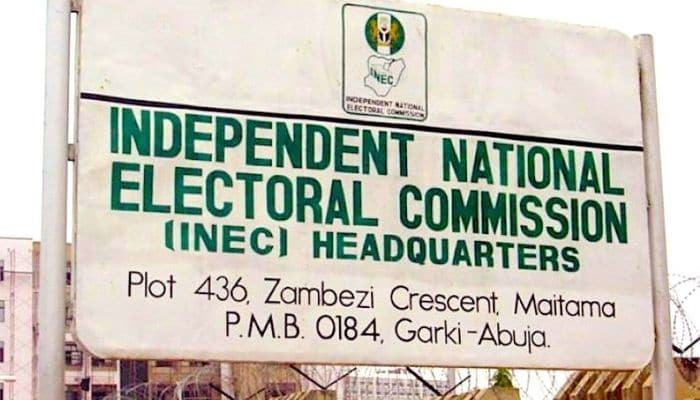
The Resident Electoral Commissioner for Independent National Electoral Commission(INEC) in Rivers State, Mr.Obo Effanga, has said the Commission will not register any new party for participation in the 2023 general election.

The Resident Electoral Commissioner for Independent National Electoral Commission(INEC) in Rivers State, Mr.Obo Effanga, has said the Commission will not register any new party for participation in the 2023 general election.

Effanga who stated this on Thursday at a new conference in Port Harcourt added that INEC had started all it needs to do to ensure that the newly signed Electoral Act is put into operation.

He said no new political parties will be registered outside of the 18 already existing ones.

The Rivers INEC boss stated that continuous registration of potential voters in the State will end in June this year.

He said INEC in the state has so far registered about 173,000 voters in the newly created polling units across state.

Effanga said, “The continued voters registration will end by June, the registration had been held in every state and local government offices of INEC.

“The Commission from next week will start the rotational registration in wards on daily basis to register voters,”he said.

Effanga urged members of the public who are yet to register to go online and register at the 2,224 newly created polling units, while those already registered can transfer to new centers closer to them.

“We have a process where we will screen to make sure that people will not do multiple registration and as many that want to do that, we will screen them out from the portal.

“We are planning in earnest for the 2023 election, we have 18 political parties ready for the election and we are not registering new parties because they are new and not up to one year.

“Political parties will submit their nomination forms online, and we are urging them to conduct their primaries, conferences and conventions very well and do the right thing,”he advised.

Effanga said that the Commission is working in synergy with the Inter Agency Consultative Committee to ensure that the 2023 election would be carried out successfully.

March 4, 2022 0 comments
0 FacebookTwitterPinterestThreadsBlueskyEmail
Africa & World

A Russian offers $1 million bounty for Putin’s “Dead or alive”

by Leading Reporters March 4, 2022
written by Leading Reporters

A Russian entrepreneur has put a $1 million bounty on Vladimir Putin, following the Russian president’s decision to invade Ukraine last week 

In a LinkedIn post that has since been taken down, entrepreneur Alex Konanykhim posted a photo of Putin and the words “Wanted: Dead or alive. Vladimir Putin for mass murder,” according to The Jerusalem Post. 

“I promise to pay $1,000,000 to the officer(s) who, complying with their constitutional duty, arrest(s) Putin as a war criminal under Russian and international laws,” wrote Konanykhin on LinkedIn, according to The Jerusalem Post. “Putin is not the Russian president, as he came to power as the result of a special operation of blowing up apartment buildings in Russia, then violated the [Russian] Constitution by eliminating free elections and murdering his opponents.”

Konanykhin is a former banker and the current CEO of TransparentBusiness, a software company based in San Francisco, California. 

“Some reports suggest that I promised to pay for the assassination of Putin,” Konanykhin wrote in an updated Facebook post on Wednesday. “It is NOT correct. While such an outcome would be cheered by millions of people around the world, I believe that Putin must be brought to justice.”

Konanykhim said he posted a similar message on Facebook, along with the “Wanted” photo, promising $1,000,000 to officers who arrested Putin as a war criminal, but it was banned by the social media platform. In a follow up post, he wrote his original message without the photo.

“I promise to pay $1,000,000 to the officer(s) who, complying with their constitutional duty, arrest(s) Putin as a war criminal under Russian and international laws,” Konanykhin wrote. 

Konanykhin did not directly respond to Fortune’s questions about the bounty on Putin, but did say that propaganda was negatively affecting the lives of Russian citizens. 

“I’m dismayed and outraged by the onslaught and war crimes Russia is committing in Ukraine. Putin cannot admit defeat or he risks to lose his power, which would almost certainly lead to his arrest. He has no legitimacy of an elected leader, as he eliminated free and fair elections, the news media and opposition a long time ago, so his power rests solely on fear he instills in his subordinates,” Konanykhin told Fortune. “He must be arrested before he makes an irreversible decision which may cost lives to many people.”

March 4, 2022 0 comments
0 FacebookTwitterPinterestThreadsBlueskyEmail
Africa & World

Europe war: Interpol decides on Russia’s membership

by Leading Reporters March 4, 2022
written by Leading Reporters
Several western countries demanded Russia’s suspension from the international police body

Interpol has rejected calls from several Western countries to suspend Russia from its ranks over the conflict in Ukraine, the world police organization said on Thursday. Canada, Poland, and the UK were among those demanding the move.

Just a few hours earlier, Canadian Prime Minister Justin Trudeau announced Ottawa had joined the chorus calling for Russia’s suspension, arguing that “international law enforcement cooperation depends on a collective commitment to the Universal Declaration of Human Rights and mutual respect between Interpol members.”

Canada, Poland, and the UK have all imposed a wide array of economic, political and other measures against Russia, accusing Moscow of aggression against Ukraine.

Russia sent troops into Ukraine last week, saying the government in Kiev was committing “genocide” in the Donbass region and needed to be demilitarized and “denazified.”

Interpol, which stands for the International Criminal Police Organization, has 195 member countries and maintains 19 police databases of crimes and criminals, including names and fingerprints, to facilitate international law enforcement cooperation. RT.com

March 4, 2022 0 comments
0 FacebookTwitterPinterestThreadsBlueskyEmail
HeadlinesOpinion

Buhari and his National Assembly friends

by Leading Reporters February 20, 2022
written by Leading Reporters

By Tonnie Iredia

Mutual distrust and suspicion between the Saraki-led 8th National Assembly and the Buhari-led Executive arm of government was an open secret.

However, the problem did not begin with delayed passage of annual budgets as some people tended to amplify; it was there from the very beginning because Bukola Saraki, the then Senate President and Yakubu Dogara, Speaker of the House of Representatives got into office against the arrangement of their party, the All Progressives Congress APC. If the 8th National Assembly was recalcitrant, the APC and the Presidency did much to hurt the leadership of the legislature. The case against Saraki at the Code of Conduct Tribunal and the refusal of the Senate to clear certain presidential nominees for critical political offices and many other antagonistic acts were all perceived as part of the cat and rat game which characterized the era. It was obviously not the best environment for good governance and President Muhammadu Buhari never missed any opportunity to denounce the development. Indeed, it was not a conducive option for attaining national development which the different of arms of government must be collaboratively committed to.

The end of tenure of the 8th Assembly presented to a reelected President an opportunity to ensure that the rancour of the last 4 years did not recur. So, the reelected ruling APC stringently avoided the elements that prompted the unnecessary bitterness of the past. The leadership of the National Assembly had greater personal reasons to act as good party members. The new Senate President Ahmad Lawan and his colleague in the House of Representatives Femi Gbajabiamila, were the same two party members previously anointed for their jobs which were overturned. They were thus not positioned to exhibit any headstrong signs. It was therefore a good beginning for both arms of government. The lack of understanding of this background was what made some analysts to express apprehension over a likely rubberstamp legislature – an apprehension exacerbated by the publicized manifesto of the leadership of the legislature as a team prepared to support anything from the Presidency.

The current National Assembly has understandably been run like what may go down in history as the most cooperative relationship with the Presidency in Nigeria. But how genuine is this friendship between both arms? This question is relevant because while many see the National Assembly as malleable, others suspect the deliberate underdog position as a ploy to insulate its members from public scrutiny of hidden illicit gains. None of the two elements can help the country’s growth because a positive aspect of the separation of powers is the opportunity the design gives to all arms of government to function together in the interest of the people. In other words, wherever one arm goes wrong should be corrected by the other; none should by commission or omission facilitate the perpetuation of any wrong by the other. This may not be easy to attain as both parties may not wish to roughen the feathers of the other even where the silence hurts society.

The 2022 Budget and the Electoral Act Amendment Bill have however left gaps for criticisms of a supposed cooperative relationship between arms of government that is hardly beneficial to the public. At the signing of this year’s budget into law, President Muhammadu Buhari was constrained to deprecate what he called “worrisome changes” to the budget by the National Assembly. We disagree with those who misunderstood the President as envisaging a situation where the legislature would pass the budget without ensuring that it would facilitate good governance. What should bother anyone is the scope of the changes whose numerical strength could derail governance. As Buhari disclosed, as many as 6,576 new items (not previously discussed behind closed doors by the two arms) were suddenly inserted into the budget as if it was a very poorly written report by a junior staff which his supervisor had to virtually rewrite.

The President does not appear to be the only one who is worried, BudgIT, a foremost civic-tech organization engaged in the advocacy for fiscal transparency and public accountability in Nigeria has explicitly expressed greater worries on behalf of many. From BudgIT we are able to learn that there are 460 duplicated items amounting to N378.9billion in budget 2022. Worse still is that several projects were inexplicably assigned to Ministries, Departments and Agencies (MDAs). For example, the National Agency for Great Green Wall, set up to prevent land degradation and desertification afflicting parts of the country is to get N1.3 billion for purchasing motorcycles, street lights and other projects which are outside its mandate. The Ministry of Environment, which is not a security agency reportedly has N67.8million to construct ‘Gun Armouries.’ This trend ought to worry any well-meaning Nigerian more so as this is not the first time of its occurrence in our budgets. Last year, as many as 316 duplicated projects were inserted into the 2021 Budget approved by the National Assembly.

The point must be made again that the ample time which our legislature spends on scrutinizing the budget is commendable because that is more likely to bring out the best of the budget. Interestingly, they do not appear to subject the request for loans by the executive to the same type of scrutiny. This is particularly curious because despite the very loud public disapproval of the numerous loans incurred by this government, none of the requests for loans is ever rejected and no changes are ever made either to the amount needed or the nature of its components. Yet, the National Assembly is made up of the same professionals of different academic and occupational backgrounds who always pick holes in budget estimates. Could it be that the Executive arm is never able to deploy the same expertise it puts into working on loans into the preparation of budgets or are presidential liaison officers not the same for budgets and loans?

The absence of a unity of direction between the Presidency and the National Assembly on the subject of the Electoral Act Amendment Bill is even more complicated. The refusal of the President to assent to the bill because of its anti-democratic feature of disallowing our political parties from having options of primary election modes cannot be faulted. But it is obvious that some legislators may have felt bad because as friends who speedily approve executive requests, Buhari should have also reciprocated by accepting the wishes of his friends to reduce the powers of governors. But then by refraining from perpetuating what is wrong, the President taught his friends a huge lesson that it makes more sense for a leader to support his friends only when their viewpoint will not hurt the public. Whereas legislators who are lawyers are fully aware that a law which is targeted at a specified group is bad law, both themselves and their other colleagues who are not learned should hereafter realize that to blindly support a friend can be injurious to both a policy and many innocent persons involved in the process.

Accordingly, our legislators who are mandated to ensure that nominees to certain public offices are fit and proper persons should stop the ‘bow and go’ contrived scheme which allows nominees with poor baggage to assume offices. The power to screen a person for an office, as we have always argued in this column, cannot be logically extended to include the power to exempt some from screening. If the Presidency nominates people for offices, the constitution requires the senate to reject those who are unfit such as partisan politicians nominated to the electoral body because the contrary would amount to perpetuation of wrong and would in turn hurt the electoral process. As President Buhari is currently struggling to reduce both our numerous institutions and government’s inability to meet University teachers’ requirements, this is not the time for friends in the legislature to be making fresh laws to create more institutions. People must learn to support their friends in office to end well.

Tonnie Iredia
February 20, 2022.

February 20, 2022 0 comments
0 FacebookTwitterPinterestThreadsBlueskyEmail
Headlines

Here is a list of countries that remain untouched by Covid with zero cases so far

by Leading Reporters February 19, 2022
written by Leading Reporters

The world is battling the deadly coronavirus pandemic for over two years now. However, there are a few countries that remain completely untouched by the pandemic. 

The WHO has released a list that shows a couple of countries that have zero cases of the virus. Most of these countries and territories are islands in the Pacific and Atlantic oceans. Here is the list:

Micronesia: This country is spread across the western Pacific Ocean comprising more than 600 islands. However, Micronesia is made up of 4 island states: Pohnpei, Kosrae, Chuuk and Yap.

Nauru: Located in Oceania, the country features a coral reef and white-sand beaches. As per the WHO list, nearly 68 people per 100 are fully vaccinated here. 

Niue: It is a small island nation in the South Pacific ocean. Over 79 people per 100 are fully vaccinated against Covid here.

Pitcairn Islands: This comprises the islands of Pitcairn, Henderson, Ducie and Oeno. It is a small volcanic region situated in the South Pacific at latitude 25.04 south and longitude 130.06 west. 74 people per 100 are fully vaccinated here.

Saint Helena: Known as the place of Napoleon Bonaparte’s exile and death, this is a remote volcanic outpost in the South Atlantic Ocean. WHO claims that 58.16 persons per 100 are fully vaccinated here.

Tokelau: Located near New Zealand, this place has a single airport. It only has a population of about 1,500 people. 

Tuvalu: This is a group of three reef islands and six atolls. Tuvalu closed its borders and mandated quarantine. As per WHO, nearly 50 people are fully vaccinated per 100 population.

Turkmenistan and North Korea have also been listed as being free of the deadly coronavirus. These countries have not yet acknowledged any case officially. 

The WHO list also mentions countries that have been the worst hit by the deadly virus. The United States tops the list with 77,521,589 cases, followed by India with 42,780,235 cases. 

February 19, 2022 0 comments
0 FacebookTwitterPinterestThreadsBlueskyEmail
Headlines

Nigeria, five others to begin COVID-19 vaccine production

by Leading Reporters February 19, 2022
written by Leading Reporters

Nigeria and five other African countries have been chosen to begin production of COVID-19 vaccines, with the continent having had limited access to jabs.

“Today I’m delighted to announce the first six African countries that will receive technology from the hub to produce their own mRNA vaccines: Egypt, Kenya Nigeria, Senegal South Africa, and Tunisia,” Director-General of the World Health Organisation Tedros Ghebreyesus, announced on Friday.

According to the WHO, they were selected as the first recipients of technology from the organisation’s global mRNA vaccine hub, in a push to ensure the African continent can make its own jabs to fight COVID and other diseases.

“I was honoured to visit the Hub last week. And it’s already producing results, with Afrigen’s announcement that it has produced its own mRNA vaccine, based on publicly-available information about the composition of an existing vaccine,” Ghebreyesus said.

“We expect clinical trials to start in the 4th quarter of this year, with approval expected in 2024. We expect the benefits of this initiative will extend far beyond #COVID19, by creating a platform for vaccines against other diseases including malaria and tuberculosis”.

“WHO will work with the companies and the government in each country to develop a roadmap for training and production, based on their needs and capacities.

“Thank you all, and we look forward to working with all of you to make this project a success, for the healthier, safer and fairer Africa”.

According to the WHO boss, no other event like the Covid-19 pandemic has shown that reliance on a few companies to supply global public goods is limiting, and dangerous.

He, therefore, stressed that the best way to address health emergencies and reach universal health coverage is to significantly increase the capacity of all regions to manufacture the health products they need.

Tedros has continually called for equitable access to vaccines in order to beat the pandemic, and rails against the way wealthy nations have hogged doses, leaving Africa lagging behind other continents in the global vaccination effort.

A ceremony marking the mRNA tech transfer announcement was held Friday in Brussels at the summit between the European Union and the African Union.

European Commission chief Ursula von der Leyen said: “We have been talking a lot about producing mRNA vaccines in Africa. But this goes even beyond. This is mRNA technology designed in Africa, led by Africa and owned by Africa.”

Self-reliance

Currently, only one per cent of the vaccines used in Africa are produced on the continent of some 1.3 billion people.

The WHO set up a global mRNA technology transfer hub in South Africa last year to support manufacturers in low- and middle-income countries to produce their own vaccines.

The global hub’s role is to ensure that manufacturers in those nations have the know-how to make mRNA vaccines at scale and according to international standards.

As used in the Pfizer/BioNTech and Moderna Covid-19 vaccines, mRNA technology provokes an immune response by delivering genetic molecules containing the code for key parts of a pathogen into human cells.

Primarily set up to address the Covid-19 pandemic, the global hub has the potential to expand manufacturing capacity for other vaccines and products, such as insulin to treat diabetes, cancer medicines and, potentially, vaccines for diseases such as malaria, tuberculosis and HIV.

The scheme’s ultimate goal is to spread capacity for national and regional production to all health technologies.

‘Mutual Respect’

The WHO said it would work with the first six countries chosen to develop a roadmap of training and support so they can start producing vaccines as soon as possible.

Training will begin in March.

The South African hub is already producing mRNA vaccines at laboratory scale and is currently scaling up towards commercial scale.

South African President Cyril Ramaphosa said Friday’s announcement “means mutual respect, mutual recognition of what we can all bring to the party, investment in our economies, infrastructure investment and, in many ways, giving back to the continent”.

French President Emmanuel Macron said supporting African health sovereignty was one of the key goals of starting up local production, “to empower regions and countries to fend for themselves, during crises, and in peace time”.

More than 10.4 billion Covid-19 vaccine doses have been administered around the world, with nearly 62 percent of the global population having received at least one shot.

However, just 11.3 per cent of Africans had been fully immunised by the start of February.

In Nigeria, many are yet to be vaccinated despite efforts by authorities to make citizens get the jab.

On Thursday, the country recorded 45 new cases of the virus, bringing its total number of confirmed cases to 254,182.

230,530 cases are, however, said to have recovered, while 3,141 deaths have been recorded in 36 states and the Federal Capital Territory.

The 45 new cases were reported from eight states – Lagos (18), Cross River (7), FCT (7), Oyo (5), Kano (3), Nasarawa (3), Ekiti (1) and Rivers (1).

Across the world, the vaccine continues to rage on.

Here are some of the latest developments on the impact of the virus:

Canadian Police Deployed

Canadian police mass in the capital, readying to clear a trucker-led anti-Covid curb protest that has choked Ottawa’s streets and provoked the government to call on rarely-used emergency powers.

Israel to end green pass 

Israeli Prime Minister Naftali Bennett announces the requirement to show proof of coronavirus vaccination to enter various sites will soon end, as the wave of infections wanes.

World ‘better prepared’

The world is becoming “better prepared” to deal with future variants of the virus, the CEO and co-founder of German vaccine-maker BioNTech tells AFP, as the company works on an Omicron-specific shot.

Japan eases strict border bar

Japan will ease its strict virus border rules to allow students and businesspeople into the country from March, but tourists will still be barred.

Portugal to lift most Covid rules

Portugal will no longer require people to present a health pass when going to restaurants and hotels, the government says, without providing a fixed date. Proof of vaccination is still necessary to enter the country.

Swiss president tests positive 

On the day Switzerland lifts almost all remaining coronavirus restrictions, the government announces President Ignazio Cassis has tested positive.

Covid-19 pill

A South Africa regulator says it has approved the use of Merck’s Covid-19 pill for high-risk adults.

US jabs for Egypt, Nigeria

The United States ships nearly 5.2 million doses of the Pfizer Covid-19 vaccine to Egypt and Nigeria, a White House official tells AFP.

Djokovic ready for Dubai comeback

Tennis world number one Novak Djokovic prepares for his comeback in Dubai, after a coronavirus vaccine row kept the Serb from defending his Australian Open title.

Aussie tennis star probed

Australian tennis player Alex de Minaur hits back at allegations he is being investigated over the purchase of false Covid passes, insisting: “I have a completely valid, accurate and true vaccination record.”

Over 5.8 million dead

Coronavirus has killed at least 5,848,104 people since the outbreak emerged in China in December 2019, according to an AFP tally compiled from official sources Thursday.

The US has recorded the most Covid deaths with 928,519, followed by Brazil with 640,774, and India 510,413.

Taking into account excess mortality linked to Covid-19, the WHO estimates the true death toll could be two to three times higher.

February 19, 2022 0 comments
0 FacebookTwitterPinterestThreadsBlueskyEmail
Headlines

N165B Fraud: Gbajabiamila launches probe against Aregbesola over prison fund

by Leading Reporters February 17, 2022
written by Leading Reporters

The House of Representatives has commenced a probe of the Minister of Interior, Rauf Aregbesola.

The Speaker, Femi Gbajabiamila, made this known on Wednesday.

Gbajabiamila is a staunch loyalist of Bola Ahmed Tinubu, a National Leader of the All Progressives Congress, APC, who has declared his intention to run for presidency in 2023.

This development is coming few days after Aregbesola publicly blasted Tinubu for turning himself into a god.

Gbajabiamila presided over the plenary on Wednesday, where members resolved that the interior minister and prisons chief, Haliru Nababa be probed.

They are being accused of misappropriating about N165billion funds earmarked for prisons development across the country.

The House resolution came as a result of a motion of urgent public importance moved by Ndudi Elumelu, who is the Minority Leader of the House.

“The House is disturbed that despite this Act and increase in budgetary allocations to the Nigerian Correctional Service to drive its renewed mandate, the tempo and quality of the service have remained the same if not retrogressing,” Elumelu said.

“The House is worried that the working conditions of staff and inmates’ welfare have deteriorated notwithstanding, the over N165 billion budget allocations to the service in the last two years.”

With this, the lawmakers resolved to have its committee on Reformatory Institutions investigate the allegations and report to the House within 12 weeks, for further legislative action.

February 17, 2022 0 comments
0 FacebookTwitterPinterestThreadsBlueskyEmail
Headlines

FBI fraud allegation, NDLEA drug-dealing claim — will DCP Kyari be tried in Nigeria or US?

by Leading Reporters February 16, 2022
written by Leading Reporters

The allegations against Abba Kyari, the suspended deputy commissioner of police, took a startling dimension on Monday when the National Drug Law Enforcement Agency (NDLEA) declared him wanted for alleged drug-dealing.

Femi Babalola, spokesperson of the NDLEA, in a press briefing, said the anti-drug agency strongly believes that “DCP Kyari is a member of a drug cartel that operates the Brazil-Ethiopia-Nigeria illicit drug pipeline”.

The NDLEA’s revelation comes months after the Federal Bureau of Investigation (FBI) indicted Kyari of conspiring with Hushpuppi, self-confessed international fraudster, in a $1.1 million scam targeting Qatari business people.

The FBI secured a court order for Kyari’s extradition and arrest over his alleged involvement in the Hushpuppi fraud.

The suspended police officer denied the allegation, claiming that his “hands are clean”.

Amid the allegation, Usman Baba, the inspector-general of police, set up a panel to probe the allegations against Kyari. A few weeks later the panel submitted its report.

Recently, the Police Service Commission (PSC) directed that a different panel be constituted to further investigate Kyari’s case.

Kyari has been under investigation since July 2021, and there is the speculation that the federal government is foot-dragging on the matter so as to scuttle the extradition.

Some Nigerians have alleged that the NDLEA’s allegation against Kyari is a ploy by the federal government to truncate his extradition.

Here, TheCable puts into perspective what the law says about extradition in the light of the litany of allegations against Kyari — home and abroad.

WHAT IS EXTRADITION AND HOW DOES IT WORKS WITH NIGERIA?

Extradition is a formal action in which a particular jurisdiction upon request hands over an accused or convicted person to another jurisdiction where an alleged offence was committed.

Hushpuppi, for instance, was arrested in Dubai, but handed over to the US for prosecution.

Nigeria has several laws and treaties guiding the extradition of its citizens to other countries. Treaties on extradition have been signed by Nigeria and some countries to facilitate the extradition of accused persons.

For instance, the Extradition Treaty 1935 was signed by Nigeria, the US and the UK. The provisions in the treaty are binding on the three countries.

First, for an extradition process to commence in Nigeria, there must be a diplomatic request from the representative of that country to the attorney-general of the federation. The request must be accompanied by a duly authenticated warrant of arrest or certificate of conviction issued in that country.

Second, the attorney-general of the federation having considered the facts presented by the requesting country may make an order to a court requesting that the case be determined for extradition.

The attorney-general also has the powers to reject the extradition request if the alleged offence has political colouration or the alleged offender is being targeted on the basis of race, religion or nationality.

Section 6 of the Extradition Act states: “(a) A request for the surrender of a fugitive criminal of any country shall be made in writing to the attorney-general by a diplomatic representative or consular officer of that country and shall be accompanied by a duly authenticated warrant of arrest or certificate of conviction issued in that country.

”(b) Where such a request is made to him, the attorney-general may by an order under his hand signify to a magistrate that such a request has been made and require the magistrate to deal with the case in accordance with the provisions of this Act, but shall not make such an order if he decides on the basis of information then available to him that the surrender of the fugitive is precluded by any of the provisions of subsection (1) to (7) of section 3 of this Act.”

DID DCP KYARI BREACH ANY EXTRADITABLE OFFENCE?

There have been arguments on whether the allegations levelled by the FBI against the suspended IRT boss constitute an extraditable offence.

Article 3 of the Extradition Treaty 1935, which was signed by Nigeria, the US and the UK, highlighted offences that are worthy of extradition.

A review of article 3 of the treaty shows that the allegations levelled against Kyari by the FBI fall under number 17 and 18 of the highlighted offences in article 3.

Article 3 states that: “Extradition shall be reciprocally granted for the following crimes or offences:

“17. Fraud by a bailee, banker, agent, factor, trustee, director, member, or public officer of any company, or fraudulent conversion.

“18. Obtaining money, valuable security, or goods, by false pretences; receiving any money, valuable security, or other property, knowing the same to have been stolen or unlawfully obtained.”

Speaking in an interview, Abubakar Malami, attorney-general of the federation, On February 6, said the federal government is working with the US on the “possible extradition” of Kyari.

Malami added that the police panel has established “reasonable grounds for suspicion” which could lead to Kyari’s extradition.

KYARI’S ALLEGED DRUG-DEALING OFFENCE IN NIGERIA VIS-A-VIS EXTRADITION 

The Extradition Act states conditions in which an accused person cannot be extradited to the requesting country.

One of such conditions as stipulated in section 3 (f) of the law is that the accused person shall not be surrendered if he or she is charged with an offence under a Nigerian law until the expiration of the sentence or prosecution, particularly when the offence is different from the one allegedly committed in the requesting country.

Section 3 (f) states: “A fugitive criminal- (a) who has been charged with an offence under the law of Nigeria or any part thereof, not being the offence for which his surrender is sought; or

“(b) who is serving a sentence imposed in respect of any such offence by a court in Nigeria, shall not be surrendered until such a time as he has been discharged whether by acquittal or on the expiration of his sentence, or otherwise.”

There is a possibility that the suspended IRT boss could be charged and arraigned in court by the NDLEA for offences bordering on drug trafficking.

If Kyari is arraigned by the NDLEA for drug-related offences, which is a breach of Nigerian law, the provisions of section 3(f) of the Extradition Act could serve as an impediment to his extradition to the US.

LAWYERS SPEAK

Speaking on the development, Festus Ogun, human rights lawyer, told TheCable that if the NDLEA files charges against Kyari the action will “succeed in hindering and frustrating” his extradition process to the US.

“The simple interpretation of the above provision of the law (referring to section 3 of the Extradition Act) in respect to this case is that any extradition application made against Abba Kyari shall be rejected if the NDLEA decides to charge him with an offence, under Nigerian law, other than the offence for which his surrender is sought in the US, that is the crime he allegedly committed in connection with Hushpuppi,” Ogun said. 

“While it is desirable that the NDLEA gets to the root of this drug cartel matter involving Abba Kyari by ensuring that those found wanting after thorough investigation are charged before a competent court of record, such an action will only succeed in hindering and frustrating his (Kyari’s) extradition.”

Ogun added that Malami has the power as the attorney-general to ensure “substantial justice” in the prosecution of Kyari by the NDLEA and extradition to the US. 

Another human rights lawyer, Inibehe Effiong told TheCable that the “sensible” decision is for the federal government to extradite Kyari to the US for prosecution. 

Effiong added that the suspended IRT boss can still be brought back to Nigeria to face trial after the outcome of his prosecution in the US.

“My opinion remains that let the case in the US take precedence, whatever the outcome of that case, he can always be brought back to Nigeria to face trial for the offence relating to alleged involvement in hard drugs,” the lawyer said.

“This is the sensible thing to do. Otherwise, it will not be unfounded to assume that this may have been orchestrated after all to frustrate his extradition since the narcotic allegation is not related to the case presented by the FBI.” TheCable

February 16, 2022 0 comments
0 FacebookTwitterPinterestThreadsBlueskyEmail
Headlines

Nigerian Institutions graduates are lazy, unemployable: Prof Pantami

by Leading Reporters February 16, 2022
written by Leading Reporters

The Minister of Communications and Digital Economy, Dr. Isa Ali Pantami, has alleged that most graduates from Nigeria institutions are unemployable and are too dependent on “government jobs.”

He decried the trend among Nigeria graduates chasing government employment rather than venturing into entrepreneurship which gives them the impetus to employ others, thereby bridging the unemployment gap in the country.

“The main challenge is not unemployment,” Mr Pantami stressed. “I am not discarding unemployment, but the major challenge is unemployability, a situation where I cannot be able to do the technical work that my certificate has stored that I have studied.”

Mr Pantami, currently facing the accusation of fraudulent professorship, further accused the youths of being too lazy to start a job on their own.

“As the situation is today, most of our young people after graduating from school are not in any way thinking of entrepreneurship. They are only interested in looking for government employment,” Mr Pantami said of Nigerian youths. “There are many job opportunities in engineering, ICT, oil and gas but most of our youths with (a) certificate if you employ them, you will discover that they will not be able to do the work you have employed them to do.”

The minister stated this at the prize presentation ceremony for the Katsina National Talent Hunt Challenge in Katsina on Tuesday.

“So on (a) daily basis, foreigners are coming to Nigeria to come and do the job for us,” Mr Pantami added. “Most of our technical people are engaged in administrative work, while we rely on other people to come and do the technical job.”

Mr Pantami himself is being accused of academic fraud. The Academic Staff Union of Universities deemed the minister’s appointment by the Federal University of Technology Owerri as a professor as illegal.

“You cannot be a minister and a lecturer in a university. It is an encouragement of illegality,” Mr Osodeke said. “Pantami has to quit as a minister and be tried for doing double jobs within the same federal system. He is not qualified. Pantami should not be treated as a professor.”

In documents seen on the media, Mr Pantami said he accepted the professorship on the instruction of President Muhammadu Buhari.

“This decision is sequel to my briefing to the President of the Federal Republic of Nigeria on Friday, March 26, 2021, and his permission for me to go ahead and share my knowledge and experience in the academia, which is a form of community service to our citizens,” Mr Pantami had defended himself.

Mr Pantami had accepted the position at the Imo-based institution before it had been formally offered to him, based on the reported documents. 

The Islamic cleric accepted the position in March. However, the appointment letter offering the professorship post to Mr Pantami has August 20 as its date.

February 16, 2022 0 comments
0 FacebookTwitterPinterestThreadsBlueskyEmail
Headlines

Despite corruption charges, Buhari confirms Bello-Koko as MD of NPA

by Leading Reporters February 16, 2022
written by Leading Reporters

The President, Major General Muhammadu Buhari (retd.), has approved the appointment of Mohammed Bello Koko as the substantive managing director for the Nigerian Ports Authority.

This was contained in a press statement signed by the Director, Press and Public Relations, Federal Ministry of Transportation on Tuesday.

“Prior to this appointment, Koko was the executive director, finance & administration of NPA,” the statement reads.

Bello-Koko was on May 6, 2021, made the acting managing director of NPA when Hadiza Bala Usman was directed to handover to the most senior Executive Director after she was suspended for insubordination.

Prior to the appointment as acting MD, Bello-Koko was the Executive Director, Finance & Administration of the Authority.

Recall that Managing Director of Nigerian Ports Authority, Mohammed Bello-Koko, is involved in offshore shenanigans, hiding behind two shell companies incorporated in a tax and secrecy haven to anonymously invest in the United Kingdom property market, potentially violating Nigeria’s public service code of conduct laws, the ongoing Pandora Papers reporting has revealed.

Mr Bello-Koko is possibly hoping to be confirmed the substantive NPA chief by President Muhammadu Buhari. The current substantive head of the agency, Hadiza Bala-Usman, remains on suspension following her disagreement with the transportation minister, Rotimi Amaechi. It is unclear if she would be recalled with a probe of her tenure seemingly unending.

Mr Bello-Koko, with his wife, Agatha Anne Koko, enlisted the services of financial secrecy seller, Cook Worldwide and Alemán, Cordero, Galindo & Lee Alcogal, an offshore law firm, to register Coulwood Limited (reg. number: 1487897) and Marney Limited (reg. number: 1487944) in the British Virgin Islands (BVI), one of the world’s most commonly used tax havens, in 2008. Both companies were registered the same day, June 19, 2008.

However, Mr Bello-Koko remains a director of the two companies even as a public servant in violation of Nigeria’s Code of Conduct Bureau and Tribunal Act (Sections 5 and 6). The regulators in the BVI also had his companies under watch for suspected money laundering, a problem Alcogal appeared to have helped him avoid with some misinformation provided to the regulators.

Panama

Alemán, Cordero, Galindo & Lee

Number of leaked files: 2,185,783

Time period: 1970-2019

Read more : Pandora Papers – Secrecy Brokers

The revelations came from Pandora Papers, a trove of 11.9 million leaked confidential records obtained by the International Consortium of Investigative Journalists, ICIJ.  The ICIJ then coordinated a team of 617 journalists from 150 news outlets, including those from PREMIUM TIMES, to dive into the data. The reporters spent two years sifting through the leaked records, tracking down sources, and digging into court files and other public records from dozens of countries. It is the biggest collaboration of investigative journalists – from 117 countries and territories – in history.

The leaked records came from 14 offshore services firms from around the world that set up shell companies and other offshore nooks for clients like Mr Bello-Koko, who seek to shroud their financial activities, often suspicious, in secrecy.

Using the two companies, Coulwood Limited and Marney Limited, tucked away offshore, Mr Bello-Koko then anonymously acquired five London properties, Pandora Papers, and public records from the UK Land Registry showed, based on research by us within the larger Pandora Papers project.

One of the properties was acquired in May 2017, after Mr Bello-Koko had taken office at the NPA. He was appointed executive director for finance and administration in 2016 and later acting MD in 2021.

The other four properties were acquired between 2009 and 2012, making Mr Bello-Koko potentially exploit UK tax loopholes that allowed the owning of UK properties using so-called envelope structure, that is, anonymously owning properties through offshore companies.

For instance, up to 2012, when former UK finance minister, George Osborne, declared new rules, owning property via an offshore company meant that ownership could be transferred by selling the company’s shares rather than the property itself, and in doing so, no UK property sale tax or capital gains tax would be paid.

Mr Bello-Koko is a former banker with responsibility for managing accounts of energy firms at the defunct FSB International Bank and later Zenith Bank, where he managed Rivers States government accounts in Nigeria’s oil-abundant Niger Delta region.

Although shell companies have been a key feature in illicit financial flow and are used to facilitate drug deals and terrorism financing, owning one is not necessarily illegal and can be for legitimate purposes.

In Mr Bello-Koko’s case, having the shell companies at the time he did as a private-sector worker was not, on the face of it, criminal under Nigerian law.

Experts, however, say shell companies are frequently used to conceal assets and avoid or evade taxes. They are also used by players in corruption high-risk sectors such as banking, government contracting, petroleum, and real estate to facilitate the flow of dirty money, sometimes for shadowy political patrons.

PREMIUM TIMES sent Mr Bello-Koko a written request for comment. For weeks, he declined to explain his acquisition of the properties and provide evidence that he declared them in his Code of Conduct fillings, in accordance with the law. He also declined to provide clarity on why he remained director of the offshore company while a public office holder in Nigeria, in violation of the law.

However, if he did not declare the BVI shell companies or any of the properties they hold, that would be a violation of Nigeria’s code of conduct law for public officials, which requires the declaration of “all” assets and liabilities owned by a person, their spouse and unmarried children under 18 “immediately” after taking office.

Mohammed Bello-Koko
Mohammed Bello-Koko

Indeed, even after becoming a public official, Mr Bello-Koko secretly acquired another property, bringing his London property portfolio to five in 2017.

The London properties

Mr Bello-Koko was introduced to Cook Worldwide by Yemi Edun, the British-Nigerian behind Daniel Ford, who has helped several other Nigerians, including politically exposed persons, PEPs, to facilitate the creation of shell companies which are in turn used to secretly invest in the UK property market.

A number of Nigerian-linked shell companies facilitated by Daniel Ford, a London property firm, were also used to own other London properties, PREMIUM TIMES investigation showed.

Google Earth Image showing Liberty Court, 141, Great North Way, London NW4 1PR

Mr Bello-Koko first used Marney Limited to acquire Flat 2, Liberty Court, 141, Great North Way, London NW4 1PR with an FBN UK mortgage, on October 20, 2009, and, then on July 23, 2012, 62, Manton Road, Enfield, London EN3 6XZ mortgage-free (with cash). Both properties cost 275,000 pounds and 280,000 pounds, respectively, when they were acquired.

Google Earth image of 62, Manton Road, Enfield, London EN3 6XZ
Google Street View image of 62 Manton Road, Enfield, London EN3 6XZ

Using the second company, Coulwood Limited, Mr Bello-Koko also bought three other London properties, namely 62 Corner Mead, Hendon, (NW9 5RD) on November 25, 2008; 37 Redlands Road, Enfield (EN3 5HN) on August 16, 2011; and 14, Faraday House, Aurora Gardens, London (SW11 8ED) on May 3, 2017.

He paid 205,000 pounds for the 2011 Enfield property, and 235,000 pounds for the 2008 Hendon property. which he sold, according to records, in May 2017 for 350,000 pounds.

Google Street View Image of 62 Corner Mead, Hendon, (NW9 G5RD)

For the third, the 2017 Aurora Garden property, he paid 475,000 pounds, being his largest single investment in the UK property market. This was acquired after his NPA appointment.

Analysis of the investments shows that between 2008 and 2012, four years before Mr Bello-Koko joined the NPA, he had spent on four London properties a sum of 995,000 pounds, an equivalent of 293 million Naira at the 2015 exchange rate of 294 Naira to a pound.

The reason Mr Bello-Koko did not acquire the London assets in his own name instead of hiding behind shell companies is unknown. His sources of funds for the investments are also not known. He did not reply to written questions emailed to him weeks ahead of this publication.

Helped by Enablers to Avoid Money Laundering Investigation

Mr Bello-Koko’s Marney Limited and Coulwood Limited were among nine companies apparently placed under watch by the Financial Investigation Agency (FIA), the regulator in the British Virgin Islands. On January 20, 2017, FIA sought information about the affected companies, owned by Nigerians, Panamanians, and Russians from their registered agent, Alcogal, documents showed.

On January 27, 2017, the pieces of information requested by FIA, including identities of the beneficial owners, directors, and shareholders with their passports and permanent residence information, were sent via a letter signed by Alcogal’s money laundering reporting officer, Blondell Challenger.

Of all the nine companies, only Marney and Couldwood have the same persons – Mr Bello-Koko and his wife Agatha – as directors, shareholders, and ultimate beneficial owners, Alcogal told FIA.

Alcogal then told FIA that the nine companies “do not have any bank accounts or assets held in their name.” But this claim is contradicted by our findings – and at least for Mr Bello-Koko’s Marney and Coulwood, Alcogal only misled the FIA. As we found from UK Land Registry, Mr Bello-Koko and his wife own four London properties at the time of the correspondence in January 2017 and the fifth was added in May of that year.

In the correspondence, Alcogal indicated that they had requested “updated due diligence documentation” from the clients and that they would seize to be a registered agent of any of the clients that did not comply.

Mr Bello-Koko apparently complied. In a March 30, 2017, correspondence, Alcogal sent “updated KYC (Know Your Customer) documents” for Coulwood and Marney, attaching Mr Bello-Koko’s Nigerian passport information page and reference letter from the First Bank (UK) Limited.

The First Bank’s letter dated March 27, 2017, and addressed to Alcogal described Mr Bello-Koko and his wife as “valued client of our Bank since 2010” and added that “they have always demonstrated a high degree of integrity and capability.” The bank mentioned the couple’s Port-Harcourt, Nigeria, address.

First Bank and Alcogal failed to provide to BVI authorities information on Mr Bello-Koko’s true identity as a Nigerian public servant and therefore a politically exposed person. They also failed to disclose that his companies Marney and Couldwood own London properties. That way, he was able to stave off a possible investigation of the source of bis money. It was an example of how enablers, including banks and law firms, impede the work of regulators tracking illicit or suspicious financial activities.

Two months after, in May 2017, he bought his fifth anonymous London property.

A document suggests that Alcogal leaked information to Mr Bello-Koko that his companies were under investigation for money laundering and then Alcogal itself came under investigation of the FIA for the leak.

We saw an Alcogal spreadsheet called “Registry of Inquiries – Financial Investigation Agency Control BVI -FIA 2017.” With regards to Mr Bello-Koko’s Marney Limited and Coulwood Limited and six other companies, the sheet recorded the nature of the FIA’s inquiry as “tipping off offence.”

In the offshore industry, tipping off is a criminal offence committed when a person knows or suspects that a money-laundering investigation is being conducted into a client and leaks information to the client or someone close to them.

Despite the document, which was described to it, Alcogal, in an emailed statement to our partner, denied it was ever investigated for a tipping-off offence.

Alcogal said it would not respond in detail “under a duty of confidentiality to its clients.”

Research contributions from Finance Uncovered were used for this report, Leading Reporters and Premium Times.

February 16, 2022 0 comments
0 FacebookTwitterPinterestThreadsBlueskyEmail
Newer Posts
Older Posts

Recent Posts

  • FCT Polls: PDP candidate steps down for APC’s Ishaku after Wike’s intervention

    February 18, 2026
  • BREAKING: Tinubu signs controversial Electoral Act amendment bill into law

    February 18, 2026
  • Kano govt ban Dj, music till after Ramadan

    February 18, 2026
  • Kaduna Terror Victims Demand Accountability for Rights Abuses Under El-Rufai Administration

    February 17, 2026
  • BREAKING: DSS Sues El-Rufai for Intercepting NSA Ribadu’s Phone

    February 16, 2026

Usefull Links

  • Contact Page
  • About Leading Reporters
  • Contact Us
  • Headlines
  • Investigation
  • Exclusives
  • Opinion
  • Business
  • Facebook
  • Twitter
  • Instagram
  • Linkedin

@2021 - All Right Reserved. Designed and Developed by PenciDesign


Back To Top
Leading Reporters
  • Featured
  • Politics
  • Opinion
  • Business
  • Entertainment
  • Sports
  • About Us
  • Contact