Leading Reporters
  • Headlines
  • Health
  • Business
  • Exclusives
  • Investigation
  • Entertainment
  • Opinion
Monday, March 16, 2026
Hot
Petrol Subsidy Removal Pushes 63% of Nigerians Below...
“We Are Not Miyetti Allah” — Plateau Fulani...
Reps prescribe 2-year jail term, 10m fine for...
Row In Senate As Natasha Akpoti-Uduaghan Dropped From...
Fire Breaks Out At Federal Head Of Service...
Police reportedly remove force PRO Hundeyin 6 months...
BREAKING: Tinubu appoints Taiwo Oyedele as Minister
“If I Run for President, Nigerians Will Vote...
Fuel Price in Nigeria Set to Increase amid...
INEC Shifts 2027 General Elections to January, February...
  • About Leading Reporters
  • Contact Us
Leading Reporters
Advertise With Us
  • Headlines
  • Health
  • Business
  • Exclusives
  • Investigation
  • Entertainment
  • Opinion
Hot
Petrol Subsidy Removal Pushes 63% of Nigerians Below...
“We Are Not Miyetti Allah” — Plateau Fulani...
Reps prescribe 2-year jail term, 10m fine for...
Row In Senate As Natasha Akpoti-Uduaghan Dropped From...
Fire Breaks Out At Federal Head Of Service...
Police reportedly remove force PRO Hundeyin 6 months...
BREAKING: Tinubu appoints Taiwo Oyedele as Minister
“If I Run for President, Nigerians Will Vote...
Fuel Price in Nigeria Set to Increase amid...
INEC Shifts 2027 General Elections to January, February...
Leading Reporters
Leading Reporters
  • Headlines
  • Health
  • Business
  • Exclusives
  • Investigation
  • Entertainment
  • Opinion
Copyright 2024 - All Right Reserved
Home > Archives for > Page 16
Author

Leading Reporters

Leading Reporters

Nigeria spends Over N25.05tr on refinery rehabilitation and subsidy Leading Reporters
Headlines

Nigeria spends Over N25.05tr on refinery rehabilitation and subsidy

by Leading Reporters May 31, 2023
written by Leading Reporters

Nigeria spends N11. 35tr on refinery rehabilitation, N13.7tr on subsidy

A report of the Ad-hoc Committee on the State of Refineries in the Country set up by the House of Representatives has revealed that the nation spent about N11. 35 trillion on the rehabilitation of the three refineries from 2010 till date.

The Nigeria Extractive Industries Transparency Initiative (NEITI) also yesterday insisted that the country spent N13.697 trillion on Premium Motor Spirit (PMS) subsidy between 2005 and 2021.

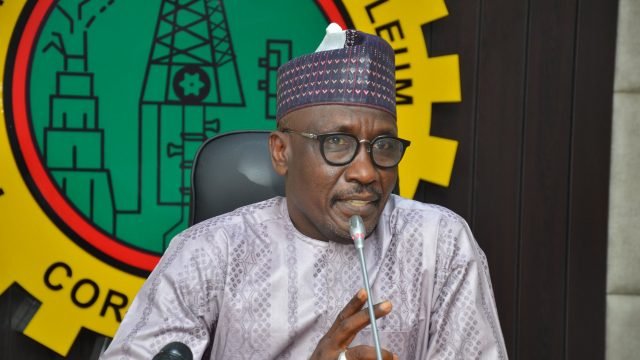
Group Chief Executive Officer, Nigerian National Petroleum Company Limited (NNPCL), Mele Kyari, yesterday said the federal government owes the company N2.8 trillion in subsidy payment deficit.

Kyari, who spoke with reporters at the Presidential Villa, Abuja, after a meeting with President Bola Tinubu, said the heavy subsidy burden has starved NNPCL of funds for its core businesses.

The House of Representatives’ report indicated that the nation spent over N4.8 trillion in running the refineries between 2010 to 2020.

The House differed consideration of the report to Thursday, June 1, 2023 to allow the committee make more far reaching recommendations which the House will adopt.

Deputy Speaker, Ahmed Idris Wase who presided over consideration of reports said even though the findings of the committee was far, the recommendations contained in it did not capture the essence for which it was set up.

Wase said the Committee was take a day to take another look at its findings and make far reaching recommendations that will help the new government in fashioning out ways of addressing the challenge identified.

The report said that the nation’s three refineries became unproductive from year 2010.

It also said “that from year 2010 to 2019, the nation’s refineries were performing sub-optimally with an annual combined capacity of less than 30 per cent. In the year 2019, the NNPC obtained an executive approval and shutdown the refineries for comprehensive rehabilitation to restore the plants to a maximum of 90 per cent nameplate company utilization”.

The total losses from the non-functional refineries since year 2010 is put at N366.52 billion.

The total cost of operations and running the refineries from 2010 to 2020 is put at N4.8 trillion. The Port Harcourt Refinery Company (PHRC) carried out rehabilitation projects over a period of seven years ranging from 2013 to 2019 valued at about N12.16 billion. The Warri Refinery and Petrochemical Company (WRPC) carried out rehabilitation projects over a period of six years ranging from 2014 to 2019 valued at about N28.22 billion. The Kaduna Refinery and Petrochemical Company (KRPC) also carried out rehabilitation works over the period under review valued at about N2.27 billion.

According to the report, the total cost of rehabilitation for the three refineries based on the submissions of the NNPC from year 2013 to 2019 is put at N42.65 billion.

The Committee recommended continuous legislative oversight of the ongoing rehabilitation works at the Port Harcourt and Warri refineries to ensure that the desired results is achieved.

It also recommend that the NNPC should ensure the immediate award of contract for the rehabilitation of the Kaduna Refinery and also take full advantage of the Petroleum Industry Act to fast track the rehabilitation of the refineries and ensure that the refineries are restored to a maximum 90% nameplate utilization.

NEITI yesterday commended President Bola Tinubu for taking the bold political step to phase out the subsidy regime.

A press statement which Deputy Director/Head Communications & Stakeholders Management, Mrs. Obiageli Onuorah issued in Abuja said, “From the NEITI reports, between 2005 to 2021, the country spent $74.3862 billion which translates to N13.697 trillion”.

She said the NEITI report breakdown of these figures showed that in 2005, the government paid $2.6Billion (N351Billion) as subsidy. In 2006 & 2007, it paid $1.99Billion & $2.176Billion (N257Billion & N272Billion) respectively.

Commending Tinubu, NEITI said, it has “welcomed with high expectations the political will, courage and sincerity of purpose demonstrated by President Bola Ahmed Tinubu to remove fuel subsidy right from his inaugural speech.

“A statement from NEITI House, Abuja described the move as a positive statement by the administration to decisively implement the findings and recommendations contained in the NEITI reports.

“This bold step is required to block leakages, grow revenues and advance the ongoing reforms in the oil, gas and mining industries.”

NEITI recalled that its recommendations for the removal of fuel subsidies have remained a persistent request since 2006 given the agency’s concerns about the huge financial burden that the subsidy regime imposed on the growth of the Nigerian economy over the years.

The report further pointed out that subsidy payments more than doubled in 2008 and 2010 and witnessed the highest increase ever in 2011 to $13.52billion (N2.11Trillion).


NEITI noted that a sharp decline was witnessed in the years 2012, 2013, 2014 and 2015 when it dropped to $3.336billion (N654Billion) in 2012. The decline in subsidy expenditure continued in 2016 and 2017 to as low as $473million (N154billion) in 2017.

According to the statement, the reduction was short-lived as the payments skyrocketed to over $3.88billion (N1.190trillion) in 2018 and 2021 to $3.575Billion (N1.43trillion).

By these figures, the organization said, Nigeria expended an average of 805.7billion Naira annually, 67.1billion monthly or N2.2billion daily.

The NEITI data, in addition, showed that the amount expended on subsidies from 2005 to 2021 is equivalent to the entire budget for health, education, agriculture and defence in the last 5 years. The sum also equals the capital expenditure for 10 years between 2011-2020. Subsidy payment reached its peak in 2011 ($ 13.52 Billion or N2.11 Trillion). NEITI explained that it was during this time (2011) that fuel subsidies dwarfed allocations to all critical areas of the economy.

NEITI ‘s persistent calls for the removal of petroleum subsidies were informed by the fact that the ways and means of funding the expenditure over these years relied more on federation accounts funds, the federal government and sometimes from external borrowing with negative consequences on government overall revenue profiles.

NEITI was also concerned that the consequences of funding subsidies have resulted in poor development of the downstream sector, declining GDP growth, rise in product theft, pipeline vandalism, environmental pollution and undue pressure on foreign exchange. Other challenges imposed on the economy were naira depreciation, low employment generation, the declining balance of payments and worsening national debt.

In a policy advisory released by the NEITI House in late 2022 to drive home the urgency to remove subsidy and re-submitted earlier in the year 2023, NEITI recommended eight steps to manage subsidy removal when and if the decision is made. These include the urgency to strengthen the implementation of the Petroleum Industry Act (PIA) as a whole and not in parts.

NEITI also underlined the importance of unveiling the implementation of people-oriented welfare programs to provide relief for the poor and vulnerable; advised on priority attention to be paid to the rehabilitation of the nation’s four refineries currently ongoing while encouraging private investments in establishing new refineries. Other policy considerations are that government should commission a special report on actual PMS consumption in Nigeria, enforce stringent sanctions for criminal activities in the oil and gas sector and conduct appropriate stakeholders’ consultations, engagements and enlightenment.

While the details of the implementation of the policy are being awaited, NEITI is set to commission a special research on the actual consumption of PMS in Nigeria. The study is to establish precisely what the nation is consuming. NEITI’s view remains that the data on the country’s actual consumption is unknown resulting in huge revenue losses to the nation through subsidy payments based on estimates.

NEITI particularly welcomed President Bola Tinubu’s position that the revenues saved from subsidy should be channeled to education, health, roads and other critical infrastructure,

The policy advisory also conducted a survey of the pump price of petrol across the country outside the major cities of Lagos & Abuja during the era of petroleum subsidy.

In the North West, North East and North Central states a litre of petrol averages N270.00, N265.80 and N 269.00 respectively. The southern states pay slightly lower with the South-South paying N232.50, South East N235.20k while the South West states pay an average of N250.00. Major marketers and prices at the state capitals stood largely between N169.90 to N190.00.

NEITI’s study on the petroleum subsidy also established the prices of Petroleum products across Nigeria’s borders and within the West and East African region. In Senegal, a litre of fuel sells for 635.91k, while in Guinea, Sierra-Leone, Togo, Cameroun and the Republic of Benin it costs N609.30k, N506.96K, N 497.78K, N449.24 and N462.23k respectively. It is on record that the supply to some of these Nigerian neighbours is largely the smuggled subsidized petroleum products from Nigeria.

NEITI’s position which is based on the data in its reports has also been strengthened by similar empirical studies and recommendations by reputable international organisations such as the World Bank and our global body, the Extractive Industries Transparency Initiative (NEITI).

NEITI, therefore, calls on the regulatory institutions to stand firm and tackle artificial scarcity, hoarding and other man-made obstacles being created at the moment to frustrate the implementation of subsidy removal.

With its removal, subsidy payments for petroleum products with its attendant insecurity in the country, due to smuggling etc will be reduced.

Kyari said: “Since the provision of the N6 trillion in 2022, and N3.7 trillion in 2023, we have not received any payment whatsoever from the federation.

“That means they (Federal Government) are unable to pay and we’ve continued to support this subsidy from the cash flow of the NNPC.

“When we net off our fiscal obligations of taxes and royalty, there’s still a balance that we’re funding from our cash flow and that has become very difficult and affecting our other operations.

“We’re not able to keep some of this cash to invest in our core businesses and the result is that it can be a huge challenge for the company.

“We have highlighted this severally to the government that they must compensate NNPC; they must pay back the NNPC for the money that we have spent on the subsidy.

“Today, the country doesn’t have the money to pay for subsidy. We can’t afford it and they are not able to pay our bill. That comes to how much the federation owes NNPC now.

“We are waiting for them to settle up to N2.8 trillion of NNPC’s cashflow from the subsidy regime and we can’t continue to build this.

“Fortunately also, by virtue of the provisions of the law and the Appropriation Act 2023, it is no longer available for that funding and we are very convinced today that the country can no longer fund this subsidy bill and they will not be able to pay NNPC.

“Therefore, we are happy and pleased to hear Mr. President’s commitment to the elimination of this subsidy because they can’t afford it anymore.”

With petrol already selling far above the official pump price in parts of the country, Kyari said steps will be taken to ensure customers are not exploited.

“We will take necessary steps to ensure that we recover our costs from the market and also be mindful of the fact that a situation like this can lead to the exploitation of customers.

“We’re also working with the regulator, whose head is here with me to see how we can cut any such excessive management of greed.

“This will be contained by the virtue of provisions of the law, the Authority or the Nigerian Petroleum Midstream and Downstream Regulatory Authority. And then the competition agency – they’ll play their part.

“We think this is a very commendable step taken by Mr. President to bring it to effect – the provisions of the law.”

Kyari explained that petrol was to be priced at its commercial value six months after the enactment of the Petroleum Industry Act.

That meant that by February 17, 2022, there should have been no subsidy on petrol.

He recalled that the Federal Government extended the terminal date till June this year.

“But the provision (of subsidy) in 2022 and 2023 (budgets) has not been funded by the government. A greater part of it is supported by the cash flow from NNPC’s other businesses.

“Therefore, even though there is provision to the end of June, there is no financing even from the start.

“Therefore, since you can’t pay, you cannot expect NNPC to continue to carry it.

“This has been the position that the NNPC has taken and what the President simply said is obeying the law and acknowledging the realities that the federation can no longer pay NNPC for the burden of subsidy that we are carrying,” Kyari said.

He noted that the queues were caused by panic buying.

The NNPCL GMD said: “Typically, consumers will rush to the fuel station to fill their tanks and that is why you’re seeing these queues.

“Also, marketers would like to see what exactly this means. ‘How are we going to sell the product if the subsidy on PMS is removed?’

“The combination of the two is what you are seeing – the obvious dislocation of distribution. And we believe that this will go away very, very quickly as you’re aware also.

“The PIA made it very clear that the price of petroleum must be at the market value. But, our country decided to provide for subsidy in the 2022 Appropriation Act and also half year in 2023.

“Therefore, we as a commercial company established under the Petroleum Act, are doing this simply as business, delivering value to a supplier of last resort by the law, but at the cost to the federation. And that cost includes the cost of subsidy,” he said.

Ahmed said there will be no price cap on petroleum products.

He said the government would ensure no marketer takes advantage of Nigerians.

“With the removal of subsidy as pronounced by Mr President, this has opened the floodgate for any market or company that wants to import PMS. And we are ready to issue licenses for them. At least that will open the competition that will reduce the burden.

“And let me assure Nigerians that the NMDRA and the Federal Competition and Consumer Protection Commission will make sure that consumers are not taken advantage of. We intend to work together on this.”

Ahmed, who said the Federal Government will not cap the oil price, called on marketers to open their petrol stations and depots to the public.

He said they will soon get the government’s directive from the NNPCL.

“I cannot tell you the exact price because the market is deregulated. Therefore, it is going to be based on delivery.

“The NNPCL will tell all the companies their transfer price, which will translate into what the pump price will be,” the CEO explained.

To lighten the burden on NNPCL, being the sole petrol importer, import licenses will be issued to interested persons.

Ahmed said the criteria for importing fuel will be similar to importing kerosene and diesel.
May 31, 2023 0 comments
0 FacebookTwitterPinterestThreadsBlueskyEmail
How “ways and means” affects ordinary Nigerians Leading Reporters
Headlines

How “ways and means” affects ordinary Nigerians

by Leading Reporters May 31, 2023
written by Leading Reporters

The phrase “ways and means” started before anyone using it today. It originated from the 17th century British Parliament and referred to “the provision of revenue to meet national expenditure requirements.”

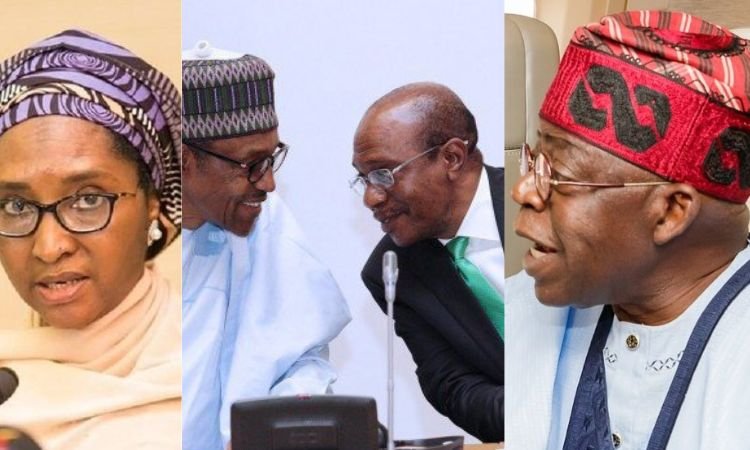
The phrase was always used by Nigerian economists and finance experts to explain debt and inflation, but it became popular when former President Muhammadu Buhari’s administration began to see it as the last resort.

For starters, “ways and means” in the Nigerian context occurs when the Federal Government obtains loans from the Central Bank of Nigeria (CBN). Yes, the Federal Government is allowed to borrow from the apex bank through “ways and means” to meet short-term needs or emergencies. This explains why the CBN is known as “lender of last resort.”

However, such borrowing is different from going to the World Bank, the International Monetary Fund (IMF) or China for loans. Borrowing via ways and means must be temporary and should only occur “in respect of temporary deficiency of budget revenue,” according to Section 38 (1) of the CBN Act. This means that the CBN can only lend to the Federal Government when the latter has a temporary revenue shortfall.

Abuse of ways and means

However, outgone President Muhammadu Buhari abused the ways and means advances. In fact, he violated the CBN Act.

Section 38 (2) of the CBN Act makes it clear that “the total amount of such advances outstanding shall not at any time exceed five per cent of the previous year’s actual revenue of the Federal Government.” However, Buhari overshot the five percent ceiling and grew ways and means from N856 billion to N23.8 trillion, representing 2,635 percent in seven years.

In 2017, actual revenue was N2.7 trillion but ways and means stood at N1,1 trillion, representing 37.2 percent of the previous year’s revenue (N2.95 trillion). This is against the spirit of Section 38(2) of the CBN Act.

In the following year, 2018, actual revenue stood at N3.87 trillion whereas ways and means was estimated at N2.1 trillion,

Ordinarily, Buhari’s administration should not have taken more than N135 billion ways and means, which was five percent of N2.7 trillion revenue realised in 2017. However, Buhari took ways and means which was 77.8 percent of the previous year’s revenue.

In 2019, actual revenue was N4.12 trillion while ways and means stood at N3.3 trillion, indicating 85.27 percent of the 2018 revenue.

In 2020, actual revenue was N4.04 trillion, with ways and means standing at N4.4 trillion, representing 107 percent of the previous year’s revenue, meaning that Buhari borrowed 7 percent more than the revenue realised in 2019 from the CBN.

In 2021, actual revenue was N 4.64 trillion while ways and means was N4.3 trillion, representing 106.4 percent of the 2020 revenue. In 2022, actual revenue was N6,49 trillion whereas ways and means advances stood at N6.4 trillion, representing 138 percent of the 2021 revenue.

Explainer: How "ways and means" affects ordinary Nigerians

Are “ways and means” loans?

There have been several arguments as to whether ways and means should be described as loan or something else. Many have contended that it should not be considered as part of Nigeria’s loan profile.

But, let us examine the meaning of loan? Investopedia, a business and investment dictionary, defines a loan as “a type of credit vehicle in which a sum of money is lent to another party in exchange for future repayment of the value or principal amount.”

Hence, ways and means are clearly loans that should be repaid. In fact, Section 38 (2) says “all advances made pursuant to this section shall be repaid as soon as possible…” The section also says that it should be repaid with interest.

However, outgone President Buhari smartly got the approval of the Senate and securitised the ways and means. These loans will thus be converted into long-term bonds and be sold to the investors, including you. How smart can that be?

Implications

There are several implications of this. First, it is a violation of the Nigerian laws, which must not be condoned. It means the Federal Government or any president in power can violate the laws and get away with it.

Two, ways and means increases inflation by raising liquidity in money or capital market. Money market is a market where short-term instruments are traded. Examples of such instruments are treasury bills and mutual funds. On the other hand, the capital market is a market dealing with long-term instruments such as bonds. It also means a market where bonds and stocks are traded.

By securitising ways and means, rather than pay back to the CBN, the Federal Government simply puts too much money in the money or capital market. For instance, when you advertise a bond of N11 trillion value, investors will trade them -pay for them. This naturally increases liquidity in the economy.

It makes more money available in the economy, thereby fuelling inflation. The World Bank has also accentuated this position, stressing that “between 2020 and 2021, inflation left about eight million more Nigerians below the poverty line by increasing the total number of poor people to about 90 million.”

In other words, the CBN is part of the party that has worsened inflation in Nigeria in the last six years. The ordinary man in the street feels the pains of rising inflation rates in the form of high cost of living.

More so, it increases Nigeria’s debt servicing burden because each loan taken must be repaid with interest – however low. This leaves little resources for infrastructure and development programmes that will benefit the common man.

Also, it leaves Nigeria with little capacity to innovate. If the president can easily run to the CBN for loans without repaying, the capacity to leverage revenue avenues will reduce. This makes it hard for any government in power to fund programmes that can improve livelihoods.

So, what should the new sheriff in town, President Bola Tinubu, do with ways and means? Simple, devise more proactive ways of raising revenue and give the CBN some space. Source: Dataphyte

May 31, 2023 0 comments
0 FacebookTwitterPinterestThreadsBlueskyEmail
Wura-Ola replaces Jere as acting Immigration CG Leading Reporters
Headlines

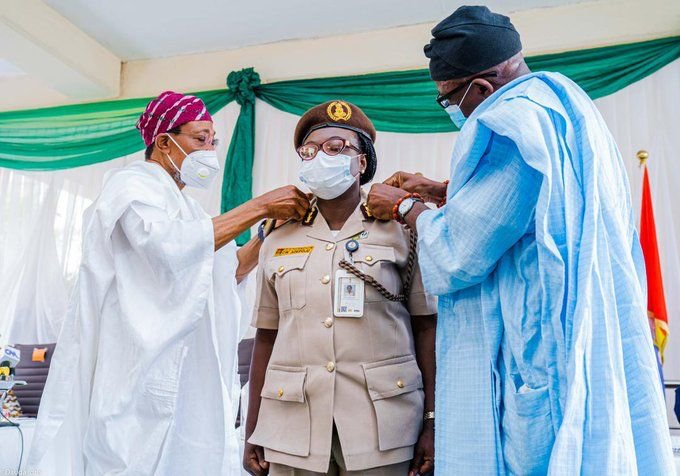
Just In: Nigeria Government Appoints First Female Yoruba CG of Immigration

by Leading Reporters May 30, 2023
written by Leading Reporters

A new Comptroller General in Acting Capacity will be taking over the affairs of Immigration on Tuesday, LeadingReporters can authoritatively report. This is following the official exit of Mr Isa Jere who has reached the mandatory age of retirement.

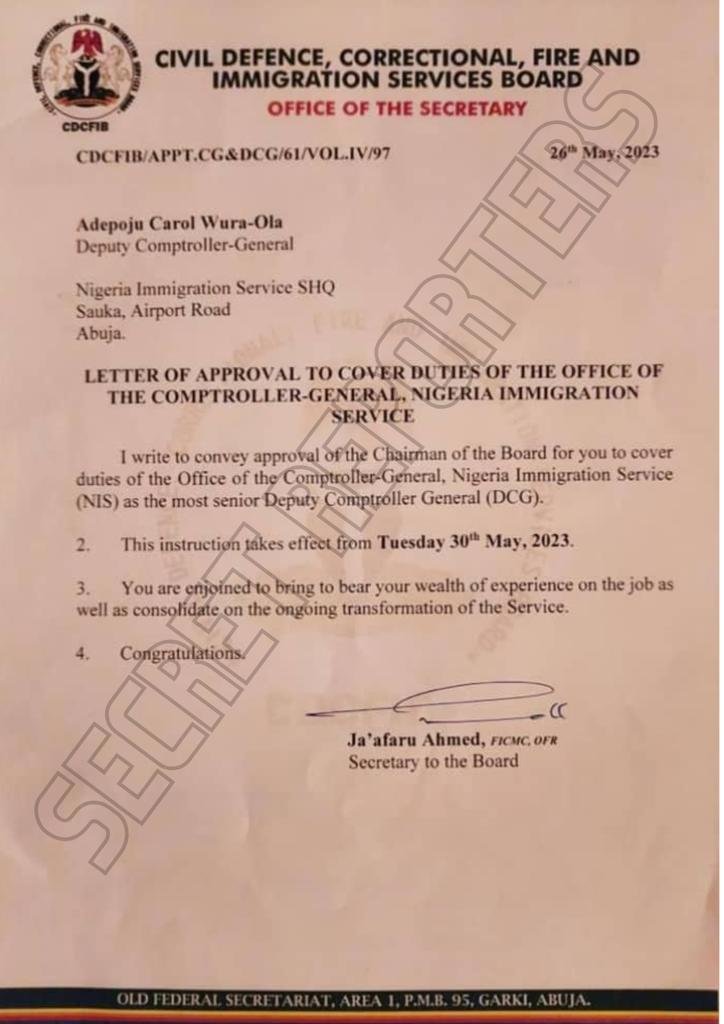
In a letter exclusively obtained by this medium, Mrs Adepoju Carol Wura-Ola who is the most senior Deputy Comptroller General has been mandated to take charge, following the board approval which was signed by Ja’afaru Ahmed, the Secretary to the board.

Mrs Carol will be the first Yoruba woman in the history of the paramilitary agency to attain such height. We gathered that a Yoruba man who was supposed to have headed the place few years ago died in mysterious circumstances, which positioned another Northerner to take over.

Sources within the agency disclose that the new Acting CG has just few months to also retire but will likely get an extension of office from President Bola Ahmed Tinubu in sentiments to the Yoruba not heading the position since its creation.

May 30, 2023 0 comments
0 FacebookTwitterPinterestThreadsBlueskyEmail
Group call on Igbos to rekindle their kindred spirit, inventiveness Leading Reporters
Opinion

Group call on Igbos to rekindle their kindred spirit, inventiveness and their survival consciousness as anti-Igbo agenda may dominate Tinubu regime

by Leading Reporters May 30, 2023
written by Leading Reporters

Igbos have been advised to copy the fighting pattern of the Hyenas that fight and confront in groups if they must survive the rumoured anti-Igbo agenda that may characterize the Tinubu-Shettima administration.  USA Igbo Tink-Tank group, the “Igbo Patriots” gave the advice following a delegate meeting it held in Texas, USA on the 16th of May, 2023.

According to a communique exclusively obtained by LeadingReporters, the group’s Security and Economic Strategic Advisor” Dr Ben Chisombiri hinted that the group has a verifiable security report that suggests the vulnerability of Igbos under the President-Elect, Ahmed Bola Tinubu.  Dr. Chisombiri said that the Tinubu Government would be circled by anti-Igbo hawks who will ensure that Igbos are economically reduced, and their properties destroyed at will.

The group said that there is expected aggrandizement of anti-Igbo crusade and the peak of it may be witnessed under the Tinubu-Shettima administration.

“The choice of Tinubu and Shettima is not a decision that was abruptly taken.  It took years of strategizing, restrategizing, engaging and re-engaging.  For those that still believe that the war is over, it is high time for them to understand that there was an agenda so many decades ago.  Igbos seem to be slowing the agenda.  Simply put, that Agenda is anti-Igbo.

“Tinubu-Shettima administration was planned to manifest that agenda and unless igbos fight as a pack, just like hyenas do, they would be swallowed up if they dare fight as one single lion in the wood.bi

The group advised Igbos to temporarily halt investments that has to do with landed property in other parts and watch events as they unfold.  The group claimed that the report is not hinged on assumptions or sentiments of tribal affiliation, but on a valid intelligence report, it possesses.

The group advised Igbos to re-stir its kindred spirit and look out for each other.  It also advised Igbos, especially those in Abuja, Lagos, Kano and other vulnerable places in Nigeria to rekindle their communality and share strategic information.

The Patriots further counselled Igbos to plan beyond buying and selling but resort to other opportunities that abound in the entertainment industry, ICT, AI, vocations, and skills acquisition.

“Our message to our dear brothers and sisters is simple.  Don’t lose your guard.  You are in the middle of jackals that hates and prey on you; jackals that envy you, and question your inventiveness.  They would do everything humanly possible to end your existence.  We are not sharing tales with you.  We are sharing evidence-based intelligence report. Do not return hatred for hatred, but surprise them with your unity, communality; your kindred spirit and your ability to break odds and shine amidst storms.  That time is now”.  Dr Chisombiri said.

May 30, 2023 0 comments
0 FacebookTwitterPinterestThreadsBlueskyEmail
Headlines

Deposed Kaduna monarchs, banks to issue NIN cards, other top national stories of preceding week

by Leading Reporters May 29, 2023
written by Leading Reporters

Last week saw a lot of events that merited news coverage. A list of some selected top national stories across Nigeria has been painstakingly prepared.

El-Rufai approves deposition of two Kaduna monarchs, sacks three others

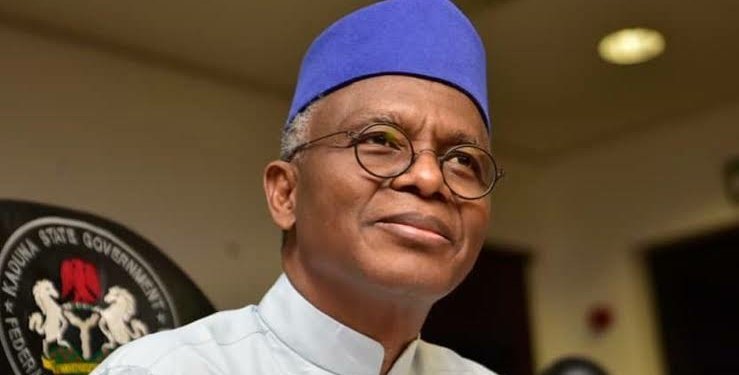
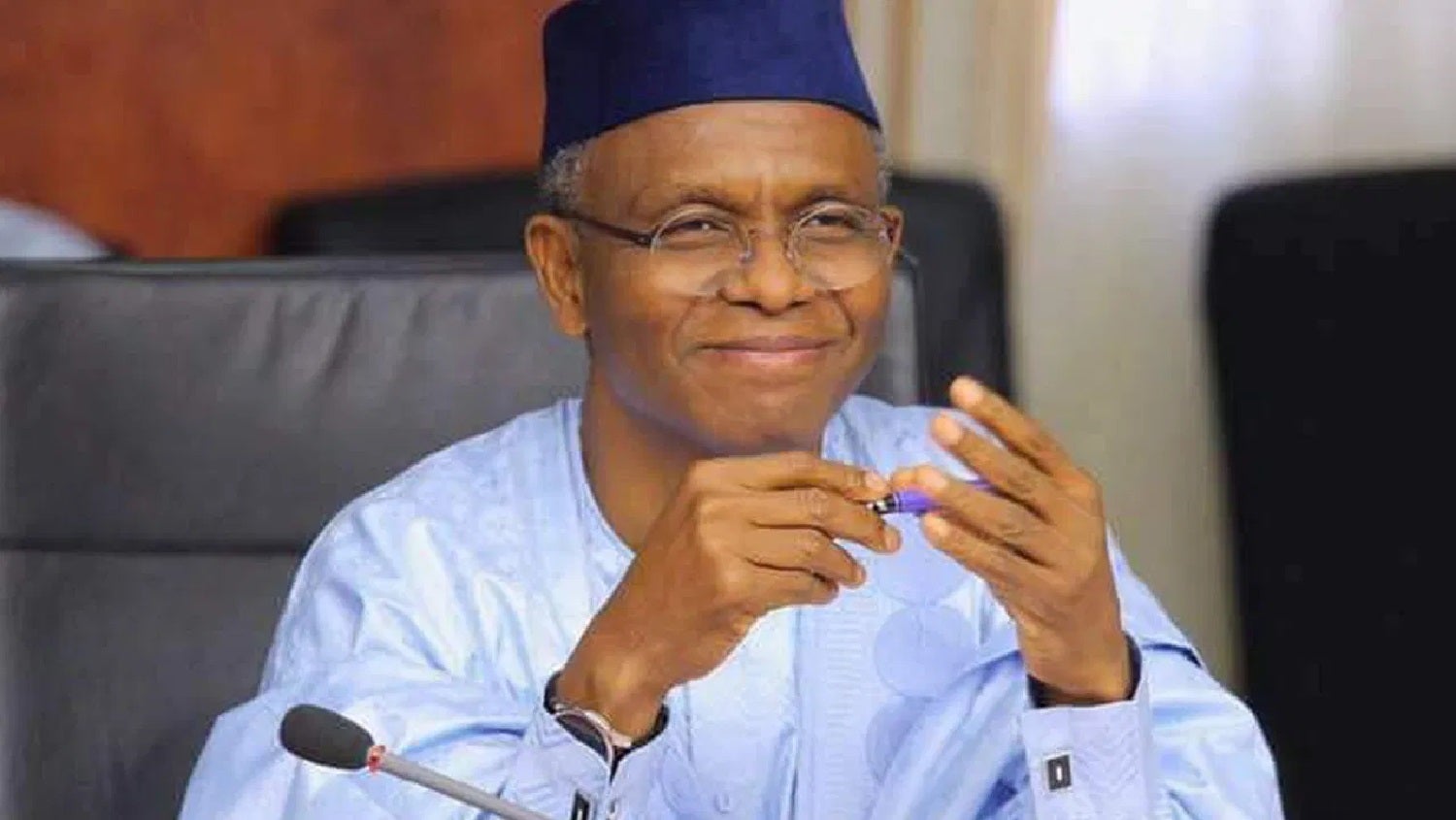
On Monday evening, Governor of Kaduna State, Malam Nasir El-Rufai authorized the removal of His Highness Jonathan Paragua Zamuna, the traditional ruler of the Piriga Chiefdom, and His Highness General Aliyu Iliyah Yammah (retired), the traditional ruler of the Arak Chiefdom.

Governor Nasir El-Rufai

According to a statement released on Monday by the state’s commissioner for local government, Hajiya Umma Ahmad, the two traditional chieftains would vacate their positions as of the 22nd of May 2023.

In accordance with Section 11 of the Traditional Institutions Law No. 21 of 2021, the commissioner further stated that the depositions were conducted in accordance with suggestions made by the Ministry of Local Government.

Buhari signs eight bills into law

On Monday, Nigeria’s President, Muhammadu Buhari has assented to eight Bills passed by the 9th National Assembly.

The Special Assistant on Digital Communications to the President, Bashir Ahmad made this known via his Twitter handle on Monday, May 22, 2023.

He listed the new laws including the National Social Investment Programme Agency Act, National Senior Secondary Education Act and the National Social Investment Programme Agency Act.

The President also assented to the Federal University of Health Sciences Ila-Orangun (Establishment) Act, Federal University of Health Sciences, Azare (Establishment) Act, Chartered Institute of Development Studies and Administration of Nigeria (Establishment) Act, Federal Institute of Industrial Research (Establishment) Act, and the Institute of Strategic Management of Nigeria Act.

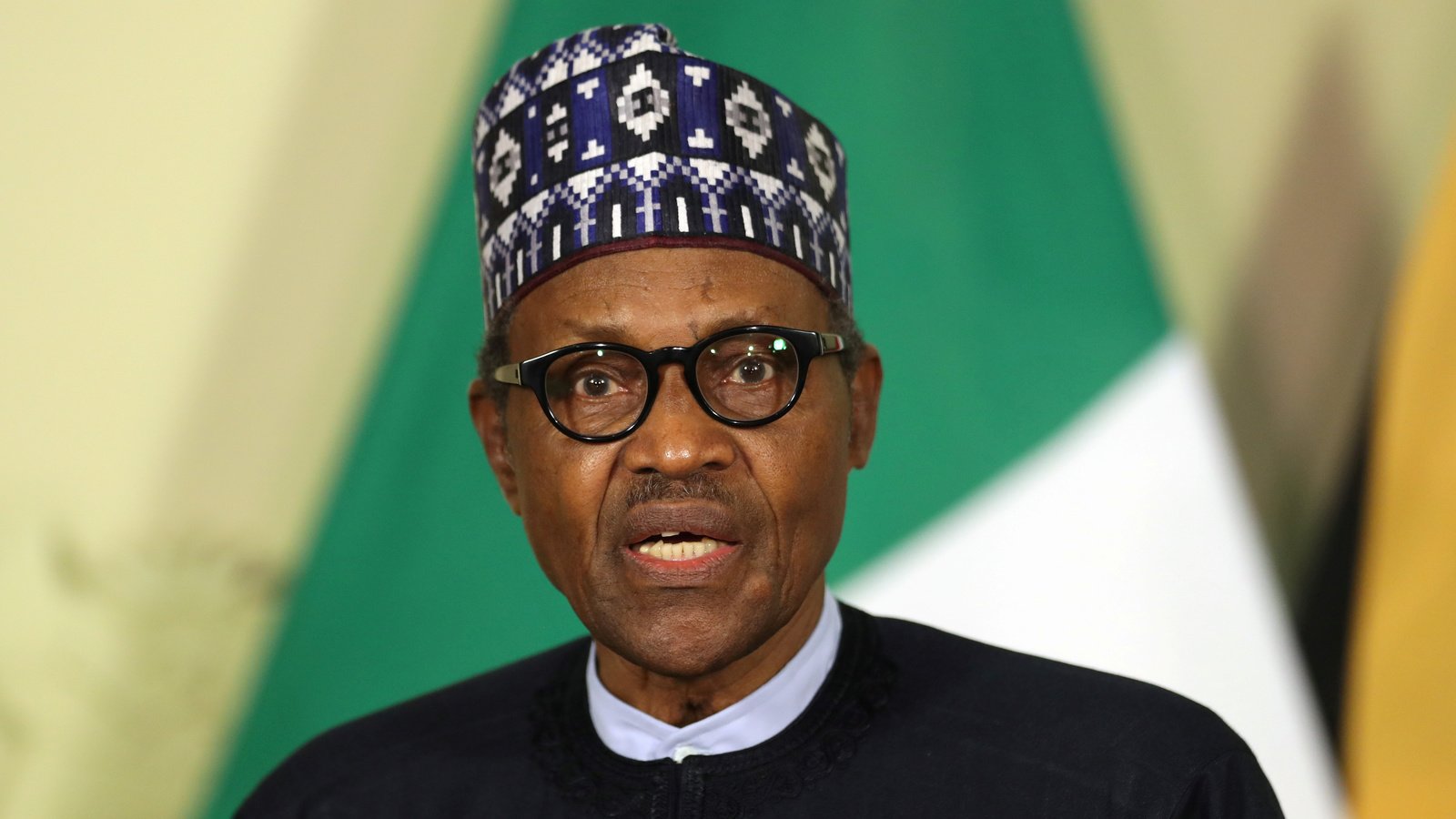
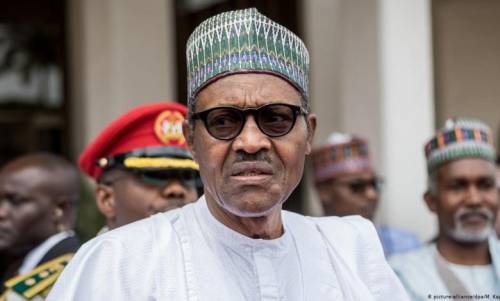
Muhammadu Buhari

This was contained in a statement released on Monday by the Senior Special Assistant to the President on National Assembly Matters (Senate), Senator Babajide Omoworare.

Omoworare said the action of the President was in accordance with the provisions of the Acts Authentication Act Cap. A2, Laws of the Federation of Nigeria, 2004.

He listed the new laws including the National Social Investment Programme Agency Act, National Senior Secondary Education Act and the National Social Investment Programme Agency Act.

Nigerian students, others barred from bringing family to UK

On Tuesday, the United Kingdom announced that persons coming to the country to study will no longer be able to bring their family as dependents with them.

According to the UK, the move is aimed at stemming the influx of people who piggyback on their family members study visa to enter UK.

Sky News reported that a new law, which will take effect from January, has been promulgated to give the clampdown on immigrants the much-needed legal backing.

CBN revokes licences of 132 Microfinance banks, others

On Tuesday, The Central Bank of Nigeria has revoked the operating licences of 132 microfinance banks, four primary mortgage banks, and three finance companies in the country.

The revocation exercise was disclosed in the official gazette of the Federal Government published on the website of the CBN on Tuesday.

According to the gazette, the licences of the financial institutions were revoked because they ceased to carry on in Nigeria, the type of business for which their licences were issued for a continuous period of six months.

They were also alleged to have “failed to fulfil or comply with the conditions subject to which their licences were granted; or failed to comply with the obligations imposed upon them by the Central Bank of Nigeria in accordance with the provisions of Banks and Other Financial Institutions Act (BOFIA) 2020, Act No. 5.”

The revocation exercise was disclosed in the official gazette of the Federal Government published on the website of the CBN.

Buhari orders banks to issue NIN cards to Nigerians

On Thursday, the Buhari-led administration disclosed that Nigerians can now request that their commercial banks issue them a debit card that also serves as their national identity card.

Prof Isa Pantami, Minister of Communications and Digital Economy, made the announcement in Abuja.

He stated that this issuance is free of charge.
Pantami stated that the approval was obtained at the Federal Executive Council meeting at the Presidential Villa in Abuja, which was presided over by President Muhammadu Buhari.

He stated that the approval came as a result of a memo from the National Identity Management Commission that authorised banks to print multipurpose debit cards that also functioned as National identity cards.

Kano Govt acquits Doguwa of Murder charges

On Thursday, Kano State Ministry of Justice stated that House leader, Alhassan Ado Doguwa, is not guilty of charges of culpable homicide and mischief by fire levelled against him.

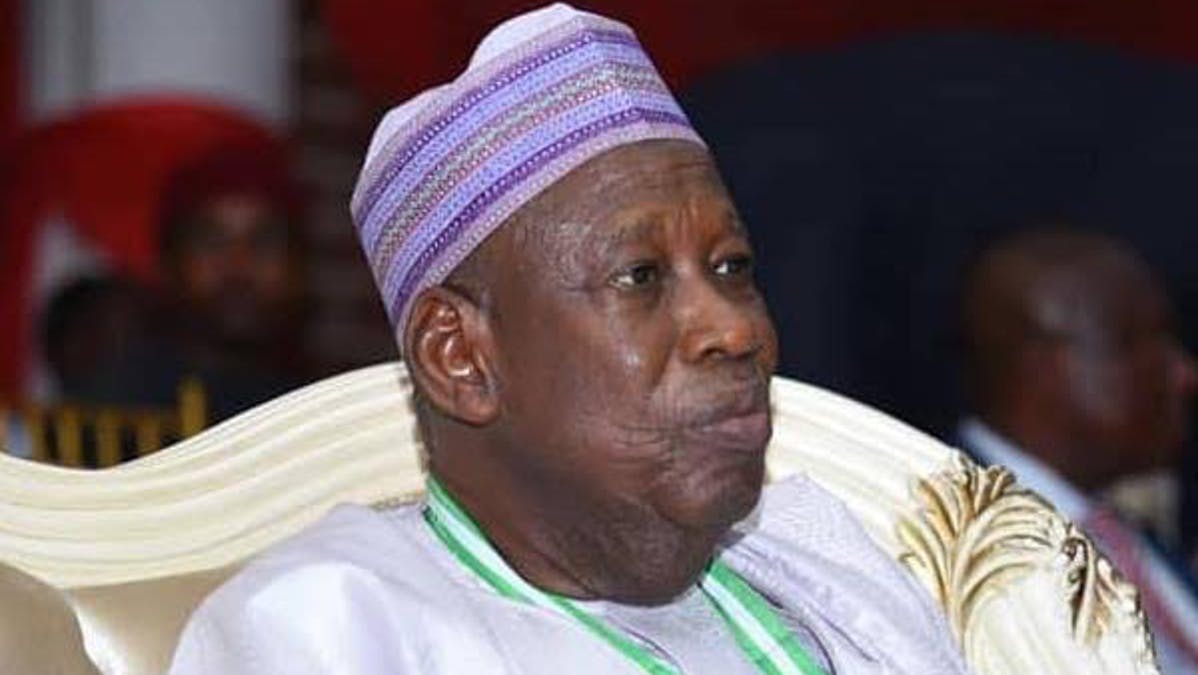
Governor Ganduje

The Attorney General and Commissioner of Justice, Musa Abdullahi Lawan, made this known while briefing journalists in Kano.

He stated that there were no proofs to corroborate the allegations against Doguwa, noting that those who incriminated him could not make their accusations stick.

He said, “Based on the foregoing facts and observations, we cannot substantiate charges of criminal conspiracy, mischief by fire and culpable homicide against Doguwa.

Supreme Court strikes out PDP’s double nomination suit against Shettima

On Friday, the Supreme Court dismissed the suit seeking the disqualification of Kashim Shettima as the vice-presidential candidate of the All Progressives Congress for double nomination.

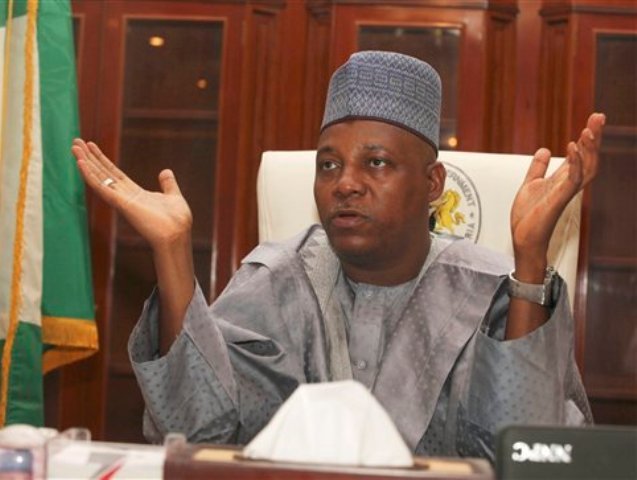
Ex-Borno state Governor and Vice-President elect Kashim Shettima

Ruling on the suit, a five-member panel of the apex court held that the Peoples Democratic Party lacked the locus standi to institute the suit.

The panel said the PDP is not a member of the APC, hence can’t challenge Shettima’s nomination.

Gov Sani Bello pardons 24 convicts, pays N20m to free 80 inmates

On Friday, Alhaji Abubakar Sani Bello, the outgoing governor of Niger state pardoned 24 criminals, including those who had previously received death sentences.

Similar to this, he paid N20 million in fines for 80 other prisoners so they may enjoy freedom.

PDP using social media to bully judges – Supreme Court

On Saturday, the Supreme Court stated that the Peoples Democratic Party (PDP) has resorted to using the social media to intimidate and strong-arm the judges.

Logo of the People’s Democratic Party

Justice of the Supreme Court, Inyang Okoro made this allegation on Friday, while delivering judgment in an appeal filed by the PDP seeking to void the election of President-elect, Asiwaju Bola Tinubu on the grounds that his running mate, Kashim Shettima, was guilty of double nomination.

Pastor Tunde Bakare vows to never address Tinubu “My President”

On Saturday, Pastor Tunde Bakare, the Serving Overseer of the Citadel Global Community Church stated that he will never refer to Bola Tinubu as his president.

Tunde Bakare

The politician and cleric said that a number of electoral frauds occurred during the 2023 elections and that the Independent National Electoral Commission messed up the campaigning process during a webinar on Saturday.

After giving his lecture on the Zoom program titled “Building the New Nigeria: The Role of the Diaspora,” which was put on by the PTB4Nigeria In Diaspora Group, he made this statement in response to a question.

May 29, 2023 0 comments
0 FacebookTwitterPinterestThreadsBlueskyEmail
Breaking News
Headlines

BREAKING: Raymond Dokpesi Is Dead

by Leading Reporters May 29, 2023
written by Leading Reporters

The Chairman Emeritus, Daar Communications, owners of AIT and Ray Power FM, High Chief Raymond Dokpesi is dead.  

Raymond Dokpesi, a leader in the Peoples Democratic Party (PDP) and the creator of DAAR Communications Ltd, has passed away.

At age 71, the media tycoon passed away in an Abuja hospital.

The Chairman Emeritus, Daar Communications, owners of AIT and Ray Power FM, High Chief Raymond Dokpesi is dead.

May 29, 2023 0 comments
0 FacebookTwitterPinterestThreadsBlueskyEmail
Tinubu chides his advisers for excluding fuel subsidy removal from inaugural speech leading Reporters
Headlines

Handover Data: President Tinubu’s administration is inheriting debt to GDP of 38%

by Leading Reporters May 29, 2023
written by Leading Reporters

Article Summary

  • The rise in total public debt under President Buhari has seen Nigeria’s Debt to GDP ratio climb to over 38%.
  • The Nigerian Senate amended the Central Bank of Nigeria (CBN) Act to increase the total CBN advances (Ways and Means provision) to the Federal Government from 5% to a maximum of 15%.
  • President Tinubu inherits a troubled economy and faces significant challenges in addressing the country’s economic issues.

On May 29th, President Muhammadu Buhari’s administration handed over to President Bola Ahmed Tinubu. The handover marked the continuous transfer of democratic power since 1999, a milestone in the history of Nigeria.

Despite the excitement that has heralded President Tinubu’s inauguration, the truth remains that he has inherited a very troubled economy. And he has his job cut out for him, as far as the economy is concerned.

One lingering theme that characterised President Muhammadu Buhari’s administration was Nigeria’s rising debt profile. Although many Nigerians raised concerns about it, the Debt Management Office (DMO) insisted that Nigeria’s debt was sustainable as long as it was within the World Bank threshold of 40% debt to GDP.

Nigeria currently sits at a Debt to GDP ratio of 38%, according to available data. However, given the rising debt service spending, the Tinubu administration will have a lot of work to do in order to prevent debt levels from rising further than this.

Ways and Means Securitization

Earlier this month, the National Assembly approved the securitization of N22.7 trillion worth of Ways and Means loans. The securitization is expected to improve debt transparency, reduce debt service costs, and help reduce the budget deficit.

According to the latest data from the Debt Management Office, the tenor of the securitization is a whopping forty (40) years with a moratorium on the principal for three years and an interest rate of 9% per annum.

  • Tenor: Forty (40) years
  • Moratorium (on Principal only): Three (3) years
  • Interest Rate: 9% p.a.
  • Repayment: Amortising over thirty-seven (37) years
  • Holder of the Securities: The Securities will be issued to the Central Bank of Nigeria (CBN) by the Federal Government of Nigeria (FGN).
  • The Securities will not be issued to the public by the FGN to raise funds.
  • It will reduce the Debt Service Cost as the new interest Rate is 9% p.a. compared to the Monetary Policy Rate plus 3% which translates to 20.5%6 p.a. (MPR – 18.5% +3%) currently being charged on the Ways and Means Advances.
  • The large savings arising from the much lower Interest Rate will help reduce the deficit in the Budget and expectedly, the level of New Borrowings.

In addition, the provisions for interest on the securitized Ways and Means Advances (starting from 2023) and principal repayments starting from year four (4), will be made in the Annual FGN Budgets. Securitization will not lead to new loans.

Debt to GDP

Between 2007 and 2015, previous administrations only took a combined total of N869 billion from the Ways and Means window.

However, in the last eight years, the current administration has collected N23.7 trillion. Total public debt at the end of 2022 was N46.3 trillion while the expected borrowings for 2023 come to N8.8trn (domestic and foreign). If we include the ways and means of N22.7 trillion to be securitized, the total expected public debt for 2023 comes to 77.8 trillion.

A total debt stock rising to N77.8 trillion will take the country’s debt-to-GDP ratio to 38.4%. This increase in public debt may require the DMO to raise the public debt ceiling from its current level of 40% of GDP contained in the medium-term debt management strategy paper.

Using data from the DMO, at the Naira exchange rate for December 2022, Nigeria’s Debt to GDP ratio in dollar terms comes out as:

Fiscal Responsibility Extension

On Saturday, May 27, The Nigerian Senate amended the Central Bank of Nigeria (CBN) Act to increase the total CBN advances (Ways and Means provision) to the Federal Government from 5% to a maximum of 15%.

The Senate leader, Abdullahi Gobir, who read the lead debate on the bill, said the proposed amendment is to enable the Federal Government to meet its immediate and future obligation in the approval of the ways and means by the National Assembly and advances to the Federal Government by the Central Bank of Nigeria.

This means, that the incoming administration will seek to increase funding from the Central Bank, and with the precedent already set in by Buhari’s administration, surpass Nigeria’s 40% debt to GDP ratio.

Tax Increase for the debt burden

To deal with the haemorrhaging revenue-to-debt service ratio, the Nigerian government last month, in a last-ditch attempt, introduced a new set of taxes on alcoholic beverages, imported vehicles and single-use plastics in its new tax regime.

Under the newly introduced taxes, the Federal Government will charge N75 per litre of beer, stout or wine imported into Nigeria.

FG pointed out that N75 per litre will be charged on “beer and stout including all alcoholic beverages and beer not made from malt- whether fermented or not fermented” in 2023, adding that this new excise duty on beer and stout will be increased to N100 per litre in 2024.

The Federal Government also introduced a Green Tax by way of excise duty on Single Use Plastics (SUPs) including plastic containers, films and bags at the rate of 10 per cent and an Import Adjustment Tax (IAT) levy on motor vehicles of the 2-litre engine (2000 cc to 3999 ccs) at 2%, while vehicles with 4-litre engines (4000 ccs) and above will attract 4% IAT with effect from June 1, 2023.

Short Term Solution

Meanwhile, Tax advisory firm, KPMG Nigeria, has urged the federal government to increase oil revenues to increase the country’s earnings. The company stated this in a May 2023 report on the Assessment of the 2023 Fiscal Policy Measures.

In the report, KPMG noted that the federal government had recently implemented new taxes on beer, imported vehicles, single-use plastics, mobile telephone services, fixed telephone, and internet services.

KPMG advised the government to look beyond creating an additional burden on business margins and work to increase oil revenues.

According to KPMG Nigeria, the federal government can work to increase oil revenues in the following ways:

  • Renegotiating or reconsidering Nigeria’s relationship with the Organization of Petroleum Exporting Countries (OPEC) like Indonesia, and Qatar did, to avoid being capped to a limit when and if the output exceeds the quota, given the country’s need for urgent revenues for development.
  • Developing joint ventures between the Nigerian National Petroleum Company Limited (NNPCL) and companies building modular refineries to process crude oil into derivatives as a means of increasing the revenues generated from selling extracts like premium motor spirit, low-pour fuel oil, and kerosene. aviation fuel, diesel, pet coke, bitumen binders, and marine fuel. These could multiply revenues generated from selling crude oil as a raw commodity.
  • The Government needs to consider an independent Joint Venture model for its production-sharing contract and encourage NNPCL to raise cash calls independently. This will help to raise Nigeria’s revenue-to-GDP ratio to the emerging markets average of 18%, as a tool to reduce deficit financing that comes from unsustainable debt cycles without sacrificing the country’s urgent need for huge development expenditure.
  • The KPMG report also advises NNPCL to secure oil output by installing high-pressure sensors on all feeder lines that take crude oil through flow stations from well-heads to terminals to be able to track and detect spikes, pulsations, surges that might occur from vandalization, and pressure tapping.
  • The NNPCL also needs to mobilize the office of the National Security Adviser, the Nigerian Army, the Marine Police, and the Nigerian Navy to arrest culprits and their back-end sponsors and accomplices. Meanwhile, all the security personnel responsible for detecting and acting on oil theft detections should be replaced every 3 months to avoid being compromised.
  • The NNPC also needs to install modern metering technology at all 33 export terminals to avoid siphoning off crude oil inventories and reduce the difference between inventory delivered by feeder lines through flow stations from well-head to terminals. News credit nairametrics
May 29, 2023 0 comments
0 FacebookTwitterPinterestThreadsBlueskyEmail
As Buhari’s govt announces new appointments during Tinubu’s inauguration Leading Reporters
Headlines

Drama: As Buhari’s govt announces new appointments during Tinubu’s inauguration

by Leading Reporters May 29, 2023
written by Leading Reporters

The spokesperson of former President Muhammadu Buhari, Garba Shehu, on Monday, announced new appointments made by the former leader.

The announcement was made in a statement sent to journalists just before 11 a.m., about the time President Bola Tinubu was being inaugurated.

Mr Shehu, however, said Mr Buhari made the appointments on Friday although the announcements were made Monday morning.

The six persons appointed are to be executive directors of the Nigeria Television Authority (NTA) and they were confirmed by the former president after their names were sent to him, Mr Shehu said.

Read Mr Shehu’s full statement below.

President Muhammadu Buhari May 26th approved the nominations submitted to him for approval as Executive Directors for the Nigerian Television Authority, NTA following the departure of the holders of the positions, whose tenure ended on 31st March.

Those appointed to the new positions are:

1. Ije Osagie (Edo State) Executive Director Engineering

2. Betsy Iheabunike (Anambra State) Executive Director Marketing

3. Lawal Umar Lalu (Katsina State) Executive Director Programmes

4. Ayo Adewuyi (Osun State) Executive Director News

5. Adamu Sambo (Adamawa State) Executive Director Special Duties

6. Nansel Nimyel (Plateau State) Executive Director Administration and Training

7. Abdullahi Ismail Ahmed (Kaduna State) Executive Director Finance.

The appointees are to serve for an initial three years, renewable for another three years.

Garba Shehu

Senior Special Assistant to the President

(Media and Publicity)

May 29, 2023 0 comments
0 FacebookTwitterPinterestThreadsBlueskyEmail
Breaking: Meet 16th President of Nigeria Bola Ahmed Tinubu Sworn in Leading Reporters
Headlines

Breaking: Meet 16th President of Nigeria Bola Ahmed Tinubu Sworn in

by Leading Reporters May 29, 2023
written by Leading Reporters

The swearing in ceremony which took place at Eagles Square Abuja, was done by the Chief Justice of Nigeria, Justice Olukayode Ariwoola.

Tinubu was accompanied to the podium by his wife Oluremi, outgoing President Muhammadu Buhari and his wife Aisha and security detail.

Taking the oath of office, Tinubu promised to discharge his duties as President in line with the constitution of the country, and to the best of his ability.

May 29, 2023 0 comments
0 FacebookTwitterPinterestThreadsBlueskyEmail
Plans to incapacitate Igbos economically, militarize South East unveiled Leading Reporters
HeadlinesOpinion

Plans to incapacitate Igbos economically, militarize South East unveiled:  El-Rufai, Kwakwanso,  FFK to lead anti-Igbo crusade

by Leading Reporters May 28, 2023
written by Leading Reporters

The 2023 general election has come and gone, but the dust it raised will last a time.  A close source of the President-Elect Bola Ahmed Tinubu has hinted at an impending plan by the Tinubu-Shettima-led APC government to decimate and incapacitate Igbos economically. 

Part of the plan is to review and revoke many Certificates of Occupancies traceable to Igbos as well as demolish and relocate markets hitherto dominated by the Igbos. Abuja, Lagos, and Kano fall within the first phase of the project of this anti-Igbo campaign.  

Nyesom Wike would be used as a strong anti-Igbo force in the South-South region, the source hinted.

Kaduna State Governor, Mallam Nasir El-Rufai, Kwakwanso of Kano State, Lagos State Governor Sanwo Olu, Femi Fani Kayode FFK and Barrister Festus Keyamo have been ‘mobilized’ to lead the anti-Igbo economic warfare.  They will hit the ground running immediately after the inauguration. Aside from the anti-Igbo economic warfare, there are plans to militarize the South East Geopolitical Zone. 

“The military would be massively detailed to Southeast to ensure that Igbos are suppressed, with a special target at the youths who they believe would mount a resistance through series of protest and a regional campaign for self-determination”.

Part of the plan is to woo the media as partners-in-the-game.  FFK would be in charge of managing the media and strategic media campaign that would see most media house either aligning with the government or having their stations constantly subjected to paying fine.  Few stations have been marked for total revocation of their licenses.

“Tinubu has already planned and voted billions of Naira to woo the media.  They are already identifying willing media partners who will suppress dissenting voices.   The media would be so controlled that anti-government remarks may earn instant closure or outrightly withdrawal of the operating licenses of media houses seen as not being part of the government.

“Currently, FFK is calling and reaching out to many pressmen from the Southern part of Nigeria.  Part of his job would be to lobby, finance and coerce the press into either looking away in silence or aligning with the -government’s anti-Igbo policies.

Another group stationed in Europe and America would serve as a lobby group for the government.  Their jobs would entail disrupting information and presenting it before the Western world as the collective desire of the people.

The source worries that since the fall of Libya, Nigeria has been targeted under a scheme called “expendable”.

Recall that the anti-Igbo campaign greeted the last election where Igbos were profiled, humiliated and thoroughly disfranchised in Lagos.  It was stated that the humiliation the President-Elect suffered in the last general election in Lagos State (considered his strongest hold) would not go unpunished. Recall that Senator Ahmed Bola Tinubu lost his stronghold Lagos to Mr. Peter Obi, a feat Tinubu was said to have vowed would be utterly altered.

Part of the plan is to ensure that Igbos are demoralized into participating in political activities, following their recent political reawakening which saw the President-Elect losing in their entire South East, and most states in South-South.  Aside from winning the Federal Capital Territory, Peter Obi is believed to have massively won in North Central States like Plateau, Benue, and Nasarawa.

The thematic objective of the exercise, according to the source is to box Igbos to a corner where they would recoil politically and rendered economically unstable.

May 28, 2023 0 comments
0 FacebookTwitterPinterestThreadsBlueskyEmail
Newer Posts
Older Posts

Recent Posts

  • WikiLeaks’ Assange says ‘no dirt’ on Trump, praises former US President

    March 15, 2026
  • Tinubu: BAT Movement Reaffirms Support for Second Term

    March 14, 2026
  • Church Donates Tech Equipment to NIS

    March 14, 2026
  • CBN directs banks to block loan defaulters from accessing credit facilities

    March 13, 2026
  • Petrol Subsidy Removal Pushes 63% of Nigerians Below Poverty Line — Report

    March 13, 2026

Usefull Links

  • Contact Page
  • About Leading Reporters
  • Contact Us
  • Headlines
  • Investigation
  • Exclusives
  • Opinion
  • Business
  • Facebook
  • Twitter
  • Instagram
  • Linkedin

@2021 - All Right Reserved. Designed and Developed by PenciDesign


Back To Top
Leading Reporters
  • Featured
  • Politics
  • Opinion
  • Business
  • Entertainment
  • Sports
  • About Us
  • Contact